

4.3 Fluid Dynamics
87
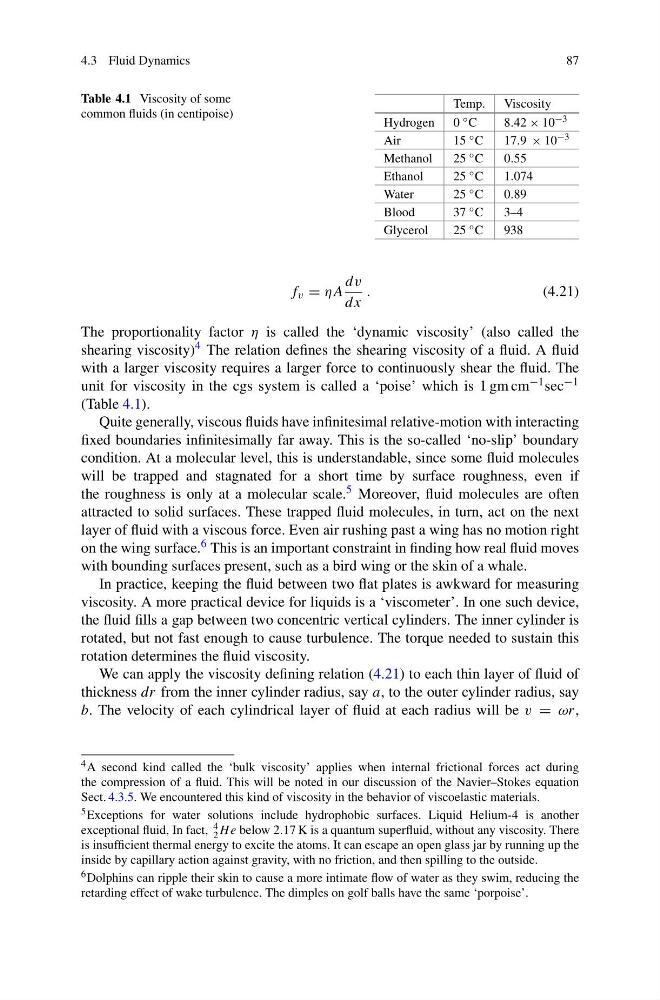
Table 4.1 Viscosity of some
common fluids (in centipoise)
Temp. Viscosity
Hydrogen 0 ◦ C
8.42 × 10 −3
Air
15 ◦ C
17.9 × 10 −3
Methanol
25 ◦ C
0.55
Ethanol
25 ◦ C
1.074
Water
25 ◦ C
0.89
Blood
37 ◦ C
3–4
Glycerol
25 ◦ C
938
f v = ηA
dv
dx
.
(4.21)
The proportionality factor η is called the ‘dynamic viscosity’ (also called the
shearing viscosity) 4 The relation defines the shearing viscosity of a fluid. A fluid
with a larger viscosity requires a larger force to continuously shear the fluid. The
unit for viscosity in the cgs system is called a ‘poise’ which is 1 gm cm −1 sec −1
(Table 4.1).
Quite generally, viscous fluids have infinitesimal relative-motion with interacting
fixed boundaries infinitesimally far away. This is the so-called ‘no-slip’ boundary
condition. At a molecular level, this is understandable, since some fluid molecules
will be trapped and stagnated for a short time by surface roughness, even if
the roughness is only at a molecular scale. 5 Moreover, fluid molecules are often
attracted to solid surfaces. These trapped fluid molecules, in turn, act on the next
layer of fluid with a viscous force. Even air rushing past a wing has no motion right
on the wing surface. 6 This is an important constraint in finding how real fluid moves
with bounding surfaces present, such as a bird wing or the skin of a whale.
In practice, keeping the fluid between two flat plates is awkward for measuring
viscosity. A more practical device for liquids is a ‘viscometer’. In one such device,
the fluid fills a gap between two concentric vertical cylinders. The inner cylinder is
rotated, but not fast enough to cause turbulence. The torque needed to sustain this
rotation determines the fluid viscosity.
We can apply the viscosity defining relation (4.21) to each thin layer of fluid of
thickness dr from the inner cylinder radius, say a, to the outer cylinder radius, say
b. The velocity of each cylindrical layer of fluid at each radius will be v = ωr,
4 A second kind called the ‘bulk viscosity’ applies when internal frictional forces act during
the compression of a fluid. This will be noted in our discussion of the Navier–Stokes equation
Sect. 4.3.5. We encountered this kind of viscosity in the behavior of viscoelastic materials.
5 Exceptions for water solutions include hydrophobic surfaces. Liquid Helium-4 is another
exceptional fluid, In fact, 4
2 H e below 2.17 K is a quantum superfluid, without any viscosity. There
is insufficient thermal energy to excite the atoms. It can escape an open glass jar by running up the
inside by capillary action against gravity, with no friction, and then spilling to the outside.
6 Dolphins can ripple their skin to cause a more intimate flow of water as they swim, reducing the
retarding effect of wake turbulence. The dimples on golf balls have the same ‘porpoise’.
87
Table 4.1 Viscosity of some
common fluids (in centipoise)
Temp. Viscosity
Hydrogen 0 ◦ C
8.42 × 10 −3
Air
15 ◦ C
17.9 × 10 −3
Methanol
25 ◦ C
0.55
Ethanol
25 ◦ C
1.074
Water
25 ◦ C
0.89
Blood
37 ◦ C
3–4
Glycerol
25 ◦ C
938
f v = ηA
dv
dx
.
(4.21)
The proportionality factor η is called the ‘dynamic viscosity’ (also called the
shearing viscosity) 4 The relation defines the shearing viscosity of a fluid. A fluid
with a larger viscosity requires a larger force to continuously shear the fluid. The
unit for viscosity in the cgs system is called a ‘poise’ which is 1 gm cm −1 sec −1
(Table 4.1).
Quite generally, viscous fluids have infinitesimal relative-motion with interacting
fixed boundaries infinitesimally far away. This is the so-called ‘no-slip’ boundary
condition. At a molecular level, this is understandable, since some fluid molecules
will be trapped and stagnated for a short time by surface roughness, even if
the roughness is only at a molecular scale. 5 Moreover, fluid molecules are often
attracted to solid surfaces. These trapped fluid molecules, in turn, act on the next
layer of fluid with a viscous force. Even air rushing past a wing has no motion right
on the wing surface. 6 This is an important constraint in finding how real fluid moves
with bounding surfaces present, such as a bird wing or the skin of a whale.
In practice, keeping the fluid between two flat plates is awkward for measuring
viscosity. A more practical device for liquids is a ‘viscometer’. In one such device,
the fluid fills a gap between two concentric vertical cylinders. The inner cylinder is
rotated, but not fast enough to cause turbulence. The torque needed to sustain this
rotation determines the fluid viscosity.
We can apply the viscosity defining relation (4.21) to each thin layer of fluid of
thickness dr from the inner cylinder radius, say a, to the outer cylinder radius, say
b. The velocity of each cylindrical layer of fluid at each radius will be v = ωr,
4 A second kind called the ‘bulk viscosity’ applies when internal frictional forces act during
the compression of a fluid. This will be noted in our discussion of the Navier–Stokes equation
Sect. 4.3.5. We encountered this kind of viscosity in the behavior of viscoelastic materials.
5 Exceptions for water solutions include hydrophobic surfaces. Liquid Helium-4 is another
exceptional fluid, In fact, 4
2 H e below 2.17 K is a quantum superfluid, without any viscosity. There
is insufficient thermal energy to excite the atoms. It can escape an open glass jar by running up the
inside by capillary action against gravity, with no friction, and then spilling to the outside.
6 Dolphins can ripple their skin to cause a more intimate flow of water as they swim, reducing the
retarding effect of wake turbulence. The dimples on golf balls have the same ‘porpoise’.