

88
4 Fluid Mechanics Applied to Biosystems
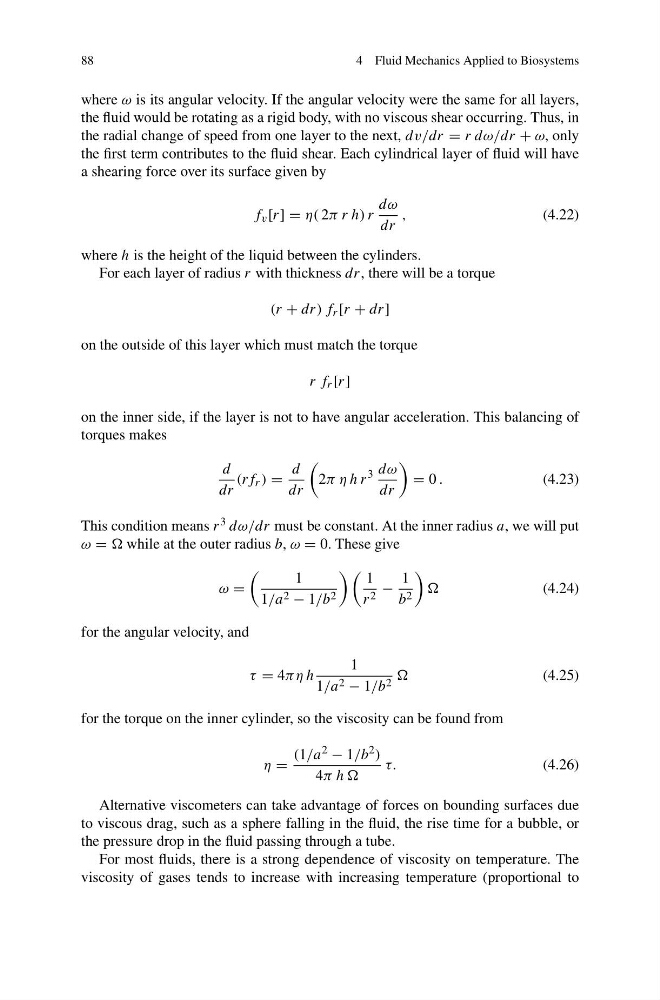
where ω is its angular velocity. If the angular velocity were the same for all layers,
the fluid would be rotating as a rigid body, with no viscous shear occurring. Thus, in
the radial change of speed from one layer to the next, dv/dr = r dω/dr + ω, only
the first term contributes to the fluid shear. Each cylindrical layer of fluid will have
a shearing force over its surface given by
f v [r] = η( 2π r h) r
dω
dr
,
(4.22)
where h is the height of the liquid between the cylinders.
For each layer of radius r with thickness dr, there will be a torque
(r + dr) f r [r + dr]
on the outside of this layer which must match the torque
r f r [r]
on the inner side, if the layer is not to have angular acceleration. This balancing of
torques makes
d
dr
(rf r ) =
d
dr
2π η h r
3 dω
dr
= 0 .
(4.23)
This condition means r 3 dω/dr must be constant. At the inner radius a, we will put
ω = while at the outer radius b, ω = 0. These give
ω =
1
1/a 2 − 1/b 2
1
r 2 −
1
b 2
(4.24)
for the angular velocity, and
τ = 4πη h
1
1/a 2 − 1/b 2
(4.25)
for the torque on the inner cylinder, so the viscosity can be found from
η =
(1/a 2 − 1/b 2 )
4π h h
τ.
(4.26)
Alternative viscometers can take advantage of forces on bounding surfaces due
to viscous drag, such as a sphere falling in the fluid, the rise time for a bubble, or
the pressure drop in the fluid passing through a tube.
For most fluids, there is a strong dependence of viscosity on temperature. The
viscosity of gases tends to increase with increasing temperature (proportional to
4 Fluid Mechanics Applied to Biosystems
where ω is its angular velocity. If the angular velocity were the same for all layers,
the fluid would be rotating as a rigid body, with no viscous shear occurring. Thus, in
the radial change of speed from one layer to the next, dv/dr = r dω/dr + ω, only
the first term contributes to the fluid shear. Each cylindrical layer of fluid will have
a shearing force over its surface given by
f v [r] = η( 2π r h) r
dω
dr
,
(4.22)
where h is the height of the liquid between the cylinders.
For each layer of radius r with thickness dr, there will be a torque
(r + dr) f r [r + dr]
on the outside of this layer which must match the torque
r f r [r]
on the inner side, if the layer is not to have angular acceleration. This balancing of
torques makes
d
dr
(rf r ) =
d
dr
2π η h r
3 dω
dr
= 0 .
(4.23)
This condition means r 3 dω/dr must be constant. At the inner radius a, we will put
ω = while at the outer radius b, ω = 0. These give
ω =
1
1/a 2 − 1/b 2
1
r 2 −
1
b 2
(4.24)
for the angular velocity, and
τ = 4πη h
1
1/a 2 − 1/b 2
(4.25)
for the torque on the inner cylinder, so the viscosity can be found from
η =
(1/a 2 − 1/b 2 )
4π h h
τ.
(4.26)
Alternative viscometers can take advantage of forces on bounding surfaces due
to viscous drag, such as a sphere falling in the fluid, the rise time for a bubble, or
the pressure drop in the fluid passing through a tube.
For most fluids, there is a strong dependence of viscosity on temperature. The
viscosity of gases tends to increase with increasing temperature (proportional to