

4.3 Fluid Dynamics
89
square root of the absolute temperature), while ordinary liquids decrease viscosity
with increased temperature (often exponentially). The viscosity of air at standard
temperature and pressure (273.15 K and 1.033 × 10 6 dyne per square centimeter) is
1.8×10 −2 centipoise, increasing by about 0.3% per Kelvin increase in temperature.
Water has a viscosity of 1.0 centipoise at 20 ◦ C and one atmosphere, decreasing by
about 2% per degree as the temperature rises (Table 4.2).
A model by Arrhenius using molecular kinetics predicts that a simple (‘Newtonian’) fluid will have a Boltzmann factor exp (−E/RT ) determining the dependence of the fluid viscosity on temperature, where E is an activation energy per
mole and R is the gas constant. Using 1/T = 1/(T o + T C ) ≈ (1 − T C /T o )/T o , this
behavior can be approximated by
η = η 0 exp (−aT C )
(4.27)
in a limited temperature range. T C is the temperature in Celsius. For water in the
range of 10–70 ◦ C, a reasonable fit is η = (37/25) exp(−T C /52) centipoise.
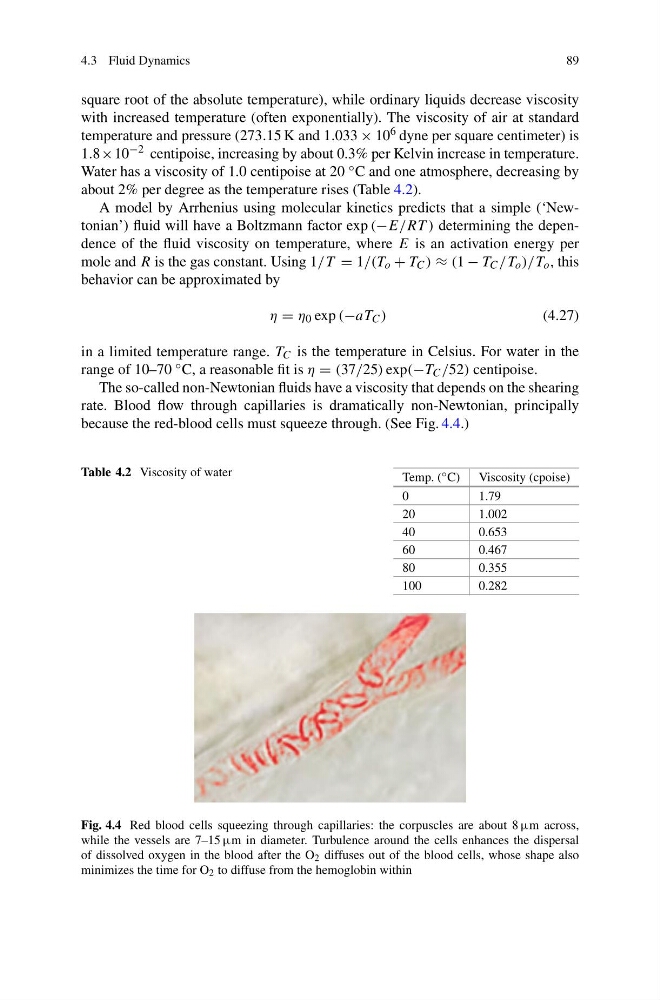
The so-called non-Newtonian fluids have a viscosity that depends on the shearing
rate. Blood flow through capillaries is dramatically non-Newtonian, principally
because the red-blood cells must squeeze through. (See Fig. 4.4.)
Table 4.2 Viscosity of water
Temp. ( ◦ C) Viscosity (cpoise)
0
1 . 7 9
20
1.002
40
0.653
60
0.467
80
0.355
100
0.282
Fig. 4.4 Red blood cells squeezing through capillaries: the corpuscles are about 8 μm across,
while the vessels are 7–15 μm in diameter. Turbulence around the cells enhances the dispersal
of dissolved oxygen in the blood after the O 2 diffuses out of the blood cells, whose shape also
minimizes the time for O 2 to diffuse from the hemoglobin within
89
square root of the absolute temperature), while ordinary liquids decrease viscosity
with increased temperature (often exponentially). The viscosity of air at standard
temperature and pressure (273.15 K and 1.033 × 10 6 dyne per square centimeter) is
1.8×10 −2 centipoise, increasing by about 0.3% per Kelvin increase in temperature.
Water has a viscosity of 1.0 centipoise at 20 ◦ C and one atmosphere, decreasing by
about 2% per degree as the temperature rises (Table 4.2).
A model by Arrhenius using molecular kinetics predicts that a simple (‘Newtonian’) fluid will have a Boltzmann factor exp (−E/RT ) determining the dependence of the fluid viscosity on temperature, where E is an activation energy per
mole and R is the gas constant. Using 1/T = 1/(T o + T C ) ≈ (1 − T C /T o )/T o , this
behavior can be approximated by
η = η 0 exp (−aT C )
(4.27)
in a limited temperature range. T C is the temperature in Celsius. For water in the
range of 10–70 ◦ C, a reasonable fit is η = (37/25) exp(−T C /52) centipoise.
The so-called non-Newtonian fluids have a viscosity that depends on the shearing
rate. Blood flow through capillaries is dramatically non-Newtonian, principally
because the red-blood cells must squeeze through. (See Fig. 4.4.)
Table 4.2 Viscosity of water
Temp. ( ◦ C) Viscosity (cpoise)
0
1 . 7 9
20
1.002
40
0.653
60
0.467
80
0.355
100
0.282
Fig. 4.4 Red blood cells squeezing through capillaries: the corpuscles are about 8 μm across,
while the vessels are 7–15 μm in diameter. Turbulence around the cells enhances the dispersal
of dissolved oxygen in the blood after the O 2 diffuses out of the blood cells, whose shape also
minimizes the time for O 2 to diffuse from the hemoglobin within