

90
4 Fluid Mechanics Applied to Biosystems
The viscosity of blood strongly depends on the relative volume of red-blood cells
to total blood volume, measured by ‘hematocrit’ in a centrifuge. In men, hematocrit
is normally about (45.5 ± 4.8)%, in women about (40.2 ± 4.1)%, making the blood
viscosity about five times that of water. Anemia can cause a decrease in hematocrit,
and various vascular and bone-marrow diseases can increase the hematocrit above
60%, directly affecting blood flow because of the viscosity increase by as much
as a factor of two. Hypothermia of the blood also increases its viscosity, so that
intentional hypothermic operations must take into account viscosity changes in
determining oxygenation of tissue.
A simple technique to determine the viscosity of a sample of blood is to measure
the rate of fall, v, of a small ball (radius a and mass m) dropped in the blood.
(See Fig. 3.6.) The ball stops accelerating almost immediately, so 6πηav = mg,
which can be solved for η. This Stokes expression fails if the flow becomes turbulent
behind the ball.
4.3.2 Fluid Flow in Tubes
Consider a fluid flowing through a tube, such as one of your arteries. The motion
of a viscous fluid at the boundary walls usually becomes vanishingly small. The
flow near the center of the tube will be higher than near the walls. This means
each cylinder of fluid from one radius to the next within the tube rubs against the
adjacent cylinder with a viscous force. The slipping layers generate heat, and energy
is required to sustain the flow through the tube. This energy is supplied by an agent,
such as your heart, which generates a force to push on the fluid at one end of the
tube, with a lesser force from the distal fluid acting back on the other end. The
difference between these two pressure forces on the opposite ends of the tube give a
net force. As the fluid moves, power is being expended by the net force given by the
pressure difference times the area of a thin tube of fluid times distance moved over
time, or p dA v, where v is the velocity of the fluid in the thin tube. (See Fig. 4.5.)
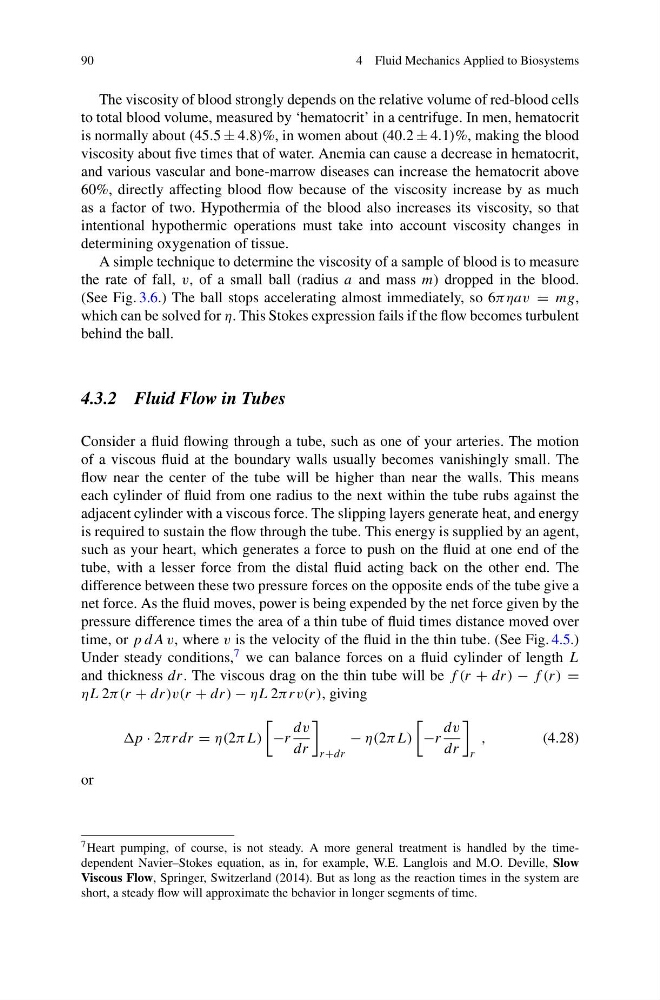
Under steady conditions, 7 we can balance forces on a fluid cylinder of length L
and thickness dr. The viscous drag on the thin tube will be f (r + dr) − f (r) =
ηL 2π(r + dr)v(r + dr) − ηL 2πrv(r), giving
p · 2πrdr = η(2πL)
−r
dv
dr
r+dr
− η(2πL)
−r
dv
dr
r
,
(4.28)
or
7 Heart pumping, of course, is not steady. A more general treatment is handled by the timedependent Navier–Stokes equation, as in, for example, W.E. Langlois and M.O. Deville, Slow
Viscous Flow, Springer, Switzerland (2014). But as long as the reaction times in the system are
short, a steady flow will approximate the behavior in longer segments of time.
4 Fluid Mechanics Applied to Biosystems
The viscosity of blood strongly depends on the relative volume of red-blood cells
to total blood volume, measured by ‘hematocrit’ in a centrifuge. In men, hematocrit
is normally about (45.5 ± 4.8)%, in women about (40.2 ± 4.1)%, making the blood
viscosity about five times that of water. Anemia can cause a decrease in hematocrit,
and various vascular and bone-marrow diseases can increase the hematocrit above
60%, directly affecting blood flow because of the viscosity increase by as much
as a factor of two. Hypothermia of the blood also increases its viscosity, so that
intentional hypothermic operations must take into account viscosity changes in
determining oxygenation of tissue.
A simple technique to determine the viscosity of a sample of blood is to measure
the rate of fall, v, of a small ball (radius a and mass m) dropped in the blood.
(See Fig. 3.6.) The ball stops accelerating almost immediately, so 6πηav = mg,
which can be solved for η. This Stokes expression fails if the flow becomes turbulent
behind the ball.
4.3.2 Fluid Flow in Tubes
Consider a fluid flowing through a tube, such as one of your arteries. The motion
of a viscous fluid at the boundary walls usually becomes vanishingly small. The
flow near the center of the tube will be higher than near the walls. This means
each cylinder of fluid from one radius to the next within the tube rubs against the
adjacent cylinder with a viscous force. The slipping layers generate heat, and energy
is required to sustain the flow through the tube. This energy is supplied by an agent,
such as your heart, which generates a force to push on the fluid at one end of the
tube, with a lesser force from the distal fluid acting back on the other end. The
difference between these two pressure forces on the opposite ends of the tube give a
net force. As the fluid moves, power is being expended by the net force given by the
pressure difference times the area of a thin tube of fluid times distance moved over
time, or p dA v, where v is the velocity of the fluid in the thin tube. (See Fig. 4.5.)
Under steady conditions, 7 we can balance forces on a fluid cylinder of length L
and thickness dr. The viscous drag on the thin tube will be f (r + dr) − f (r) =
ηL 2π(r + dr)v(r + dr) − ηL 2πrv(r), giving
p · 2πrdr = η(2πL)
−r
dv
dr
r+dr
− η(2πL)
−r
dv
dr
r
,
(4.28)
or
7 Heart pumping, of course, is not steady. A more general treatment is handled by the timedependent Navier–Stokes equation, as in, for example, W.E. Langlois and M.O. Deville, Slow
Viscous Flow, Springer, Switzerland (2014). But as long as the reaction times in the system are
short, a steady flow will approximate the behavior in longer segments of time.