

4.3 Fluid Dynamics
91
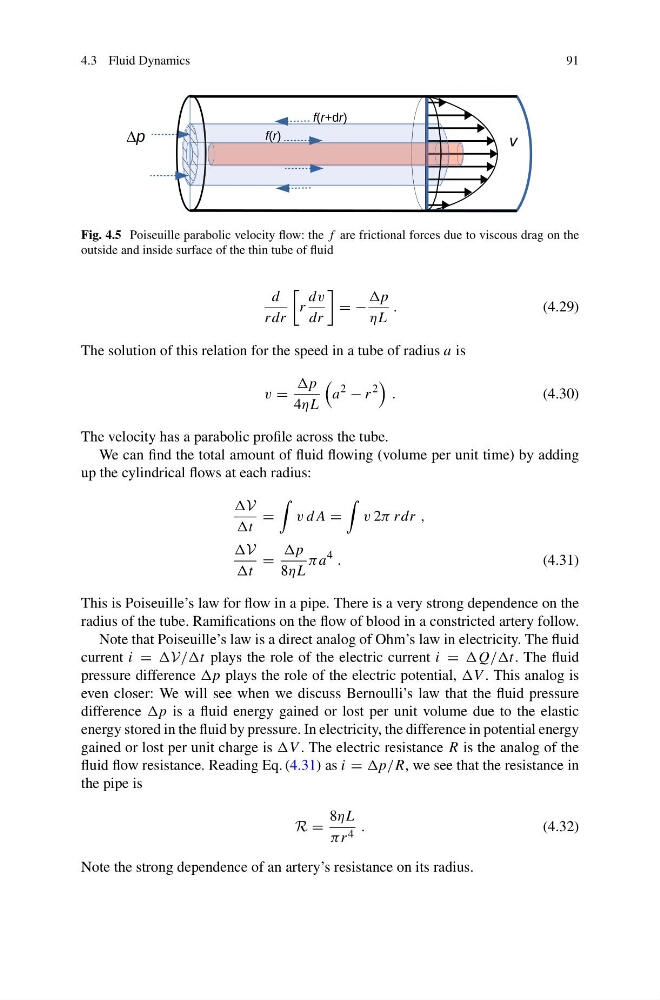
Fig. 4.5 Poiseuille parabolic velocity flow: the f are frictional forces due to viscous drag on the
outside and inside surface of the thin tube of fluid
d
rdr
r
dv
dr
= −
p
ηL
.
(4.29)
The solution of this relation for the speed in a tube of radius a is
v =
p
4ηL
a
2
− r
2
.
(4.30)
The velocity has a parabolic profile across the tube.
We can find the total amount of fluid flowing (volume per unit time) by adding
up the cylindrical flows at each radius:
V
t
=
v dA =
v 2π rdr ,
V
t
=
p
8ηL
πa
4 .
(4.31)
This is Poiseuille’s law for flow in a pipe. There is a very strong dependence on the
radius of the tube. Ramifications on the flow of blood in a constricted artery follow.
Note that Poiseuille’s law is a direct analog of Ohm’s law in electricity. The fluid
current i = V//t plays the role of the electric current i = Q//t. The fluid
pressure difference p plays the role of the electric potential, V . This analog is
even closer: We will see when we discuss Bernoulli’s law that the fluid pressure
difference p is a fluid energy gained or lost per unit volume due to the elastic
energy stored in the fluid by pressure. In electricity, the difference in potential energy
gained or lost per unit charge is V . The electric resistance R is the analog of the
fluid flow resistance. Reading Eq. (4.31) as i = we see that the resistance in
the pipe is
R =
8ηL
πr 4 .
(4.32)
Note the strong dependence of an artery’s resistance on its radius.
91
Fig. 4.5 Poiseuille parabolic velocity flow: the f are frictional forces due to viscous drag on the
outside and inside surface of the thin tube of fluid
d
rdr
r
dv
dr
= −
p
ηL
.
(4.29)
The solution of this relation for the speed in a tube of radius a is
v =
p
4ηL
a
2
− r
2
.
(4.30)
The velocity has a parabolic profile across the tube.
We can find the total amount of fluid flowing (volume per unit time) by adding
up the cylindrical flows at each radius:
V
t
=
v dA =
v 2π rdr ,
V
t
=
p
8ηL
πa
4 .
(4.31)
This is Poiseuille’s law for flow in a pipe. There is a very strong dependence on the
radius of the tube. Ramifications on the flow of blood in a constricted artery follow.
Note that Poiseuille’s law is a direct analog of Ohm’s law in electricity. The fluid
current i = V//t plays the role of the electric current i = Q//t. The fluid
pressure difference p plays the role of the electric potential, V . This analog is
even closer: We will see when we discuss Bernoulli’s law that the fluid pressure
difference p is a fluid energy gained or lost per unit volume due to the elastic
energy stored in the fluid by pressure. In electricity, the difference in potential energy
gained or lost per unit charge is V . The electric resistance R is the analog of the
fluid flow resistance. Reading Eq. (4.31) as i = we see that the resistance in
the pipe is
R =
8ηL
πr 4 .
(4.32)
Note the strong dependence of an artery’s resistance on its radius.