

82
4 Fluid Mechanics Applied to Biosystems
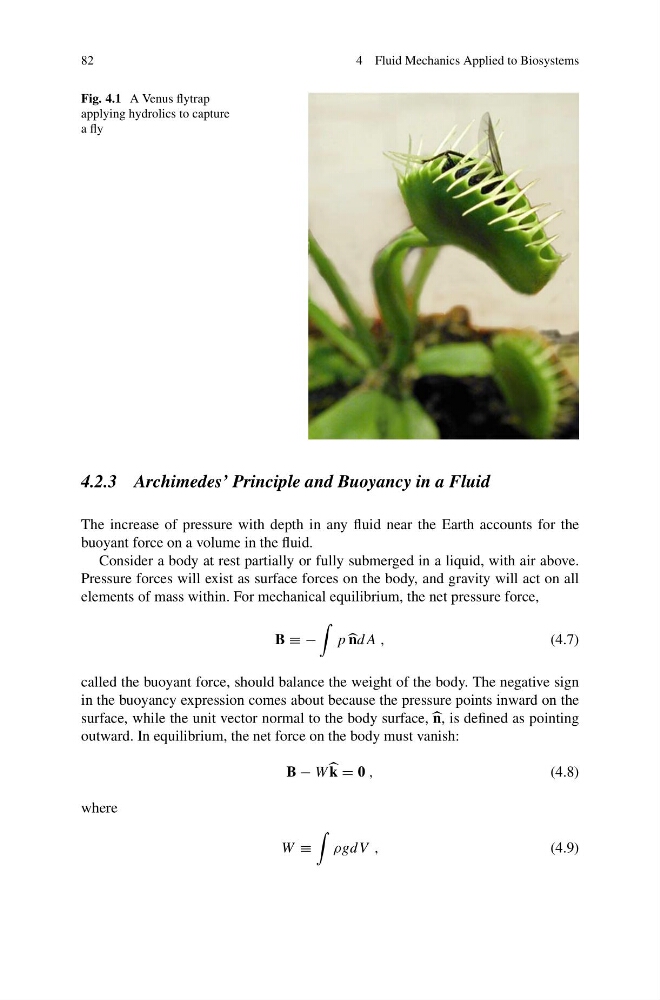
Fig. 4.1 A Venus flytrap
applying hydrolics to capture
a fly
4.2.3 Archimedes’ Principle and Buoyancy in a Fluid
The increase of pressure with depth in any fluid near the Earth accounts for the
buoyant force on a volume in the fluid.
Consider a body at rest partially or fully submerged in a liquid, with air above.
Pressure forces will exist as surface forces on the body, and gravity will act on all
elements of mass within. For mechanical equilibrium, the net pressure force,
B ≡ −
p ndA ,
(4.7)
called the buoyant force, should balance the weight of the body. The negative sign
in the buoyancy expression comes about because the pressure points inward on the
surface, while the unit vector normal to the body surface, n, is defined as pointing
outward. In equilibrium, the net force on the body must vanish:
B − W k = 0 ,
(4.8)
where
W ≡
ρgdV ,
(4.9)
4 Fluid Mechanics Applied to Biosystems
Fig. 4.1 A Venus flytrap
applying hydrolics to capture
a fly
4.2.3 Archimedes’ Principle and Buoyancy in a Fluid
The increase of pressure with depth in any fluid near the Earth accounts for the
buoyant force on a volume in the fluid.
Consider a body at rest partially or fully submerged in a liquid, with air above.
Pressure forces will exist as surface forces on the body, and gravity will act on all
elements of mass within. For mechanical equilibrium, the net pressure force,
B ≡ −
p ndA ,
(4.7)
called the buoyant force, should balance the weight of the body. The negative sign
in the buoyancy expression comes about because the pressure points inward on the
surface, while the unit vector normal to the body surface, n, is defined as pointing
outward. In equilibrium, the net force on the body must vanish:
B − W k = 0 ,
(4.8)
where
W ≡
ρgdV ,
(4.9)