

3.10 Bones, Ligaments, and Other Structures
71
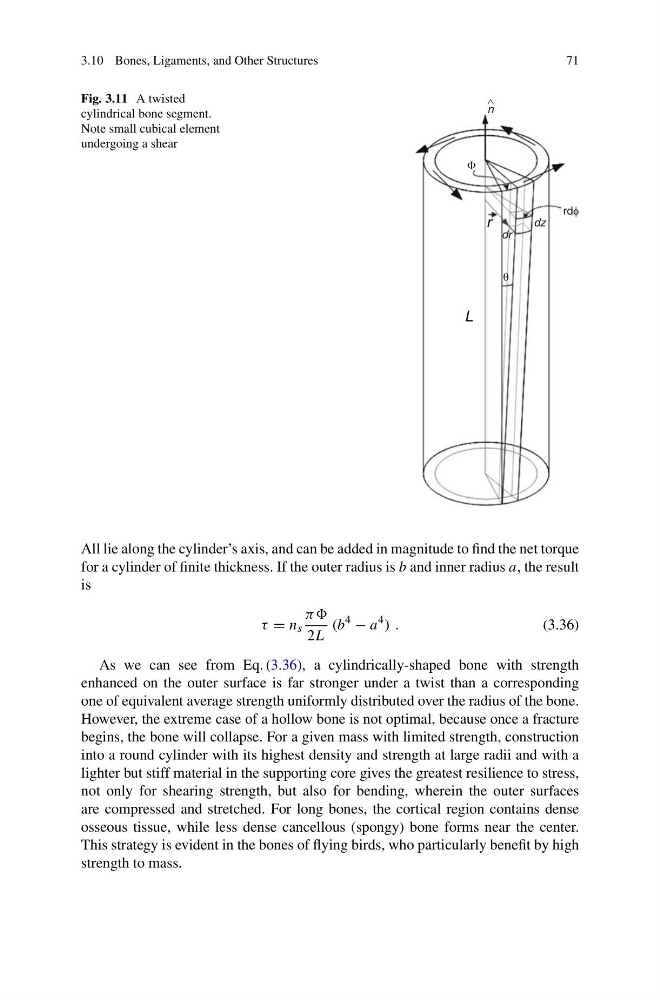
Fig. 3.11 A twisted
cylindrical bone segment.
Note small cubical element
undergoing a shear
n
r
L
dr
dz
∧
Φ
rdφ
θ
All lie along the cylinder’s axis, and can be added in magnitude to find the net torque
for a cylinder of finite thickness. If the outer radius is b and inner radius a, the result
is
τ = n s
ππ
2L
(b
4
− a
4 ) .
(3.36)
As we can see from Eq. (3.36), a cylindrically-shaped bone with strength
enhanced on the outer surface is far stronger under a twist than a corresponding
one of equivalent average strength uniformly distributed over the radius of the bone.
However, the extreme case of a hollow bone is not optimal, because once a fracture
begins, the bone will collapse. For a given mass with limited strength, construction
into a round cylinder with its highest density and strength at large radii and with a
lighter but stiff material in the supporting core gives the greatest resilience to stress,
not only for shearing strength, but also for bending, wherein the outer surfaces
are compressed and stretched. For long bones, the cortical region contains dense
osseous tissue, while less dense cancellous (spongy) bone forms near the center.
This strategy is evident in the bones of flying birds, who particularly benefit by high
strength to mass.
71
Fig. 3.11 A twisted
cylindrical bone segment.
Note small cubical element
undergoing a shear
n
r
L
dr
dz
∧
Φ
rdφ
θ
All lie along the cylinder’s axis, and can be added in magnitude to find the net torque
for a cylinder of finite thickness. If the outer radius is b and inner radius a, the result
is
τ = n s
ππ
2L
(b
4
− a
4 ) .
(3.36)
As we can see from Eq. (3.36), a cylindrically-shaped bone with strength
enhanced on the outer surface is far stronger under a twist than a corresponding
one of equivalent average strength uniformly distributed over the radius of the bone.
However, the extreme case of a hollow bone is not optimal, because once a fracture
begins, the bone will collapse. For a given mass with limited strength, construction
into a round cylinder with its highest density and strength at large radii and with a
lighter but stiff material in the supporting core gives the greatest resilience to stress,
not only for shearing strength, but also for bending, wherein the outer surfaces
are compressed and stretched. For long bones, the cortical region contains dense
osseous tissue, while less dense cancellous (spongy) bone forms near the center.
This strategy is evident in the bones of flying birds, who particularly benefit by high
strength to mass.