

70
3 Mechanical Aspects of Biosystems
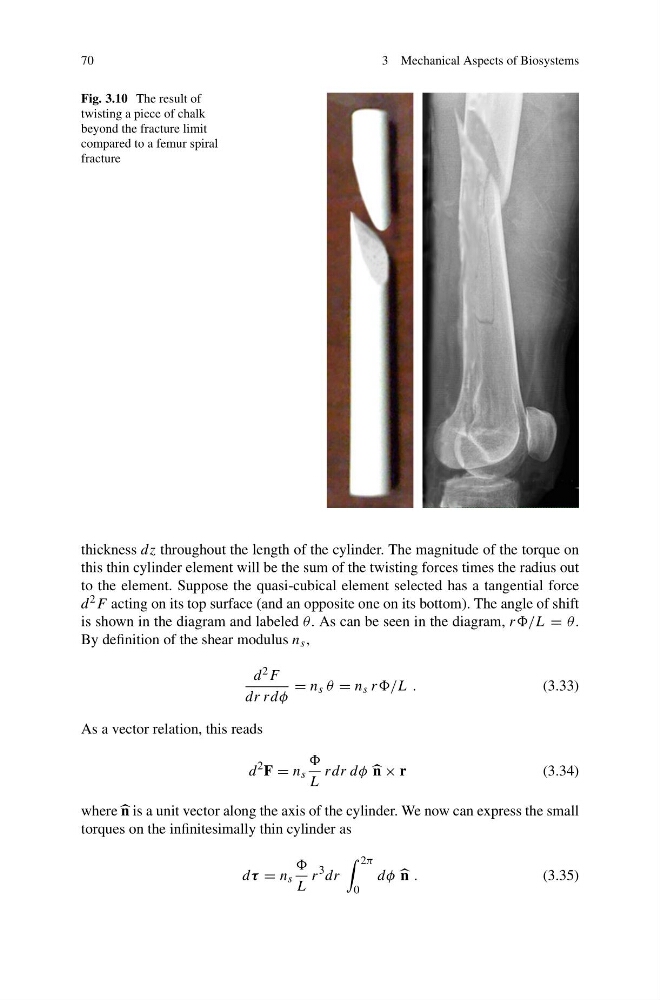
Fig. 3.10 The result of
twisting a piece of chalk
beyond the fracture limit
compared to a femur spiral
fracture
thickness dz throughout the length of the cylinder. The magnitude of the torque on
this thin cylinder element will be the sum of the twisting forces times the radius out
to the element. Suppose the quasi-cubical element selected has a tangential force
d 2 F acting on its top surface (and an opposite one on its bottom). The angle of shift
is shown in the diagram and labeled θ . As can be seen in the diagram, rr/L = θ .
By definition of the shear modulus n s ,
d 2 F
dr rdφ
= n s θ = n s rr/L .
(3.33)
As a vector relation, this reads
d
2 F = n s
L
rdr dφ n × r
(3.34)
where n is a unit vector along the axis of the cylinder. We now can express the small
torques on the infinitesimally thin cylinder as
dτ = n s
L
r
3 dr
2π
0
dφ n .
(3.35)
3 Mechanical Aspects of Biosystems
Fig. 3.10 The result of
twisting a piece of chalk
beyond the fracture limit
compared to a femur spiral
fracture
thickness dz throughout the length of the cylinder. The magnitude of the torque on
this thin cylinder element will be the sum of the twisting forces times the radius out
to the element. Suppose the quasi-cubical element selected has a tangential force
d 2 F acting on its top surface (and an opposite one on its bottom). The angle of shift
is shown in the diagram and labeled θ . As can be seen in the diagram, rr/L = θ .
By definition of the shear modulus n s ,
d 2 F
dr rdφ
= n s θ = n s rr/L .
(3.33)
As a vector relation, this reads
d
2 F = n s
L
rdr dφ n × r
(3.34)
where n is a unit vector along the axis of the cylinder. We now can express the small
torques on the infinitesimally thin cylinder as
dτ = n s
L
r
3 dr
2π
0
dφ n .
(3.35)