

3.10 Bones, Ligaments, and Other Structures
69
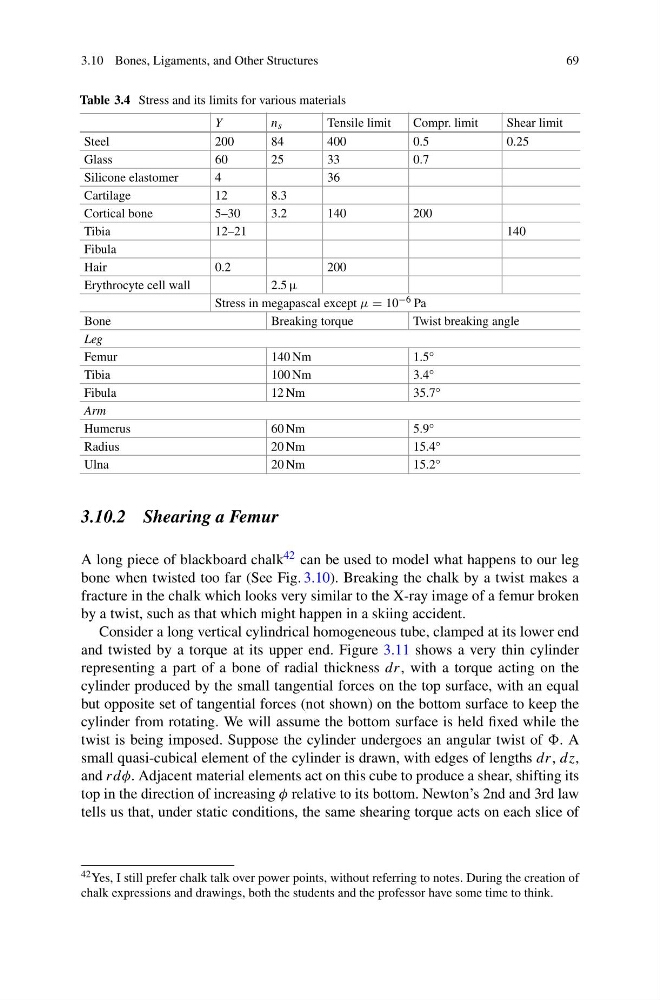
Table 3.4 Stress and its limits for various materials
Y
n s
Tensile limit
Compr. limit
Shear limit
Steel
200
84
400
0.5
0.25
Glass
60
25
33
0.7
Silicone elastomer
4
36
Cartilage
12
8.3
Cortical bone
5–30
3.2
140
200
Tibia
12–21
140
Fibula
Hair
0.2
200
Erythrocyte cell wall
2.5 μ
Stress in megapascal except μ = 10 −6 Pa
Bone
Breaking torque
Twist breaking angle
Leg
Femur
140 Nm
1.5 ◦
Tibia
100 Nm
3.4 ◦
Fibula
12 Nm
35.7 ◦
Arm
Humerus
60 Nm
5.9 ◦
Radius
20 Nm
15.4 ◦
Ulna
20 Nm
15.2 ◦
3.10.2 Shearing a Femur
A long piece of blackboard chalk 42 can be used to model what happens to our leg
bone when twisted too far (See Fig. 3.10). Breaking the chalk by a twist makes a
fracture in the chalk which looks very similar to the X-ray image of a femur broken
by a twist, such as that which might happen in a skiing accident.
Consider a long vertical cylindrical homogeneous tube, clamped at its lower end
and twisted by a torque at its upper end. Figure 3.11 shows a very thin cylinder
representing a part of a bone of radial thickness dr, with a torque acting on the
cylinder produced by the small tangential forces on the top surface, with an equal
but opposite set of tangential forces (not shown) on the bottom surface to keep the
cylinder from rotating. We will assume the bottom surface is held fixed while the
twist is being imposed. Suppose the cylinder undergoes an angular twist of . A
small quasi-cubical element of the cylinder is drawn, with edges of lengths dr, dz,
and rdφ. Adjacent material elements act on this cube to produce a shear, shifting its
top in the direction of increasing φ relative to its bottom. Newton’s 2nd and 3rd law
tells us that, under static conditions, the same shearing torque acts on each slice of
42 Yes, I still prefer chalk talk over power points, without referring to notes. During the creation of
chalk expressions and drawings, both the students and the professor have some time to think.
69
Table 3.4 Stress and its limits for various materials
Y
n s
Tensile limit
Compr. limit
Shear limit
Steel
200
84
400
0.5
0.25
Glass
60
25
33
0.7
Silicone elastomer
4
36
Cartilage
12
8.3
Cortical bone
5–30
3.2
140
200
Tibia
12–21
140
Fibula
Hair
0.2
200
Erythrocyte cell wall
2.5 μ
Stress in megapascal except μ = 10 −6 Pa
Bone
Breaking torque
Twist breaking angle
Leg
Femur
140 Nm
1.5 ◦
Tibia
100 Nm
3.4 ◦
Fibula
12 Nm
35.7 ◦
Arm
Humerus
60 Nm
5.9 ◦
Radius
20 Nm
15.4 ◦
Ulna
20 Nm
15.2 ◦
3.10.2 Shearing a Femur
A long piece of blackboard chalk 42 can be used to model what happens to our leg
bone when twisted too far (See Fig. 3.10). Breaking the chalk by a twist makes a
fracture in the chalk which looks very similar to the X-ray image of a femur broken
by a twist, such as that which might happen in a skiing accident.
Consider a long vertical cylindrical homogeneous tube, clamped at its lower end
and twisted by a torque at its upper end. Figure 3.11 shows a very thin cylinder
representing a part of a bone of radial thickness dr, with a torque acting on the
cylinder produced by the small tangential forces on the top surface, with an equal
but opposite set of tangential forces (not shown) on the bottom surface to keep the
cylinder from rotating. We will assume the bottom surface is held fixed while the
twist is being imposed. Suppose the cylinder undergoes an angular twist of . A
small quasi-cubical element of the cylinder is drawn, with edges of lengths dr, dz,
and rdφ. Adjacent material elements act on this cube to produce a shear, shifting its
top in the direction of increasing φ relative to its bottom. Newton’s 2nd and 3rd law
tells us that, under static conditions, the same shearing torque acts on each slice of
42 Yes, I still prefer chalk talk over power points, without referring to notes. During the creation of
chalk expressions and drawings, both the students and the professor have some time to think.