

J Useful Biophysical Data
683
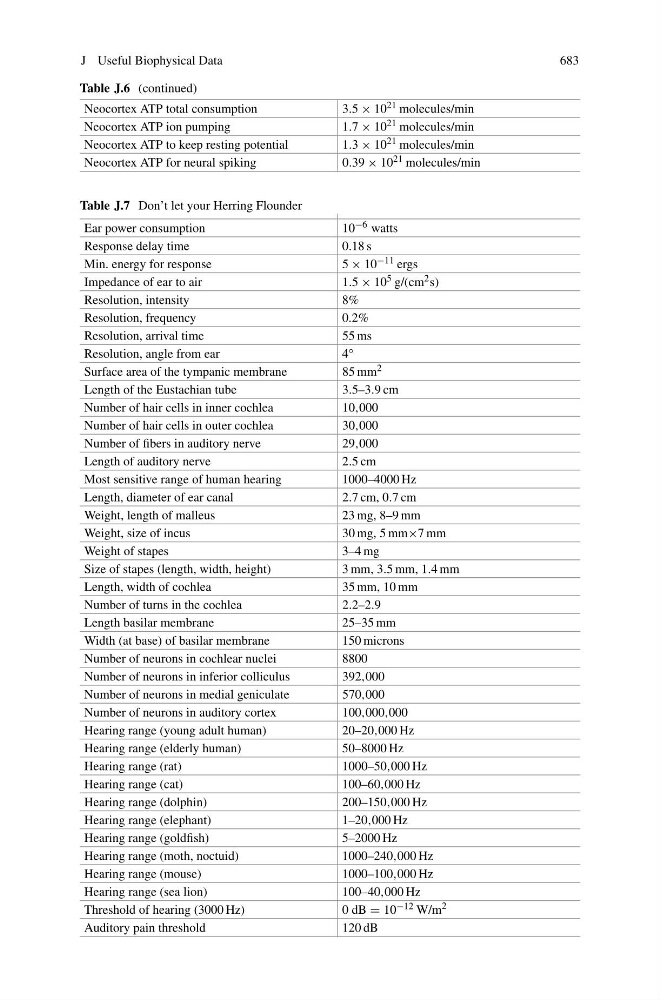
Table J.6 (continued)
Neocortex ATP total consumption
3.5 × 10 21 molecules/min
Neocortex ATP ion pumping
1.7 × 10 21 molecules/min
Neocortex ATP to keep resting potential
1.3 × 10 21 molecules/min
Neocortex ATP for neural spiking
0.39 × 10 21 molecules/min
Table J.7 Don’t let your Herring Flounder
Ear power consumption
10 −6 watts
Response delay time
0.18 s
Min. energy for response
5 × 10 −11 ergs
Impedance of ear to air
1.5 × 10 5 g/(cm 2 s)
Resolution, intensity
8%
Resolution, frequency
0.2%
Resolution, arrival time
55 ms
Resolution, angle from ear
4 ◦
Surface area of the tympanic membrane
85 mm 2
Length of the Eustachian tube
3.5–3.9 cm
Number of hair cells in inner cochlea
10,000
Number of hair cells in outer cochlea
30,000
Number of fibers in auditory nerve
29,000
Length of auditory nerve
2.5 cm
Most sensitive range of human hearing
1000–4000 Hz
Length, diameter of ear canal
2.7 cm, 0.7 cm
Weight, length of malleus
23 mg, 8–9 mm
Weight, size of incus
30 mg, 5 mm×7 mm
Weight of stapes
3–4 mg
Size of stapes (length, width, height)
3 mm, 3.5 mm, 1.4 mm
Length, width of cochlea
35 mm, 10 mm
Number of turns in the cochlea
2.2–2.9
Length basilar membrane
25–35 mm
Width (at base) of basilar membrane
150 microns
Number of neurons in cochlear nuclei
8800
Number of neurons in inferior colliculus
392,000
Number of neurons in medial geniculate
570,000
Number of neurons in auditory cortex
100,000,000
Hearing range (young adult human)
20–20,000 Hz
Hearing range (elderly human)
50–8000 Hz
Hearing range (rat)
1000–50,000 Hz
Hearing range (cat)
100–60,000 Hz
Hearing range (dolphin)
200–150,000 Hz
Hearing range (elephant)
1–20,000 Hz
Hearing range (goldfish)
5–2000 Hz
Hearing range (moth, noctuid)
1000–240,000 Hz
Hearing range (mouse)
1000–100,000 Hz
Hearing range (sea lion)
100–40,000 Hz
Threshold of hearing (3000 Hz)
0 dB = 10 −12 W/m
2
Auditory pain threshold
120 dB