

682
J Useful Biophysical Data
Table J.5 (continued)
Heat of vaporization of water
H vap
539.2· cal/gm
Thermal conductivity of air @ 20 ◦ C
k a
25.7 · mW/(m ◦ C)
Thermal conductivity of water
k w
598.4 · mW/(m ◦ C)
Equivalent weight of ion
EW
Atomic Weight/Valence
Quantity of an electrolyte
Q el
milligrams/(liter-EW) (mEq/L)
J.3 Biophysical Constants
‘Here we have Biological Physiques’
— wcp
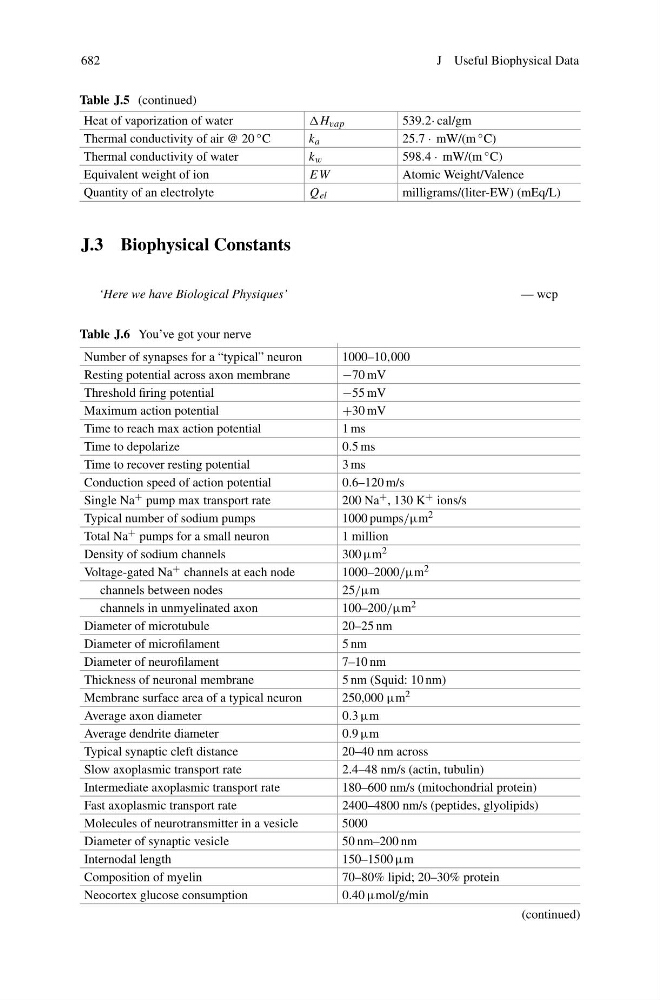
Table J.6 You’ve got your nerve
Number of synapses for a “typical” neuron
1000–10,000
Resting potential across axon membrane
−70 mV
Threshold firing potential
−55 mV
Maximum action potential
+30 mV
Time to reach max action potential
1 ms
Time to depolarize
0.5 ms
Time to recover resting potential
3 ms
Conduction speed of action potential
0.6–120 m/s
Single Na + pump max transport rate
200 Na + , 130 K + ions/s
Typical number of sodium pumps
1000 pumps/μm 2
Total Na + pumps for a small neuron
1 million
Density of sodium channels
300 μm 2
Voltage-gated Na + channels at each node
1000–2000/μm 2
channels between nodes
25/μm
channels in unmyelinated axon
100–200/μm 2
Diameter of microtubule
20–25 nm
Diameter of microfilament
5 nm
Diameter of neurofilament
7–10 nm
Thickness of neuronal membrane
5 nm (Squid: 10 nm)
Membrane surface area of a typical neuron
250,000 μm 2
Average axon diameter
0.3 μm
Average dendrite diameter
0.9 μm
Typical synaptic cleft distance
20–40 nm across
Slow axoplasmic transport rate
2.4–48 nm/s (actin, tubulin)
Intermediate axoplasmic transport rate
180–600 nm/s (mitochondrial protein)
Fast axoplasmic transport rate
2400–4800 nm/s (peptides, glyolipids)
Molecules of neurotransmitter in a vesicle
5000
Diameter of synaptic vesicle
50 nm–200 nm
Internodal length
150–1500 μm
Composition of myelin
70–80% lipid; 20–30% protein
Neocortex glucose consumption
0.40 μmol/g/min
(continued)