

G Some Tools of Vector Analysis
661
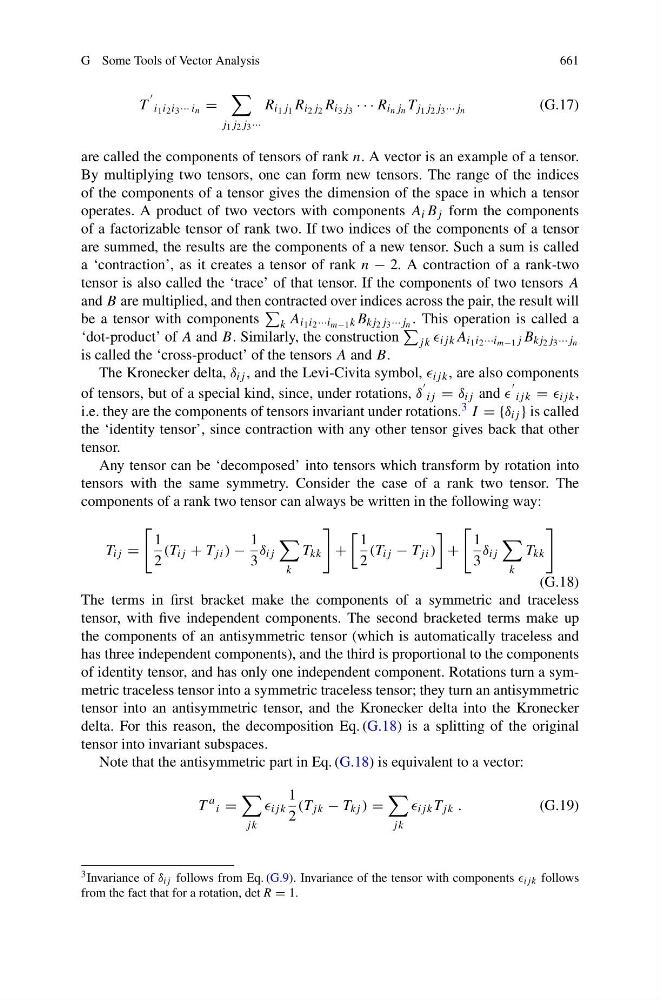
T
i 1 i 2 i 3 ··· i n =
j 1 j 2 j 3 ···
R i 1 j 1 R i 2 j 2 R i 3 j 3 · · · R i n j n T j 1 j 2 j 3 ···j n
(G.17)
are called the components of tensors of rank n. A vector is an example of a tensor.
By multiplying two tensors, one can form new tensors. The range of the indices
of the components of a tensor gives the dimension of the space in which a tensor
operates. A product of two vectors with components A i B j form the components
of a factorizable tensor of rank two. If two indices of the components of a tensor
are summed, the results are the components of a new tensor. Such a sum is called
a ‘contraction’, as it creates a tensor of rank n − 2. A contraction of a rank-two
tensor is also called the ‘trace’ of that tensor. If the components of two tensors A
and B are multiplied, and then contracted over indices across the pair, the result will
be a tensor with components
k A i 1 i 2 ···i m−1 k B kj 2 j 3 ···j n . This operation is called a
‘dot-product’ of A and B. Similarly, the construction
jk ij k A i 1 i 2 ···i m−1 j B kj 2 j 3 ···j n
is called the ‘cross-product’ of the tensors A and B.
The Kronecker delta, δ ij , and the Levi-Civita symbol, ij k , are also components
of tensors, but of a special kind, since, under rotations, δ
ij = δ ij and
ij k = ij k ,
i.e. they are the components of tensors invariant under rotations. 3 I = {δ ij } is called
the ‘identity tensor’, since contraction with any other tensor gives back that other
tensor.
Any tensor can be ‘decomposed’ into tensors which transform by rotation into
tensors with the same symmetry. Consider the case of a rank two tensor. The
components of a rank two tensor can always be written in the following way:
T ij =
1
2
(T ij + T ji ) −
1
3
δ ij
k
T kk
+
1
2
(T ij − T ji )
+
1
3
δ ij
k
T kk
(G.18)
The terms in first bracket make the components of a symmetric and traceless
tensor, with five independent components. The second bracketed terms make up
the components of an antisymmetric tensor (which is automatically traceless and
has three independent components), and the third is proportional to the components
of identity tensor, and has only one independent component. Rotations turn a symmetric traceless tensor into a symmetric traceless tensor; they turn an antisymmetric
tensor into an antisymmetric tensor, and the Kronecker delta into the Kronecker
delta. For this reason, the decomposition Eq. (G.18) is a splitting of the original
tensor into invariant subspaces.
Note that the antisymmetric part in Eq. (G.18) is equivalent to a vector:
T
a
i =
jk
ij k
1
2
(T jk − T kj ) =
jk
ij k T jk .
(G.19)
3 Invariance of δ ij follows from Eq. (G.9). Invariance of the tensor with components ij k follows
from the fact that for a rotation, det R = 1.