

660
G Some Tools of Vector Analysis
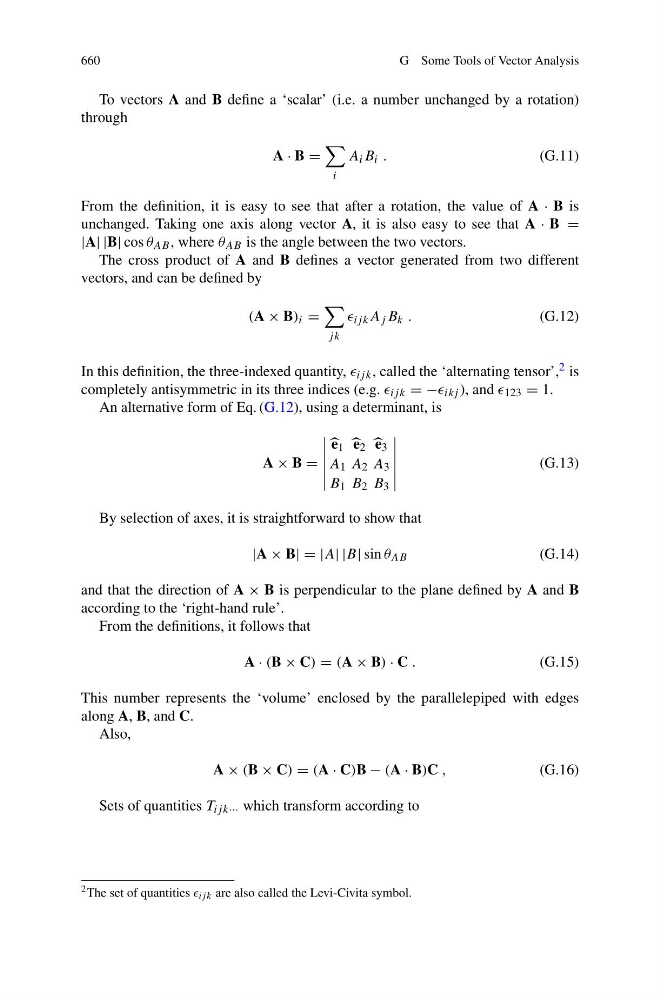
To vectors A and B define a ‘scalar’ (i.e. a number unchanged by a rotation)
through
A · B =
i
A i B i .
(G.11)
From the definition, it is easy to see that after a rotation, the value of A · B is
unchanged. Taking one axis along vector A, it is also easy to see that A · B =
|A| |B| cos θ AB , where θ AB is the angle between the two vectors.
The cross product of A and B defines a vector generated from two different
vectors, and can be defined by
(A × B) i =
jk
ij k A j B k .
(G.12)
In this definition, the three-indexed quantity, ij k , called the ‘alternating tensor’, 2 is
completely antisymmetric in its three indices (e.g. ij k = − ikj ), and 123 = 1.
An alternative form of Eq. (G.12), using a determinant, is
A × B =
e 1 e 2 e 3
A 1 A 2 A 3
B 1 B 2 B 3
(G.13)
By selection of axes, it is straightforward to show that
|A × B| = |A| |B| sin θ AB
(G.14)
and that the direction of A × B is perpendicular to the plane defined by A and B
according to the ‘right-hand rule’.
From the definitions, it follows that
A · (B × C) = (A × B) · C .
(G.15)
This number represents the ‘volume’ enclosed by the parallelepiped with edges
along A, B, and C.
Also,
A × (B × C) = (A · C)B − (A · B)C ,
(G.16)
Sets of quantities T ij k··· which transform according to
2 The set of quantities ij k are also called the Levi-Civita symbol.