

G Some Tools of Vector Analysis
659
dx
= dx cos θ + dy sin θ
(G.5)
dy
= −dx sin θ + dy cos θ
(G.6)
dz
= dz .
(G.7)
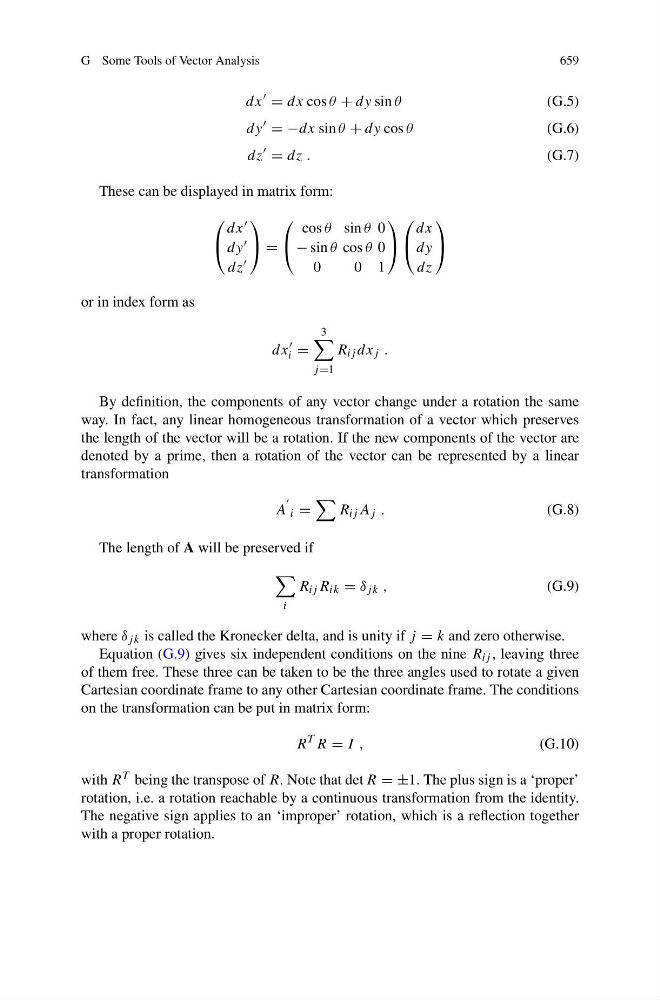
These can be displayed in matrix form:
⎛
⎝
dx
dy
dz
⎞
⎠ =
⎛
⎝
cos θ sin θ 0
− sin θ cos θ 0
0
0 1
⎞
⎠
⎛
⎝
dx
dy
dz
⎞
⎠
or in index form as
dx
i =
3
j =1
R ij dx j .
By definition, the components of any vector change under a rotation the same
way. In fact, any linear homogeneous transformation of a vector which preserves
the length of the vector will be a rotation. If the new components of the vector are
denoted by a prime, then a rotation of the vector can be represented by a linear
transformation
A
i =
R ij A j .
(G.8)
The length of A will be preserved if
i
R ij R ik = δ jk ,
(G.9)
where δ jk is called the Kronecker delta, and is unity if j = k and zero otherwise.
Equation (G.9) gives six independent conditions on the nine R ij , leaving three
of them free. These three can be taken to be the three angles used to rotate a given
Cartesian coordinate frame to any other Cartesian coordinate frame. The conditions
on the transformation can be put in matrix form:
R
T R = I ,
(G.10)
with R T being the transpose of R. Note that det R = ±1. The plus sign is a ‘proper’
rotation, i.e. a rotation reachable by a continuous transformation from the identity.
The negative sign applies to an ‘improper’ rotation, which is a reflection together
with a proper rotation.