

658
G Some Tools of Vector Analysis
h 1
h 2
h 3
dx 1
dx 2
dx 3 e 1 e 2
e 3
Cartesian
1
1
1
dx
dy
dz
i
j
k
Cylindrical
1
ρ
1
dρ
dϕ
dz
u r u ϕ u z
Spherical polar 1
r sin θ
r
dr
dϕ
dθ
u r u ϕ u θ
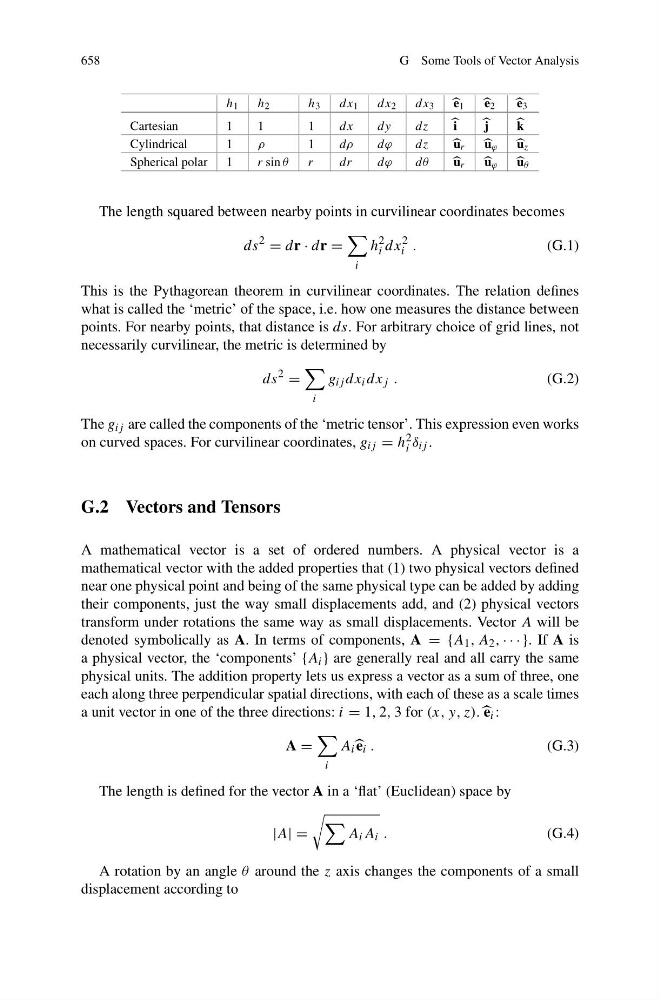
The length squared between nearby points in curvilinear coordinates becomes
ds
2
= dr · dr =
i
h
2
i dx
2
i .
(G.1)
This is the Pythagorean theorem in curvilinear coordinates. The relation defines
what is called the ‘metric’ of the space, i.e. how one measures the distance between
points. For nearby points, that distance is ds. For arbitrary choice of grid lines, not
necessarily curvilinear, the metric is determined by
ds
2
=
i
g ij dx i dx j .
(G.2)
The g ij are called the components of the ‘metric tensor’. This expression even works
on curved spaces. For curvilinear coordinates, g ij = h 2
i δ ij .
G.2 Vectors and Tensors
A mathematical vector is a set of ordered numbers. A physical vector is a
mathematical vector with the added properties that (1) two physical vectors defined
near one physical point and being of the same physical type can be added by adding
their components, just the way small displacements add, and (2) physical vectors
transform under rotations the same way as small displacements. Vector A will be
denoted symbolically as A. In terms of components, A = {A 1 , A 2 , · · · }. If A is
a physical vector, the ‘components’ {A i } are generally real and all carry the same
physical units. The addition property lets us express a vector as a sum of three, one
each along three perpendicular spatial directions, with each of these as a scale times
a unit vector in one of the three directions: i = 1, 2, 3 for (x, y, z). e i :
A =
i
A i e i .
(G.3)
The length is defined for the vector A in a ‘flat’ (Euclidean) space by
|A| =
A i A i .
(G.4)
A rotation by an angle θ around the z axis changes the components of a small
displacement according to