

662
G Some Tools of Vector Analysis
We see that there are only three kinds of tensors which can be constructed from
a product of two vectors A and B, and which are not mixed by transformations
which rotate the coordinate frame: (1) A scalar A · B, (2) A vector, A × B, and
(3) A symmetric traceless tensor (1/2)(AB + BA) − (1/3) (A · B) I. (Here, I is the
Kronecker-delta tensor.)
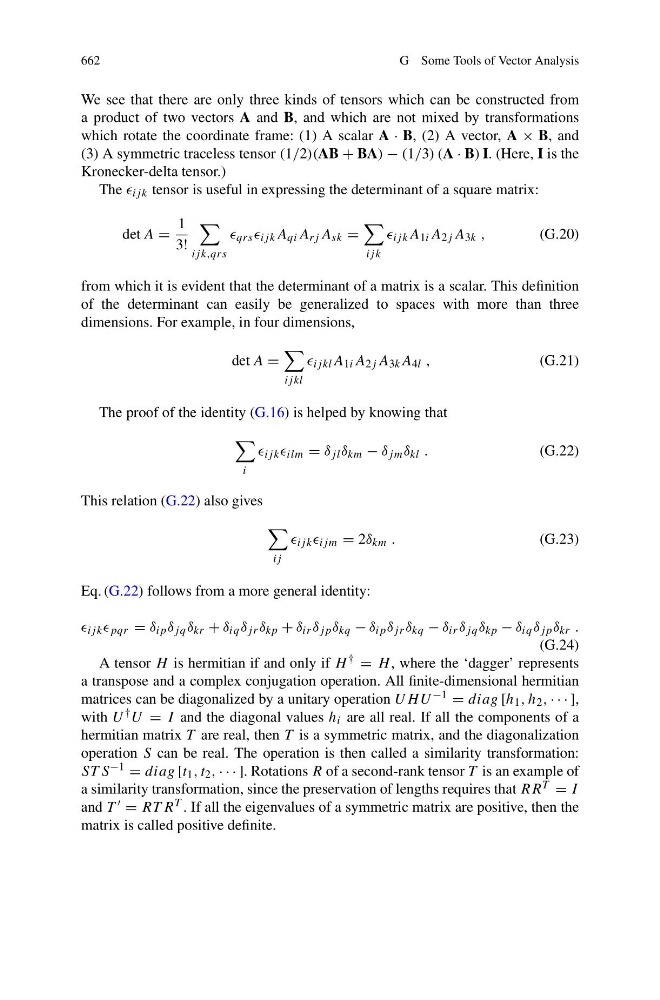
The ij k tensor is useful in expressing the determinant of a square matrix:
det A =
1
3!
ij k,qrs
qrs ij k A qi A rj A sk =
ij k
ij k A 1i A 2j A 3k ,
(G.20)
from which it is evident that the determinant of a matrix is a scalar. This definition
of the determinant can easily be generalized to spaces with more than three
dimensions. For example, in four dimensions,
det A =
ij kl
ij kl A 1i A 2j A 3k A 4l ,
(G.21)
The proof of the identity (G.16) is helped by knowing that
i
ij k ilm = δ jl δ km − δ jm δ kl .
(G.22)
This relation (G.22) also gives
ij
ij k ij m = 2δ km .
(G.23)
Eq. (G.22) follows from a more general identity:
ij k pqr = δ ip δ jq δ kr + δ iq δ jr δ kp + δ ir δ jp δ kq − δ ip δ jr δ kq − δ ir δ jq δ kp − δ iq δ jp δ kr .
(G.24)
A tensor H is hermitian if and only if H † = H , where the ‘dagger’ represents
a transpose and a complex conjugation operation. All finite-dimensional hermitian
matrices can be diagonalized by a unitary operation UH U −1 = diag [h 1 , h 2 , · · · ],
with U † U = I and the diagonal values h i are all real. If all the components of a
hermitian matrix T are real, then T is a symmetric matrix, and the diagonalization
operation S can be real. The operation is then called a similarity transformation:
ST S −1 = diag [t 1 , t 2 , · · · ]. Rotations R of a second-rank tensor T is an example of
a similarity transformation, since the preservation of lengths requires that RR T = I
and T = RT R T . If all the eigenvalues of a symmetric matrix are positive, then the
matrix is called positive definite.