

654
F The Planck Distribution
=
hf
e βhf − 1
.
(F.2)
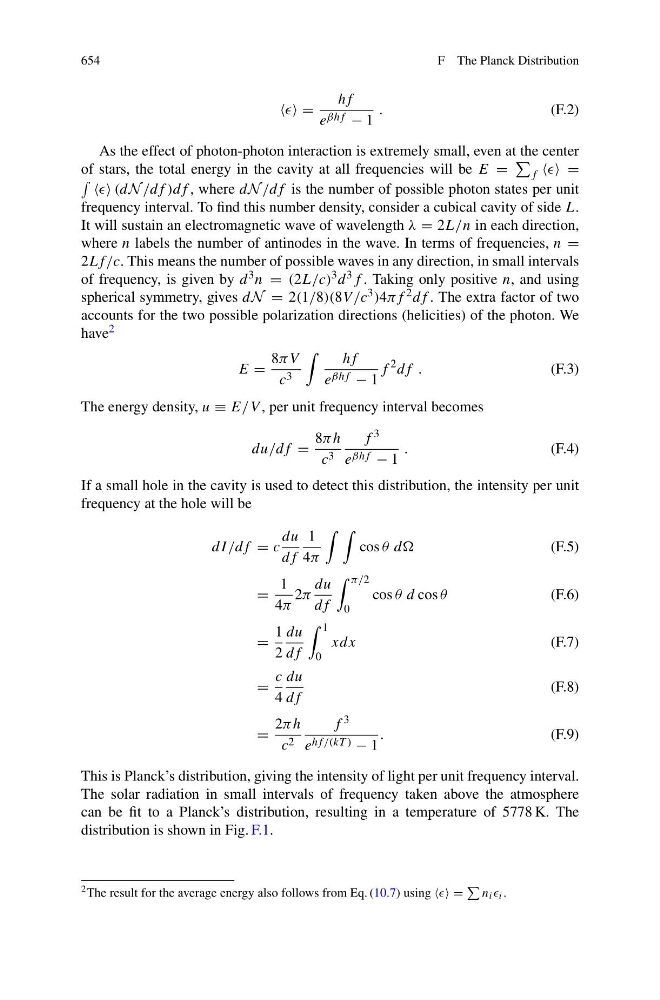
As the effect of photon-photon interaction is extremely small, even at the center
of stars, the total energy in the cavity at all frequencies will be E =
f =
(dN /df )df , where dN /df is the number of possible photon states per unit
frequency interval. To find this number density, consider a cubical cavity of side L.
It will sustain an electromagnetic wave of wavelength λ = 2L/n in each direction,
where n labels the number of antinodes in the wave. In terms of frequencies, n =
2Lf/c. This means the number of possible waves in any direction, in small intervals
of frequency, is given by d 3 n = (2L/c) 3 d 3 f . Taking only positive n, and using
spherical symmetry, gives dN = 2(1/8)(8V /c 3 )4πf 2 df . The extra factor of two
accounts for the two possible polarization directions (helicities) of the photon. We
have 2
E =
8πV
c 3
hf
e βhf − 1
f
2 df .
(F.3)
The energy density, u ≡ E/V , per unit frequency interval becomes
du/df =
8πh
c 3
f 3
e βhf − 1
.
(F.4)
If a small hole in the cavity is used to detect this distribution, the intensity per unit
frequency at the hole will be
dI/df = c
du
df
1
4π
cos θ dd
(F.5)
=
1
4π
2π
du
df
π/2
0
cos θ d cos θ
(F.6)
=
1
2
du
df
1
0
xdx
(F.7)
=
c
4
du
df
(F.8)
=
2πh
c 2
f 3
e hf/(kT ) − 1
.
(F.9)
This is Planck’s distribution, giving the intensity of light per unit frequency interval.
The solar radiation in small intervals of frequency taken above the atmosphere
can be fit to a Planck’s distribution, resulting in a temperature of 5778 K. The
distribution is shown in Fig. F.1.
2 The result for the average energy also follows from Eq. (10.7) using =
n i i .