

Appendix F
The Planck Distribution
We have no right to assume that any physical laws exist.
— Max Planck
In 1900, Max Planck was the first to explain the distribution of light coming from
a hot body. (If all the chemical color of an object is removed, making it black,
it still radiates, so the hot-body radiation is also called ‘black-body radiation’.)
Before 1900, classical Maxwell theory and thermodynamics could not explain the
distribution of frequencies emitted by a hot body. In fact, classical theory predicts
that a hot body radiates at very high frequencies. This was not seen. Also, the body
would very quickly radiate all its internal thermal energy, dropping in temperature
to absolute zero, far faster than observed cooling rates.
Consider a macroscopic cavity surrounded by a material kept at temperature
T . The atomic vibration within ordinary material will generate electromagnetic
waves, which will permeate the cavity. The radiation will also be absorbed by
the walls of the cavity, so that an equilibrium will be established between the
radiation and the vibrating charges. If those vibrations are thermal, then we should
expect, according to Boltzmann, that various modes of vibration are excited, with a
distribution proportional to exp (−ββ i ), where the possible energies are indexed by
i. This means the average energy in the photons for each possible photon frequency
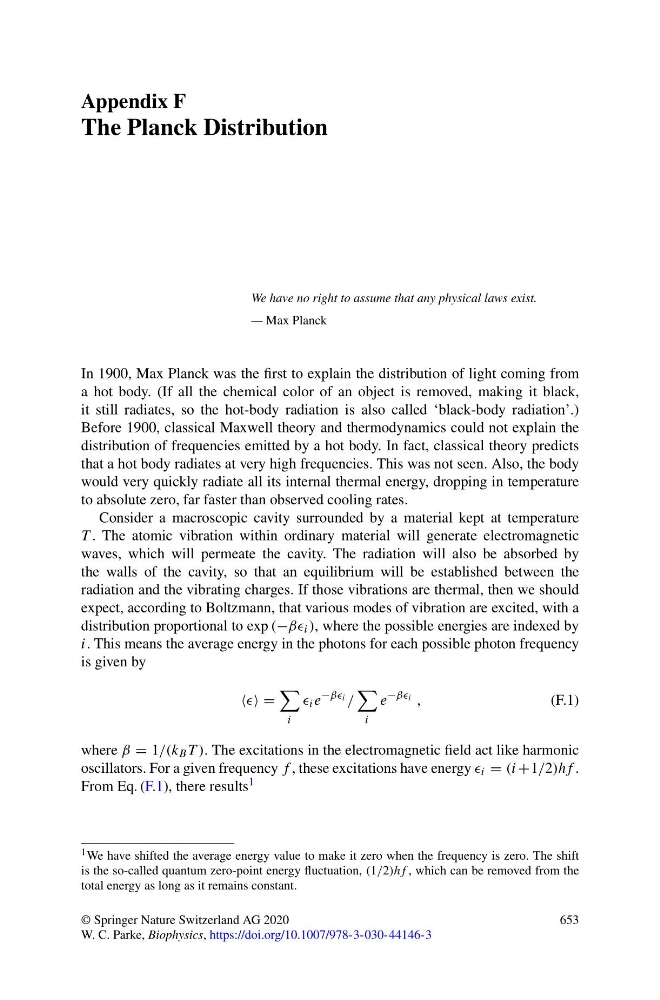
is given by
=
i
i e
−ββ i /
i
e
−ββ i ,
(F.1)
where β = 1/(k B T ). The excitations in the electromagnetic field act like harmonic
oscillators. For a given frequency f , these excitations have energy i = (i +1/2)hf .
From Eq. (F.1), there results 1
1 We have shifted the average energy value to make it zero when the frequency is zero. The shift
is the so-called quantum zero-point energy fluctuation, (1/2)hf , which can be removed from the
total energy as long as it remains constant.
© Springer Nature Switzerland AG 2020
W. C. Parke, Biophysics, https://doi.org/10.1007/978-3-030-44146-3
653