

F The Planck Distribution
655
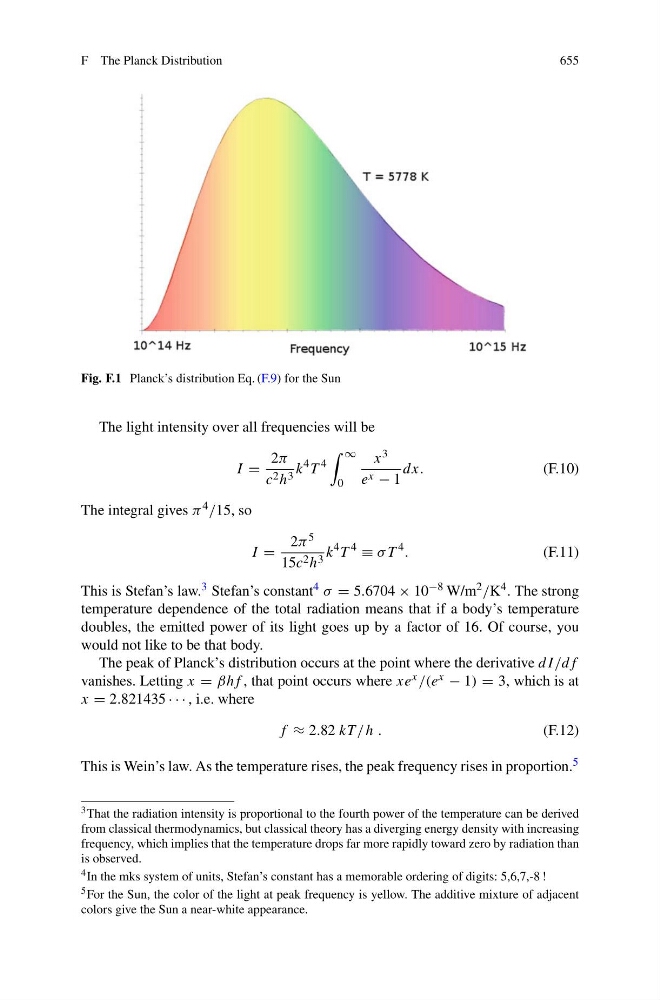
Fig. F.1 Planck’s distribution Eq. (F.9) for the Sun
The light intensity over all frequencies will be
I =
2π
c 2 h 3 k
4 T
4
∞
0
x 3
e x − 1
dx.
(F.10)
The integral gives π 4 /15, so
I =
2π 5
15c 2 h 3 k
4 T
4
≡ σ T
4 .
(F.11)
This is Stefan’s law. 3 Stefan’s constant 4 σ = 5.6704 × 10 −8 W/m 2 /K 4 . The strong
temperature dependence of the total radiation means that if a body’s temperature
doubles, the emitted power of its light goes up by a factor of 16. Of course, you
would not like to be that body.
The peak of Planck’s distribution occurs at the point where the derivative dI/df
vanishes. Letting x = βhf , that point occurs where xe x /(e x − 1) = 3, which is at
x = 2.821435 · · · , i.e. where
f ≈ 2.82 kT / h .
(F.12)
This is Wein’s law. As the temperature rises, the peak frequency rises in proportion. 5
3 That the radiation intensity is proportional to the fourth power of the temperature can be derived
from classical thermodynamics, but classical theory has a diverging energy density with increasing
frequency, which implies that the temperature drops far more rapidly toward zero by radiation than
is observed.
4 In the mks system of units, Stefan’s constant has a memorable ordering of digits: 5,6,7,-8 !
5 For the Sun, the color of the light at peak frequency is yellow. The additive mixture of adjacent
colors give the Sun a near-white appearance.