

566
13 Modeling Biological Systems
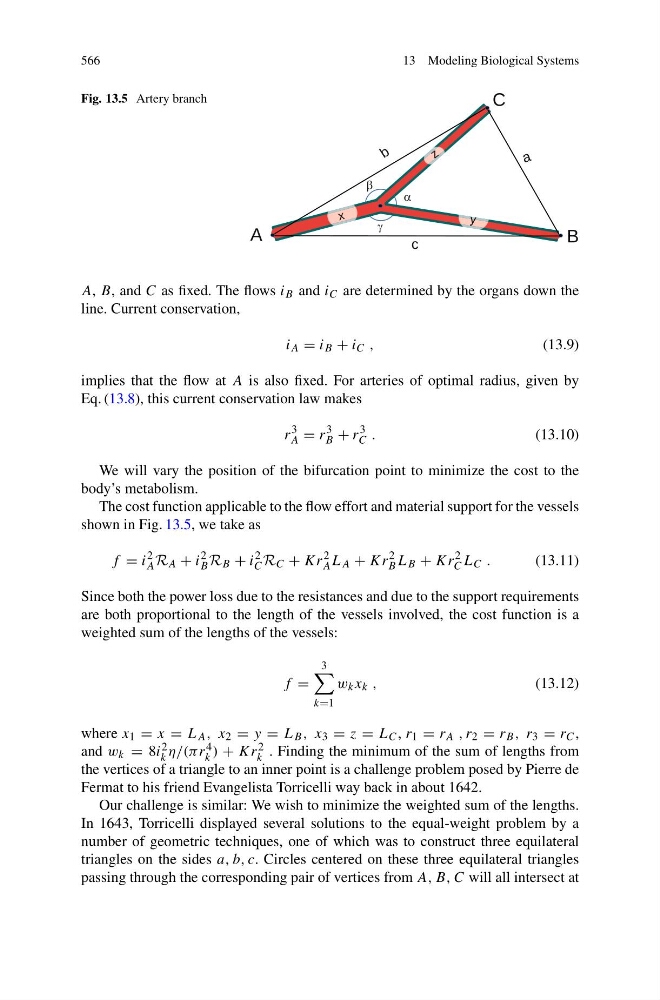
Fig. 13.5 Artery branch
y
A, B, and C as fixed. The flows i B and i C are determined by the organs down the
line. Current conservation,
i A = i B + i C ,
(13.9)
implies that the flow at A is also fixed. For arteries of optimal radius, given by
Eq. (13.8), this current conservation law makes
r
3
A = r
3
B + r
3
C .
(13.10)
We will vary the position of the bifurcation point to minimize the cost to the
body’s metabolism.
The cost function applicable to the flow effort and material support for the vessels
shown in Fig. 13.5, we take as
f = i
2
A R A + i
2
B R B + i
2
C R C + Kr
2
A L A + Kr
2
B L B + Kr
2
C L C .
(13.11)
Since both the power loss due to the resistances and due to the support requirements
are both proportional to the length of the vessels involved, the cost function is a
weighted sum of the lengths of the vessels:
f =
3
k=1
w k x k ,
(13.12)
where x 1 = x = L A , x 2 = y = L B , x 3 = z = L C , r 1 = r A , r 2 = r B , r 3 = r C ,
and w k = 8i 2
k η/(πr 4
k ) + Kr 2
k . Finding the minimum of the sum of lengths from
the vertices of a triangle to an inner point is a challenge problem posed by Pierre de
Fermat to his friend Evangelista Torricelli way back in about 1642.
Our challenge is similar: We wish to minimize the weighted sum of the lengths.
In 1643, Torricelli displayed several solutions to the equal-weight problem by a
number of geometric techniques, one of which was to construct three equilateral
triangles on the sides a, b, c. Circles centered on these three equilateral triangles
passing through the corresponding pair of vertices from A, B, C will all intersect at