

13.3 Optimality Conditions
565
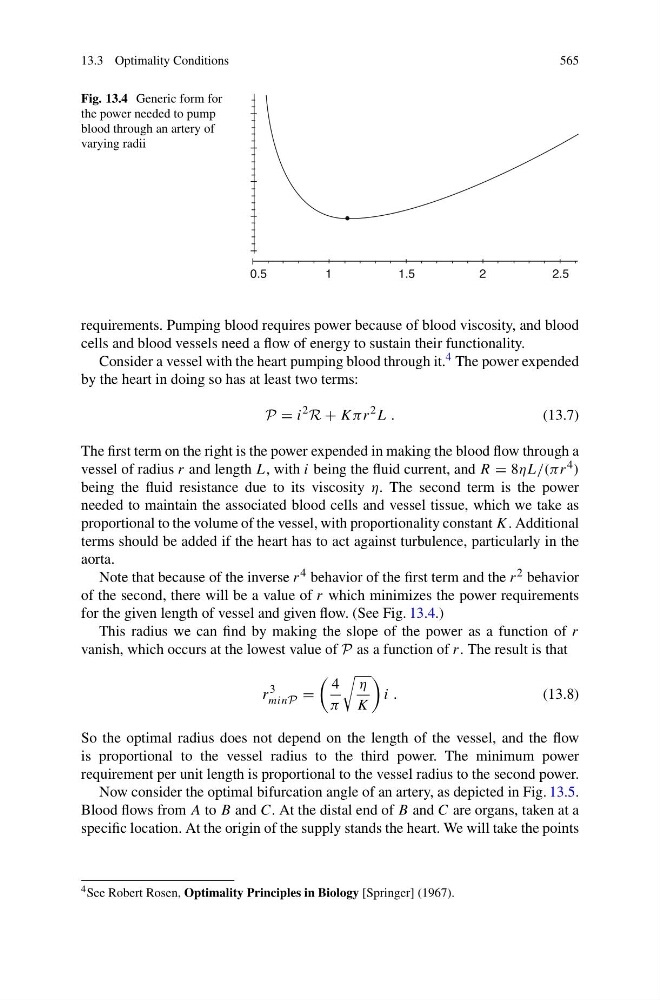
Fig. 13.4 Generic form for
the power needed to pump
blood through an artery of
varying radii
0.5
1
1.5
2
2.5
requirements. Pumping blood requires power because of blood viscosity, and blood
cells and blood vessels need a flow of energy to sustain their functionality.
Consider a vessel with the heart pumping blood through it. 4 The power expended
by the heart in doing so has at least two terms:
P = i
2
R + Kπr
2 L .
(13.7)
The first term on the right is the power expended in making the blood flow through a
vessel of radius r and length L, with i being the fluid current, and R = 8ηL/(πr 4 )
being the fluid resistance due to its viscosity η. The second term is the power
needed to maintain the associated blood cells and vessel tissue, which we take as
proportional to the volume of the vessel, with proportionality constant K. Additional
terms should be added if the heart has to act against turbulence, particularly in the
aorta.
Note that because of the inverse r 4 behavior of the first term and the r 2 behavior
of the second, there will be a value of r which minimizes the power requirements
for the given length of vessel and given flow. (See Fig. 13.4.)
This radius we can find by making the slope of the power as a function of r
vanish, which occurs at the lowest value of P as a function of r. The result is that
r
3
minP =
4
π
η
K
i .
(13.8)
So the optimal radius does not depend on the length of the vessel, and the flow
is proportional to the vessel radius to the third power. The minimum power
requirement per unit length is proportional to the vessel radius to the second power.
Now consider the optimal bifurcation angle of an artery, as depicted in Fig. 13.5.
Blood flows from A to B and C. At the distal end of B and C are organs, taken at a
specific location. At the origin of the supply stands the heart. We will take the points
4 See Robert Rosen, Optimality Principles in Biology [Springer] (1967).