

11.7 Weak Molecular Interactions
531
11.7.3 Charge-Induced Dipole Interactions
If an ion of charge q approaches a non-polar molecule, it will cause a change in the
separation of centers for positive and negative charges in the molecule. The induced
dipole moment μ should be proportional to the external field of the ion: d = αE.
The energy stored in the process of making the dipole, starting with a weak field, is
then −
αEdE or
V qα (r) = −(1/2)αE
2
= −(1/2)αk
2 q
2 /r
4 .
It follows that the force between the ion and the molecule will vary with r as r −5 .
11.7.4 Dipole-Dipole Interactions
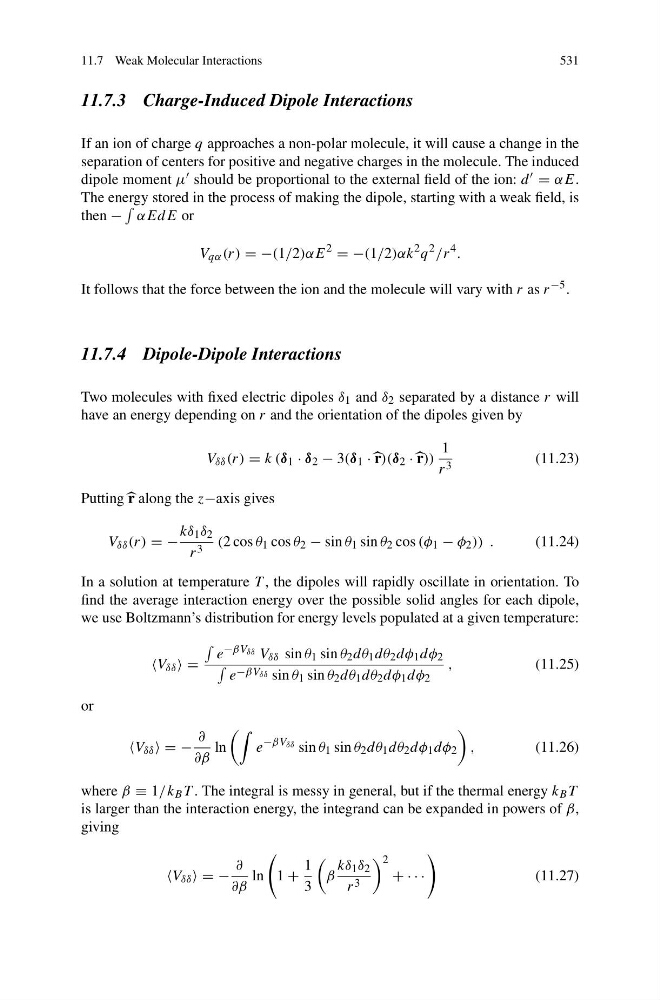
Two molecules with fixed electric dipoles δ 1 and δ 2 separated by a distance r will
have an energy depending on r and the orientation of the dipoles given by
V δδ (r) = k (δ 1 · δ 2 − 3(δ 1 · r)(δ 2 · r))
1
r 3
(11.23)
Putting r along the z−axis gives
V δδ (r) = −
kδ 1 δ 2
r 3 (2 cos θ 1 cos θ 2 − sin θ 1 sin θ 2 cos (φ 1 − φ 2 )) .
(11.24)
In a solution at temperature T , the dipoles will rapidly oscillate in orientation. To
find the average interaction energy over the possible solid angles for each dipole,
we use Boltzmann’s distribution for energy levels populated at a given temperature:
V δδ =
e −βV δδ V δδ sin θ 1 sin θ 2 dθ 1 dθ 2 dφ 1 dφ 2
e −βV δδ sin θ 1 sin θ 2 dθ 1 dθ 2 dφ 1 dφ 2
,
(11.25)
or
V δδ = −
∂
∂β
ln
e
−βV δδ sin θ 1 sin θ 2 dθ 1 dθ 2 dφ 1 dφ 2
,
(11.26)
where β ≡ 1/k B T . The integral is messy in general, but if the thermal energy k B T
is larger than the interaction energy, the integrand can be expanded in powers of β,
giving
V δδ = −
∂
∂β
ln
1 +
1
3
β
kδ 1 δ 2
r 3
2
+ · · ·
(11.27)