

532
11 Biomolecular Structure and Interactions
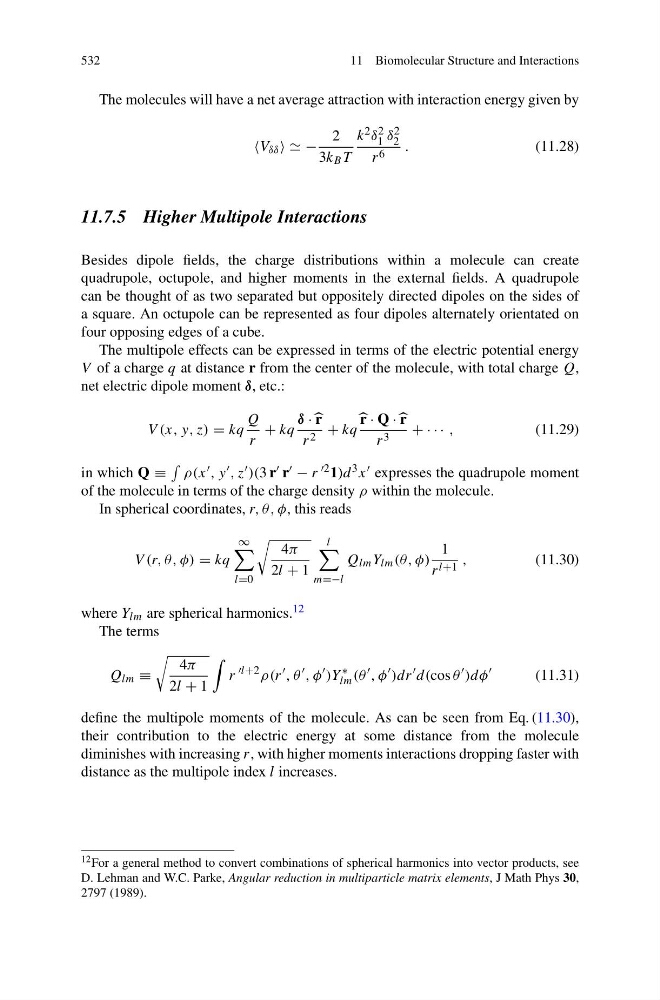
The molecules will have a net average attraction with interaction energy given by
V δδ −
2
3k B T
k 2 δ 2
1 δ 2
2
r 6 .
(11.28)
11.7.5 Higher Multipole Interactions
Besides dipole fields, the charge distributions within a molecule can create
quadrupole, octupole, and higher moments in the external fields. A quadrupole
can be thought of as two separated but oppositely directed dipoles on the sides of
a square. An octupole can be represented as four dipoles alternately orientated on
four opposing edges of a cube.
The multipole effects can be expressed in terms of the electric potential energy
V of a charge q at distance r from the center of the molecule, with total charge Q,
net electric dipole moment δ, etc.:
V (x, y, z) = kq
Q
r
+ kq
δ · r
r 2 + kq
r · Q · r
r 3 + · · · ,
(11.29)
in which Q ≡
ρ(x , y , z )(3 r r − r 2 1)d 3 x expresses the quadrupole moment
of the molecule in terms of the charge density ρ within the molecule.
In spherical coordinates, r, θ, φ, this reads
V (r, θ, φ) = kq
∞
l=0
4π
2l + 1
l
m=−l
Q lm Y lm (θ, φ)
1
r l+1 ,
(11.30)
where Y lm are spherical harmonics. 12
The terms
Q lm ≡
4π
2l + 1
r
l+2 ρ(r
, θ
, φ
)Y
∗
lm (θ
, φ
)dr
d(cos θ
)dφ
(11.31)
define the multipole moments of the molecule. As can be seen from Eq. (11.30),
their contribution to the electric energy at some distance from the molecule
diminishes with increasing r, with higher moments interactions dropping faster with
distance as the multipole index l increases.
12 For a general method to convert combinations of spherical harmonics into vector products, see
D. Lehman and W.C. Parke, Angular reduction in multiparticle matrix elements, J Math Phys 30,
2797 (1989).