

530
11 Biomolecular Structure and Interactions
ions will show a deviation from Coulomb’s law, since the orbitals from one ion to
the next will be partially overlapping. A valence electron in the chlorine will now
sometimes be found near the sodium, forming a ‘molecular orbital’.
In water, sodium and chloride ions become surrounded with water molecules,
with their polar sides facing toward or away from the ions, according to the charge
on the ions. This tends to keep the ions apart. But with increasing concentrations of
sodium and chloride ions in a water solution, salt crystals will form, with greater
binding than the separate ions bound to water in a concentrated solution. (This
crystallization process is exothermic. Others can be endothermic).
11.7 Weak Molecular Interactions
11.7.1 Hydrogen Bonding
A hydrogen bond can be formed from an atom with a number of electrons exposed
in outer orbitals (‘electronegative’ atoms), such as in oxygen or nitrogen, extending
to a hydrogen proton already bound to another molecule. A hydrogen bond is a
relatively weak bond, typically less than a quarter of an eV binding each, but
this is larger than room-temperature thermal energy, ∼1/25 eV. Water molecules
in solution form hydrogen bonds with nearby molecules.
Intramolecular hydrogen bonds can be formed, such as in proteins, in their
secondary and tertiary configurations. Along the DNA molecule, two hydrogen
bonds weakly hold adenine to thymine, and three hydrogen bonds weakly hold
guanine to cytosine, with the series of base-pair hydrogen bonds keeping the two
strands of the DNA helix together until they are locally spread for transcription of
the DNA code or unzipped during replication.
11.7.2 Charge-Dipole Interactions
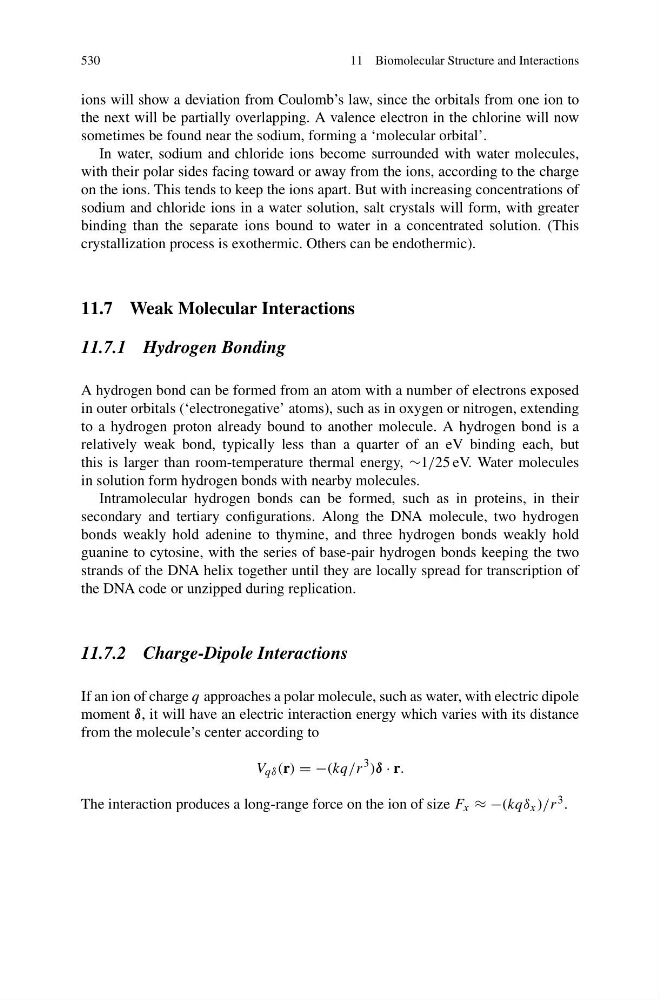
If an ion of charge q approaches a polar molecule, such as water, with electric dipole
moment δ, it will have an electric interaction energy which varies with its distance
from the molecule’s center according to
V qδ (r) = −(kq/r
3 )δ · r.
The interaction produces a long-range force on the ion of size F x ≈ −(kqδ x )/r 3 .