

11.6 Binding Interactions Between Atoms
529
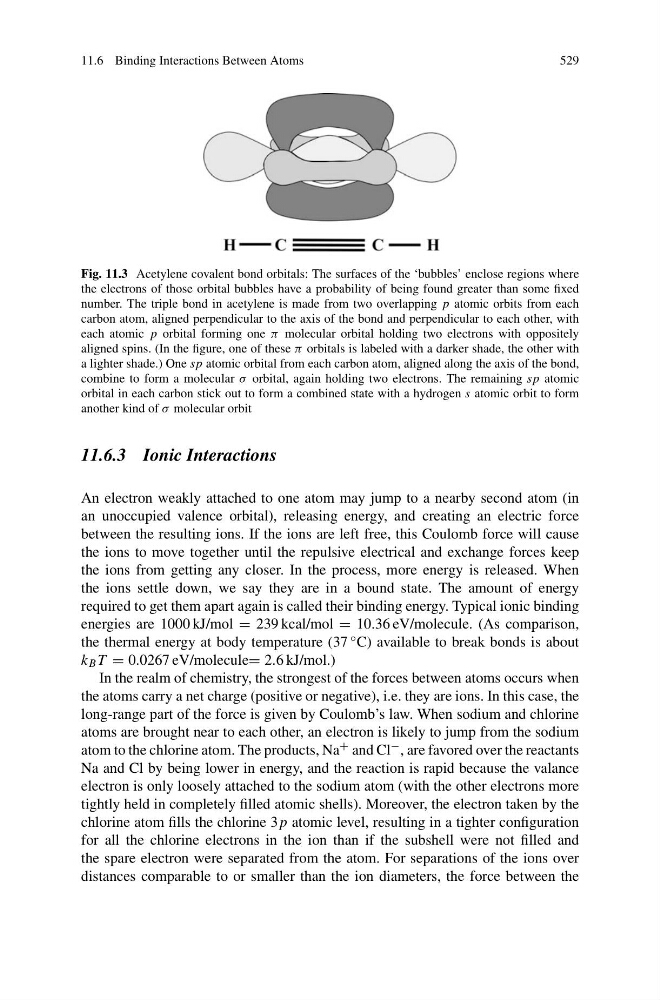
Fig. 11.3 Acetylene covalent bond orbitals: The surfaces of the ‘bubbles’ enclose regions where
the electrons of those orbital bubbles have a probability of being found greater than some fixed
number. The triple bond in acetylene is made from two overlapping p atomic orbits from each
carbon atom, aligned perpendicular to the axis of the bond and perpendicular to each other, with
each atomic p orbital forming one π molecular orbital holding two electrons with oppositely
aligned spins. (In the figure, one of these π orbitals is labeled with a darker shade, the other with
a lighter shade.) One sp atomic orbital from each carbon atom, aligned along the axis of the bond,
combine to form a molecular σ orbital, again holding two electrons. The remaining sp atomic
orbital in each carbon stick out to form a combined state with a hydrogen s atomic orbit to form
another kind of σ molecular orbit
11.6.3 Ionic Interactions
An electron weakly attached to one atom may jump to a nearby second atom (in
an unoccupied valence orbital), releasing energy, and creating an electric force
between the resulting ions. If the ions are left free, this Coulomb force will cause
the ions to move together until the repulsive electrical and exchange forces keep
the ions from getting any closer. In the process, more energy is released. When
the ions settle down, we say they are in a bound state. The amount of energy
required to get them apart again is called their binding energy. Typical ionic binding
energies are 1000 kJ/mol = 239 kcal/mol = 10.36 eV/molecule. (As comparison,
the thermal energy at body temperature (37 ◦ C) available to break bonds is about
k B T = 0.0267 eV/molecule= 2.6 kJ/mol.)
In the realm of chemistry, the strongest of the forces between atoms occurs when
the atoms carry a net charge (positive or negative), i.e. they are ions. In this case, the
long-range part of the force is given by Coulomb’s law. When sodium and chlorine
atoms are brought near to each other, an electron is likely to jump from the sodium
atom to the chlorine atom. The products, Na + and Cl − , are favored over the reactants
Na and Cl by being lower in energy, and the reaction is rapid because the valance
electron is only loosely attached to the sodium atom (with the other electrons more
tightly held in completely filled atomic shells). Moreover, the electron taken by the
chlorine atom fills the chlorine 3p atomic level, resulting in a tighter configuration
for all the chlorine electrons in the ion than if the subshell were not filled and
the spare electron were separated from the atom. For separations of the ions over
distances comparable to or smaller than the ion diameters, the force between the