

528
11 Biomolecular Structure and Interactions
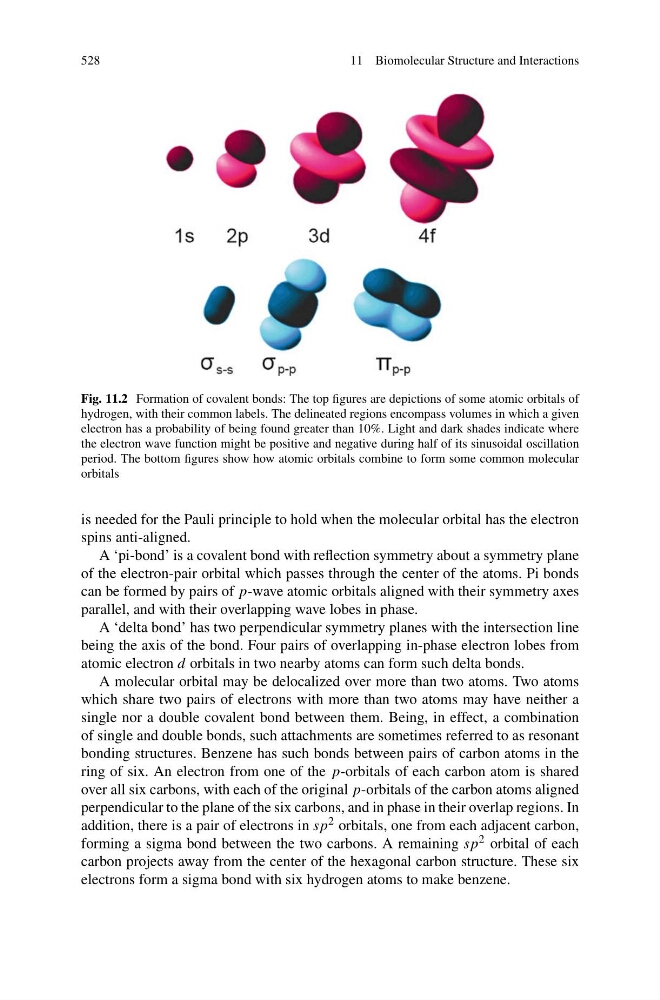
Fig. 11.2 Formation of covalent bonds: The top figures are depictions of some atomic orbitals of
hydrogen, with their common labels. The delineated regions encompass volumes in which a given
electron has a probability of being found greater than 10%. Light and dark shades indicate where
the electron wave function might be positive and negative during half of its sinusoidal oscillation
period. The bottom figures show how atomic orbitals combine to form some common molecular
orbitals
is needed for the Pauli principle to hold when the molecular orbital has the electron
spins anti-aligned.
A ‘pi-bond’ is a covalent bond with reflection symmetry about a symmetry plane
of the electron-pair orbital which passes through the center of the atoms. Pi bonds
can be formed by pairs of p-wave atomic orbitals aligned with their symmetry axes
parallel, and with their overlapping wave lobes in phase.
A ‘delta bond’ has two perpendicular symmetry planes with the intersection line
being the axis of the bond. Four pairs of overlapping in-phase electron lobes from
atomic electron d orbitals in two nearby atoms can form such delta bonds.
A molecular orbital may be delocalized over more than two atoms. Two atoms
which share two pairs of electrons with more than two atoms may have neither a
single nor a double covalent bond between them. Being, in effect, a combination
of single and double bonds, such attachments are sometimes referred to as resonant
bonding structures. Benzene has such bonds between pairs of carbon atoms in the
ring of six. An electron from one of the p-orbitals of each carbon atom is shared
over all six carbons, with each of the original p-orbitals of the carbon atoms aligned
perpendicular to the plane of the six carbons, and in phase in their overlap regions. In
addition, there is a pair of electrons in sp 2 orbitals, one from each adjacent carbon,
forming a sigma bond between the two carbons. A remaining sp 2 orbital of each
carbon projects away from the center of the hexagonal carbon structure. These six
electrons form a sigma bond with six hydrogen atoms to make benzene.