

520
11 Biomolecular Structure and Interactions
and
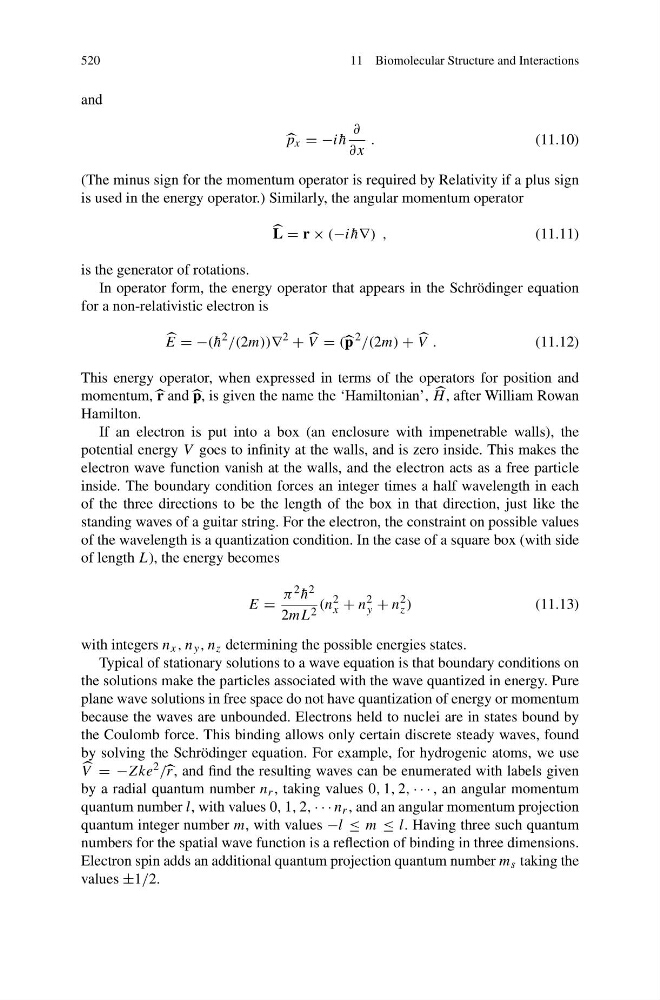
p x = −i ¯
h
∂
∂x
.
(11.10)
(The minus sign for the momentum operator is required by Relativity if a plus sign
is used in the energy operator.) Similarly, the angular momentum operator
L = r × (−i ¯
h∇) ,
(11.11)
is the generator of rotations.
In operator form, the energy operator that appears in the Schrödinger equation
for a non-relativistic electron is
E = −( ¯
h
2 /(2m))∇
2
+
V = ( p
2 /(2m) +
V .
(11.12)
This energy operator, when expressed in terms of the operators for position and
momentum, r and p, is given the name the ‘Hamiltonian’,
H , after William Rowan
Hamilton.
If an electron is put into a box (an enclosure with impenetrable walls), the
potential energy V goes to infinity at the walls, and is zero inside. This makes the
electron wave function vanish at the walls, and the electron acts as a free particle
inside. The boundary condition forces an integer times a half wavelength in each
of the three directions to be the length of the box in that direction, just like the
standing waves of a guitar string. For the electron, the constraint on possible values
of the wavelength is a quantization condition. In the case of a square box (with side
of length L), the energy becomes
E =
π 2 ¯
h 2
2mL 2 (n
2
x + n
2
y + n
2
z )
(11.13)
with integers n x , n y , n z determining the possible energies states.
Typical of stationary solutions to a wave equation is that boundary conditions on
the solutions make the particles associated with the wave quantized in energy. Pure
plane wave solutions in free space do not have quantization of energy or momentum
because the waves are unbounded. Electrons held to nuclei are in states bound by
the Coulomb force. This binding allows only certain discrete steady waves, found
by solving the Schrödinger equation. For example, for hydrogenic atoms, we use
V = −Zke 2 / r, and find the resulting waves can be enumerated with labels given
by a radial quantum number n r , taking values 0, 1, 2, · · · , an angular momentum
quantum number l, with values 0, 1, 2, · · · n r , and an angular momentum projection
quantum integer number m, with values −l ≤ m ≤ l. Having three such quantum
numbers for the spatial wave function is a reflection of binding in three dimensions.
Electron spin adds an additional quantum projection quantum number m s taking the
values ±1/2.