

11.2 Quantum Behavior of Matter
519
where E is a constant with the units of energy. (Note that the time dependence goes
away in ψ ∗ ψ.)
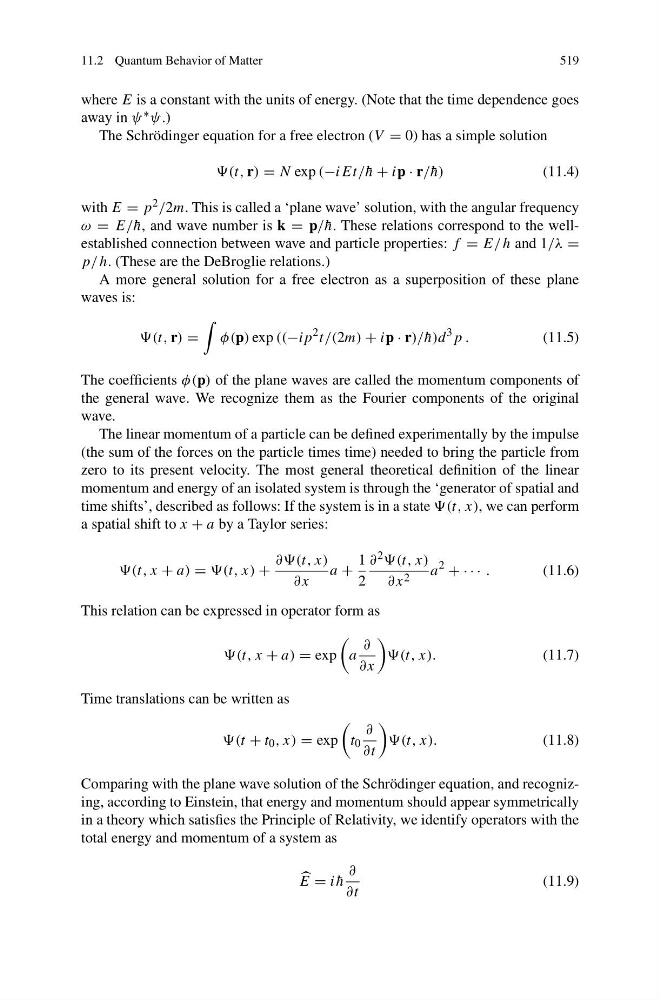
The Schrödinger equation for a free electron (V = 0) has a simple solution
r) = N exp (−iEt/ ¯
h + ip · r/ ¯
h)
(11.4)
with E = p 2 /2m. This is called a ‘plane wave’ solution, with the angular frequency
ω = E/ ¯
h, and wave number is k = p/ ¯
h. These relations correspond to the wellestablished connection between wave and particle properties: f = E/ h and 1/λ =
p/ h. (These are the DeBroglie relations.)
A more general solution for a free electron as a superposition of these plane
waves is:
r) =
φ(p) exp ((−ip
2 t/(2m) + ip · r)/ ¯
h)d
3 p .
(11.5)
The coefficients φ(p) of the plane waves are called the momentum components of
the general wave. We recognize them as the Fourier components of the original
wave.
The linear momentum of a particle can be defined experimentally by the impulse
(the sum of the forces on the particle times time) needed to bring the particle from
zero to its present velocity. The most general theoretical definition of the linear
momentum and energy of an isolated system is through the ‘generator of spatial and
time shifts’, described as follows: If the system is in a state (t, x), we can perform
a spatial shift to x + a by a Taylor series:
x + a) = (t, x) +
∂∂(t, x)
∂x
a +
1
2
∂ 2 (t, x)
∂x 2 a
2
+ · · · .
(11.6)
This relation can be expressed in operator form as
x + a) = exp
a
∂
∂x
x).
(11.7)
Time translations can be written as
(t + t 0 , x) = exp
t 0
∂
∂t
(t, x).
(11.8)
Comparing with the plane wave solution of the Schrödinger equation, and recognizing, according to Einstein, that energy and momentum should appear symmetrically
in a theory which satisfies the Principle of Relativity, we identify operators with the
total energy and momentum of a system as
E = i ¯
h
∂
∂t
(11.9)