

518
11 Biomolecular Structure and Interactions
A − A
2
≡ A. Then one can show that after repeated measurements
of a system identically initialized before measuring
A or
B, we will have
AAB ≥ (1/2)
A
B −
B
A
. The relation implies that if
A does not
commute with
B, then the measurements of
A and
B will have uncertainties
inversely related.
11. A ‘complete set of commuting observables’ is the maximal set of operators in
a quantum theory that obey
A
BB
=
B
AA
for any pair in the set. For
example, for the electrons in hydrogen, the energy
E, the square of the angular
momentum
L 2 , the angular momentum projection
L z , and the electron spin
projection
S z , form such a set. The electron wave can be indexed by giving
the eigenvalues of these operators, i.e. {E n , l(l + 1), m, m s }. Each are called a
hydrogen atomic orbital.
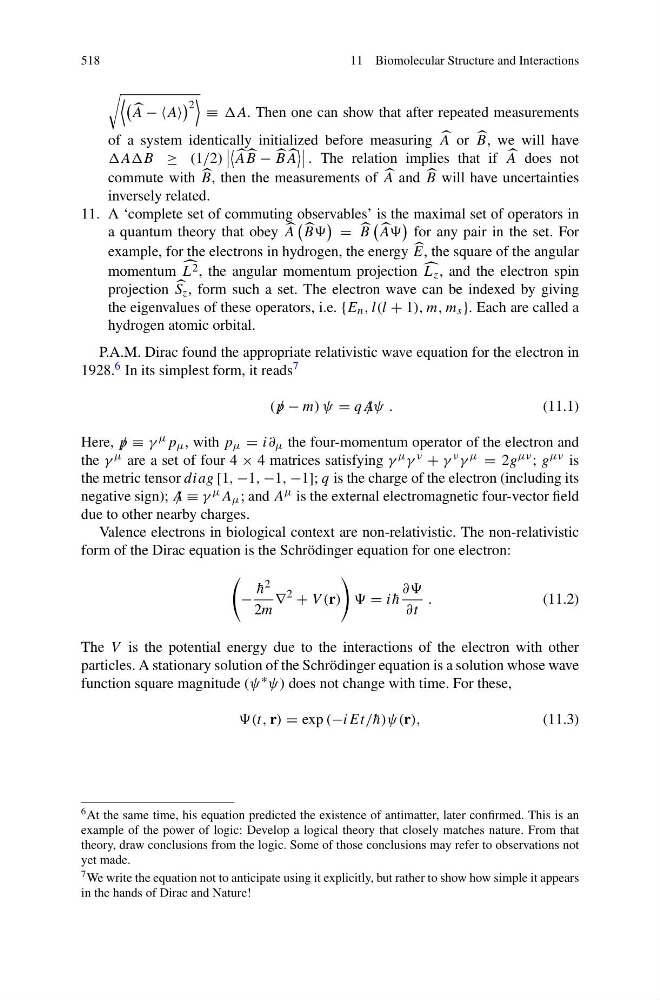
P.A.M. Dirac found the appropriate relativistic wave equation for the electron in
1928. 6 In its simplest form, it reads 7
(p / − m) ψ = qA /ψ .
(11.1)
Here, p / ≡ γ μ p μ , with p μ = i∂ μ the four-momentum operator of the electron and
the γ μ are a set of four 4 × 4 matrices satisfying γ μ γ ν + γ ν γ μ = 2g μν ; g μν is
the metric tensor diag [1, −1, −1, −1]; q is the charge of the electron (including its
negative sign); A / ≡ γ μ A μ ; and A μ is the external electromagnetic four-vector field
due to other nearby charges.
Valence electrons in biological context are non-relativistic. The non-relativistic
form of the Dirac equation is the Schrödinger equation for one electron:
−
¯
h 2
2m
∇
2
+ V (r)
= i ¯
h
∂∂
∂t
.
(11.2)
The V is the potential energy due to the interactions of the electron with other
particles. A stationary solution of the Schrödinger equation is a solution whose wave
function square magnitude (ψ ∗ ψ) does not change with time. For these,
r) = exp (−iEt/ ¯
h)ψ(r),
(11.3)
6 At the same time, his equation predicted the existence of antimatter, later confirmed. This is an
example of the power of logic: Develop a logical theory that closely matches nature. From that
theory, draw conclusions from the logic. Some of those conclusions may refer to observations not
yet made.
7 We write the equation not to anticipate using it explicitly, but rather to show how simple it appears
in the hands of Dirac and Nature!