

11.3 Atomic Structure
521
11.3 Atomic Structure
Common sense is the layer of prejudices put down before the age of eighteen.
— Albert Einstein
We can predict the structure of atoms and molecules from electrical interactions
and quantum theory. (Magnetic interactions have only a minor role in structure.)
Nuclei of atoms have a mass much larger than the surrounding electrons. The
electrons are electrically attracted to the nuclei, but are prevented from radiating
away their energy and being ‘sucked’ into the nucleus because of their quantum
wave properties: The nucleus is just too small to contain the wave for such a light
particle. 8
The simplest atomic structure is that of the hydrogen atom. The electron waves
satisfy the Schrödinger equation. The electron in a hydrogen atom is acted on by the
central proton through an electric (Coulombic) field produced by that proton. Since
the proton is almost 2000 times the mass of the electron, the proton hardly wiggles
as the electron moves around it. A good approximation is then to assume the proton
is at rest. The potential energy of the electron in the electric field of the proton is then
V (r) = −ke 2 /r. (In the mks system of units, k = 1/(4ππ o ) ≈ 9 × 10 9 J/(mC
2 ).)
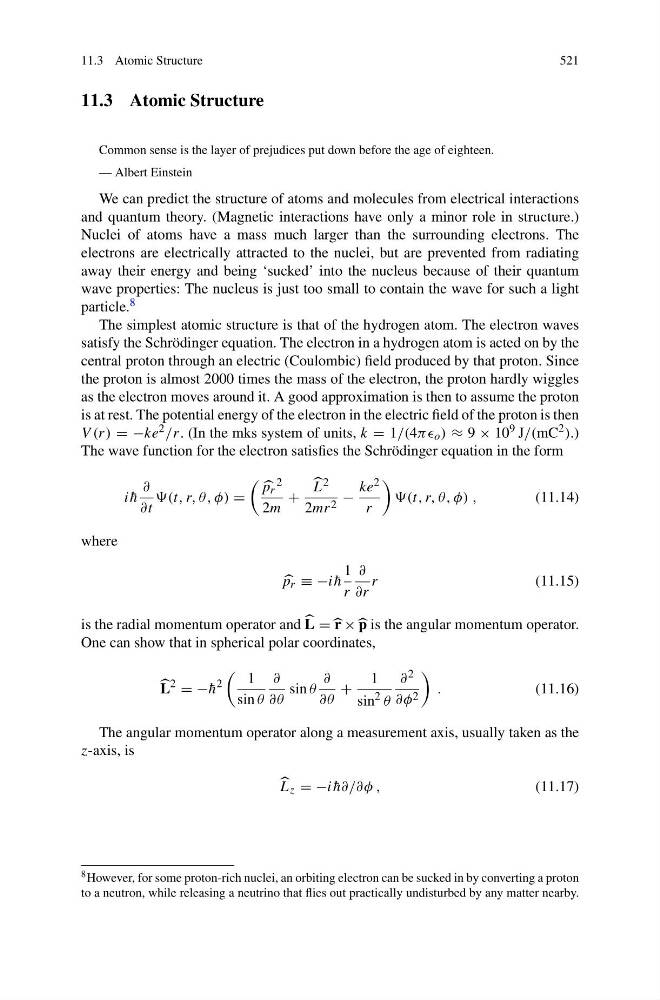
The wave function for the electron satisfies the Schrödinger equation in the form
i ¯
h
∂
∂t
r, θ, φ) =
p r
2
2m
+
L 2
2mr 2 −
ke 2
r
(t, r, θ, φ) ,
(11.14)
where
p r ≡ −i ¯
h
1
r
∂
∂r
r
(11.15)
is the radial momentum operator and L = r × p is the angular momentum operator.
One can show that in spherical polar coordinates,
L
2
= − ¯
h
2
1
sin θ
∂
∂θ
sin θ
∂
∂θ
+
1
sin
2 θ
∂ 2
∂φ 2
.
(11.16)
The angular momentum operator along a measurement axis, usually taken as the
z-axis, is
L z = −i ¯
h∂/∂φ ,
(11.17)
8 However, for some proton-rich nuclei, an orbiting electron can be sucked in by converting a proton
to a neutron, while releasing a neutrino that flies out practically undisturbed by any matter nearby.