

494
10 The Statistical Basis of Bioenergetics
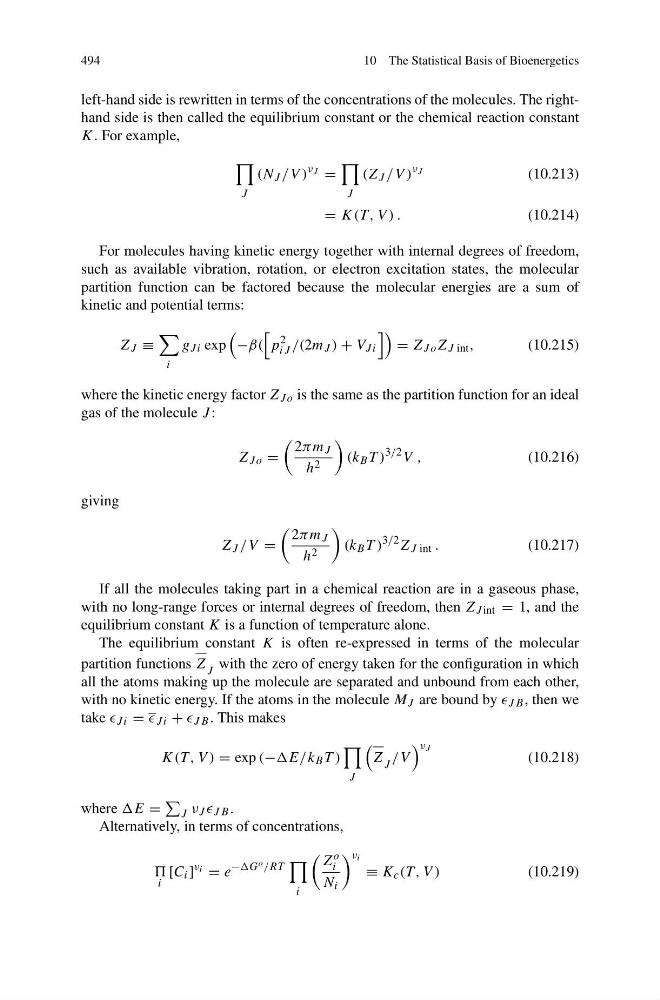
left-hand side is rewritten in terms of the concentrations of the molecules. The righthand side is then called the equilibrium constant or the chemical reaction constant
K. For example,
J
(N J /V )
ν J =
J
(Z J /V )
ν J
(10.213)
= K(T , V ) .
(10.214)
For molecules having kinetic energy together with internal degrees of freedom,
such as available vibration, rotation, or electron excitation states, the molecular
partition function can be factored because the molecular energies are a sum of
kinetic and potential terms:
Z J ≡
i
g J i exp
−β(
p
2
iJ /(2m J ) + V J i
= Z J o Z J int ,
(10.215)
where the kinetic energy factor Z J o is the same as the partition function for an ideal
gas of the molecule J :
Z J o =
2πm J
h 2
(k B T )
3/2 V ,
(10.216)
giving
Z J /V =
2πm J
h 2
(k B T )
3/2 Z J int .
(10.217)
If all the molecules taking part in a chemical reaction are in a gaseous phase,
with no long-range forces or internal degrees of freedom, then Z J int = 1, and the
equilibrium constant K is a function of temperature alone.
The equilibrium constant K is often re-expressed in terms of the molecular
partition functions Z J with the zero of energy taken for the configuration in which
all the atoms making up the molecule are separated and unbound from each other,
with no kinetic energy. If the atoms in the molecule M J are bound by J B , then we
take J i = J i + J B . This makes
K(T , V ) = exp (− B T )
J
Z J /V
ν J
(10.218)
where E =
J ν J J B .
Alternatively, in terms of concentrations,
i
[C i ]
ν i = e
−G o /RT
i
Z o
i
N i
ν i
≡ K c (T , V )
(10.219)
10 The Statistical Basis of Bioenergetics
left-hand side is rewritten in terms of the concentrations of the molecules. The righthand side is then called the equilibrium constant or the chemical reaction constant
K. For example,
J
(N J /V )
ν J =
J
(Z J /V )
ν J
(10.213)
= K(T , V ) .
(10.214)
For molecules having kinetic energy together with internal degrees of freedom,
such as available vibration, rotation, or electron excitation states, the molecular
partition function can be factored because the molecular energies are a sum of
kinetic and potential terms:
Z J ≡
i
g J i exp
−β(
p
2
iJ /(2m J ) + V J i
= Z J o Z J int ,
(10.215)
where the kinetic energy factor Z J o is the same as the partition function for an ideal
gas of the molecule J :
Z J o =
2πm J
h 2
(k B T )
3/2 V ,
(10.216)
giving
Z J /V =
2πm J
h 2
(k B T )
3/2 Z J int .
(10.217)
If all the molecules taking part in a chemical reaction are in a gaseous phase,
with no long-range forces or internal degrees of freedom, then Z J int = 1, and the
equilibrium constant K is a function of temperature alone.
The equilibrium constant K is often re-expressed in terms of the molecular
partition functions Z J with the zero of energy taken for the configuration in which
all the atoms making up the molecule are separated and unbound from each other,
with no kinetic energy. If the atoms in the molecule M J are bound by J B , then we
take J i = J i + J B . This makes
K(T , V ) = exp (− B T )
J
Z J /V
ν J
(10.218)
where E =
J ν J J B .
Alternatively, in terms of concentrations,
i
[C i ]
ν i = e
−G o /RT
i
Z o
i
N i
ν i
≡ K c (T , V )
(10.219)