

10.9 Statistics Applied to Biochemical Reactions
495
where the Z o
i /N i are calculated at a standard state for which the concentration of
type labeled by ‘i’ is well-defined. Remember that the stoichiometric coefficients
ν i give the number of molecules of reactants (taken here with negative values) or
products (taken with positive values). So
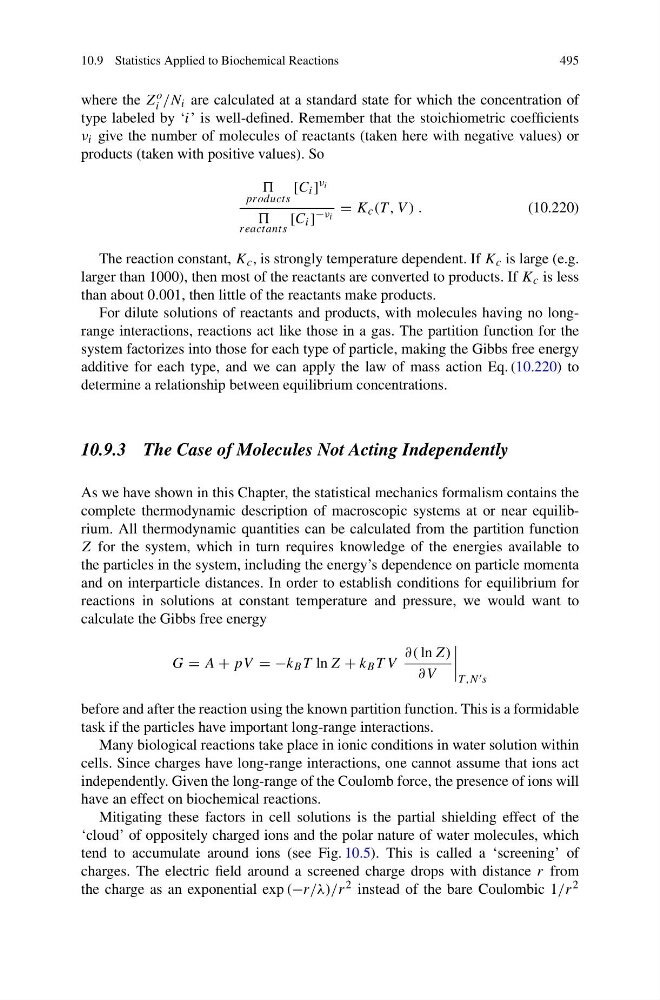
products
[C i ]
ν i
reactants
[C i ]
−ν i
= K c (T , V ) .
(10.220)
The reaction constant, K c , is strongly temperature dependent. If K c is large (e.g.
larger than 1000), then most of the reactants are converted to products. If K c is less
than about 0.001, then little of the reactants make products.
For dilute solutions of reactants and products, with molecules having no longrange interactions, reactions act like those in a gas. The partition function for the
system factorizes into those for each type of particle, making the Gibbs free energy
additive for each type, and we can apply the law of mass action Eq. (10.220) to
determine a relationship between equilibrium concentrations.
10.9.3 The Case of Molecules Not Acting Independently
As we have shown in this Chapter, the statistical mechanics formalism contains the
complete thermodynamic description of macroscopic systems at or near equilibrium. All thermodynamic quantities can be calculated from the partition function
Z for the system, which in turn requires knowledge of the energies available to
the particles in the system, including the energy’s dependence on particle momenta
and on interparticle distances. In order to establish conditions for equilibrium for
reactions in solutions at constant temperature and pressure, we would want to
calculate the Gibbs free energy
G = A + pV = −k B T ln Z + k B T V
∂( ln Z)
∂V
T ,N s
before and after the reaction using the known partition function. This is a formidable
task if the particles have important long-range interactions.
Many biological reactions take place in ionic conditions in water solution within
cells. Since charges have long-range interactions, one cannot assume that ions act
independently. Given the long-range of the Coulomb force, the presence of ions will
have an effect on biochemical reactions.
Mitigating these factors in cell solutions is the partial shielding effect of the
‘cloud’ of oppositely charged ions and the polar nature of water molecules, which
tend to accumulate around ions (see Fig. 10.5). This is called a ‘screening’ of
charges. The electric field around a screened charge drops with distance r from
the charge as an exponential exp (−r/λ)/r 2 instead of the bare Coulombic 1/r 2
495
where the Z o
i /N i are calculated at a standard state for which the concentration of
type labeled by ‘i’ is well-defined. Remember that the stoichiometric coefficients
ν i give the number of molecules of reactants (taken here with negative values) or
products (taken with positive values). So
products
[C i ]
ν i
reactants
[C i ]
−ν i
= K c (T , V ) .
(10.220)
The reaction constant, K c , is strongly temperature dependent. If K c is large (e.g.
larger than 1000), then most of the reactants are converted to products. If K c is less
than about 0.001, then little of the reactants make products.
For dilute solutions of reactants and products, with molecules having no longrange interactions, reactions act like those in a gas. The partition function for the
system factorizes into those for each type of particle, making the Gibbs free energy
additive for each type, and we can apply the law of mass action Eq. (10.220) to
determine a relationship between equilibrium concentrations.
10.9.3 The Case of Molecules Not Acting Independently
As we have shown in this Chapter, the statistical mechanics formalism contains the
complete thermodynamic description of macroscopic systems at or near equilibrium. All thermodynamic quantities can be calculated from the partition function
Z for the system, which in turn requires knowledge of the energies available to
the particles in the system, including the energy’s dependence on particle momenta
and on interparticle distances. In order to establish conditions for equilibrium for
reactions in solutions at constant temperature and pressure, we would want to
calculate the Gibbs free energy
G = A + pV = −k B T ln Z + k B T V
∂( ln Z)
∂V
T ,N s
before and after the reaction using the known partition function. This is a formidable
task if the particles have important long-range interactions.
Many biological reactions take place in ionic conditions in water solution within
cells. Since charges have long-range interactions, one cannot assume that ions act
independently. Given the long-range of the Coulomb force, the presence of ions will
have an effect on biochemical reactions.
Mitigating these factors in cell solutions is the partial shielding effect of the
‘cloud’ of oppositely charged ions and the polar nature of water molecules, which
tend to accumulate around ions (see Fig. 10.5). This is called a ‘screening’ of
charges. The electric field around a screened charge drops with distance r from
the charge as an exponential exp (−r/λ)/r 2 instead of the bare Coulombic 1/r 2