

10.9 Statistics Applied to Biochemical Reactions
493
= −k B T ln
J
Z J
N J
ν J
δλ
(10.206)
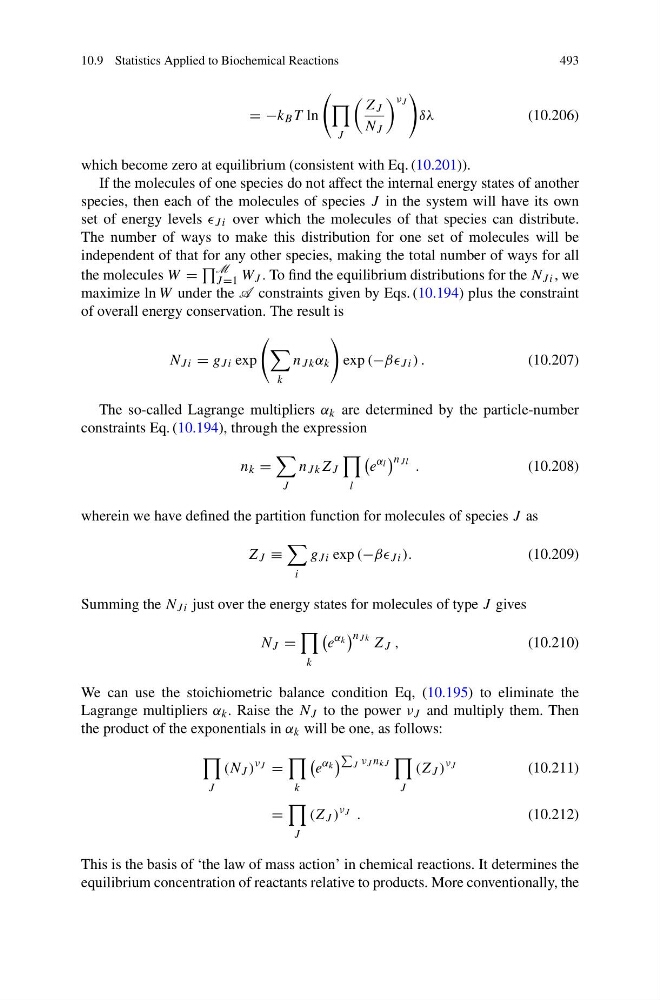
which become zero at equilibrium (consistent with Eq. (10.201)).
If the molecules of one species do not affect the internal energy states of another
species, then each of the molecules of species J in the system will have its own
set of energy levels J i over which the molecules of that species can distribute.
The number of ways to make this distribution for one set of molecules will be
independent of that for any other species, making the total number of ways for all
the molecules W =
M
J =1 W J . To find the equilibrium distributions for the N J i , we
maximize ln W under the A constraints given by Eqs. (10.194) plus the constraint
of overall energy conservation. The result is
N J i = g J i exp
k
n J k α k
exp (−ββ J i ) .
(10.207)
The so-called Lagrange multipliers α k are determined by the particle-number
constraints Eq. (10.194), through the expression
n k =
J
n J k Z J
l
e
α l
n J l .
(10.208)
wherein we have defined the partition function for molecules of species J as
Z J ≡
i
g J i exp (−ββ J i ).
(10.209)
Summing the N J i just over the energy states for molecules of type J gives
N J =
k
e
α k
n J k Z J ,
(10.210)
We can use the stoichiometric balance condition Eq, (10.195) to eliminate the
Lagrange multipliers α k . Raise the N J to the power ν J and multiply them. Then
the product of the exponentials in α k will be one, as follows:
J
(N J )
ν J =
k
e
α k
J ν J n kJ
J
(Z J )
ν J
(10.211)
=
J
(Z J )
ν J .
(10.212)
This is the basis of ‘the law of mass action’ in chemical reactions. It determines the
equilibrium concentration of reactants relative to products. More conventionally, the
493
= −k B T ln
J
Z J
N J
ν J
δλ
(10.206)
which become zero at equilibrium (consistent with Eq. (10.201)).
If the molecules of one species do not affect the internal energy states of another
species, then each of the molecules of species J in the system will have its own
set of energy levels J i over which the molecules of that species can distribute.
The number of ways to make this distribution for one set of molecules will be
independent of that for any other species, making the total number of ways for all
the molecules W =
M
J =1 W J . To find the equilibrium distributions for the N J i , we
maximize ln W under the A constraints given by Eqs. (10.194) plus the constraint
of overall energy conservation. The result is
N J i = g J i exp
k
n J k α k
exp (−ββ J i ) .
(10.207)
The so-called Lagrange multipliers α k are determined by the particle-number
constraints Eq. (10.194), through the expression
n k =
J
n J k Z J
l
e
α l
n J l .
(10.208)
wherein we have defined the partition function for molecules of species J as
Z J ≡
i
g J i exp (−ββ J i ).
(10.209)
Summing the N J i just over the energy states for molecules of type J gives
N J =
k
e
α k
n J k Z J ,
(10.210)
We can use the stoichiometric balance condition Eq, (10.195) to eliminate the
Lagrange multipliers α k . Raise the N J to the power ν J and multiply them. Then
the product of the exponentials in α k will be one, as follows:
J
(N J )
ν J =
k
e
α k
J ν J n kJ
J
(Z J )
ν J
(10.211)
=
J
(Z J )
ν J .
(10.212)
This is the basis of ‘the law of mass action’ in chemical reactions. It determines the
equilibrium concentration of reactants relative to products. More conventionally, the