

492
10 The Statistical Basis of Bioenergetics
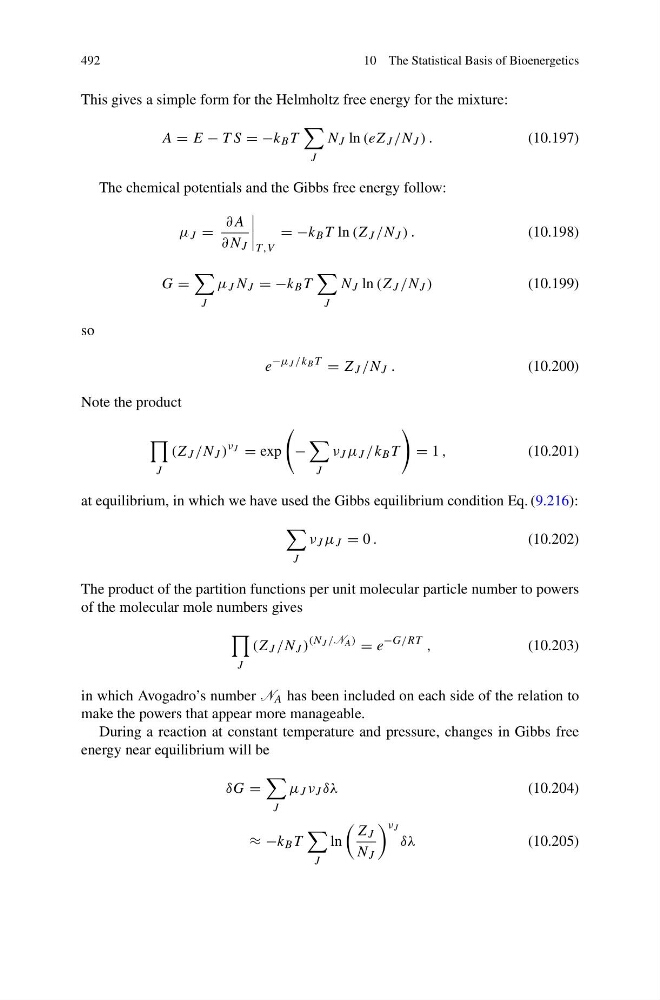
This gives a simple form for the Helmholtz free energy for the mixture:
A = E − T S = −k B T
J
N J ln (eZ J /N J ) .
(10.197)
The chemical potentials and the Gibbs free energy follow:
μ J =
∂A
∂N J
T ,V
= −k B T ln (Z J /N J ) .
(10.198)
G =
J
μ J N J = −k B T
J
N J ln (Z J /N J )
(10.199)
so
e
−μ J /k B T
= Z J /N J .
(10.200)
Note the product
J
(Z J /N J )
ν J = exp
−
J
ν J μ J /k B T
= 1 ,
(10.201)
at equilibrium, in which we have used the Gibbs equilibrium condition Eq. (9.216):
J
ν J μ J = 0 .
(10.202)
The product of the partition functions per unit molecular particle number to powers
of the molecular mole numbers gives
J
(Z J /N J )
(N J /N A )
= e
−G/RT ,
(10.203)
in which Avogadro’s number N A has been included on each side of the relation to
make the powers that appear more manageable.
During a reaction at constant temperature and pressure, changes in Gibbs free
energy near equilibrium will be
δG =
J
μ J ν J δλ
(10.204)
≈ −k B T
J
ln
Z J
N J
ν J
δλ
(10.205)
10 The Statistical Basis of Bioenergetics
This gives a simple form for the Helmholtz free energy for the mixture:
A = E − T S = −k B T
J
N J ln (eZ J /N J ) .
(10.197)
The chemical potentials and the Gibbs free energy follow:
μ J =
∂A
∂N J
T ,V
= −k B T ln (Z J /N J ) .
(10.198)
G =
J
μ J N J = −k B T
J
N J ln (Z J /N J )
(10.199)
so
e
−μ J /k B T
= Z J /N J .
(10.200)
Note the product
J
(Z J /N J )
ν J = exp
−
J
ν J μ J /k B T
= 1 ,
(10.201)
at equilibrium, in which we have used the Gibbs equilibrium condition Eq. (9.216):
J
ν J μ J = 0 .
(10.202)
The product of the partition functions per unit molecular particle number to powers
of the molecular mole numbers gives
J
(Z J /N J )
(N J /N A )
= e
−G/RT ,
(10.203)
in which Avogadro’s number N A has been included on each side of the relation to
make the powers that appear more manageable.
During a reaction at constant temperature and pressure, changes in Gibbs free
energy near equilibrium will be
δG =
J
μ J ν J δλ
(10.204)
≈ −k B T
J
ln
Z J
N J
ν J
δλ
(10.205)