

480
10 The Statistical Basis of Bioenergetics
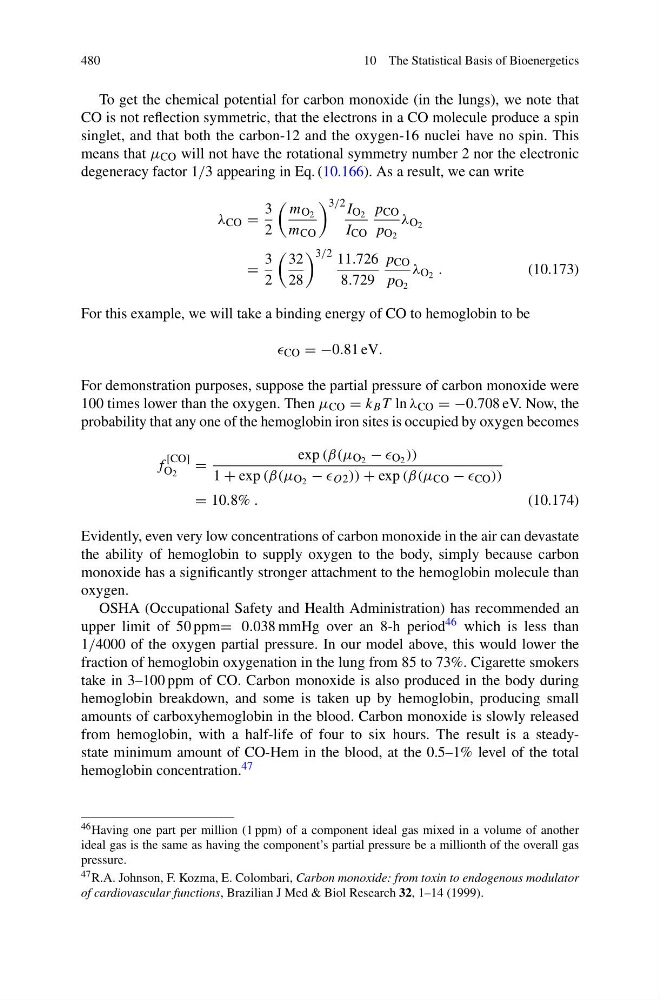
To get the chemical potential for carbon monoxide (in the lungs), we note that
CO is not reflection symmetric, that the electrons in a CO molecule produce a spin
singlet, and that both the carbon-12 and the oxygen-16 nuclei have no spin. This
means that μ CO will not have the rotational symmetry number 2 nor the electronic
degeneracy factor 1/3 appearing in Eq. (10.166). As a result, we can write
λ CO =
3
2
m O 2
m CO
3/2 I O 2
I CO
p CO
p O 2
λ O 2
=
3
2
32
28
3/2 11.726
8.729
p CO
p O 2
λ O 2 .
(10.173)
For this example, we will take a binding energy of CO to hemoglobin to be
CO = −0.81 eV.
For demonstration purposes, suppose the partial pressure of carbon monoxide were
100 times lower than the oxygen. Then μ CO = k B T ln λ CO = −0.708 eV. Now, the
probability that any one of the hemoglobin iron sites is occupied by oxygen becomes
f
[CO]
O 2
=
exp (β(μ O 2 − O 2 ))
1 + exp (β(μ O 2 − O2 )) + exp (β(μ CO − CO ))
= 10.8% .
(10.174)
Evidently, even very low concentrations of carbon monoxide in the air can devastate
the ability of hemoglobin to supply oxygen to the body, simply because carbon
monoxide has a significantly stronger attachment to the hemoglobin molecule than
oxygen.
OSHA (Occupational Safety and Health Administration) has recommended an
upper limit of 50 ppm= 0.038 mmHg over an 8-h period 46 which is less than
1/4000 of the oxygen partial pressure. In our model above, this would lower the
fraction of hemoglobin oxygenation in the lung from 85 to 73%. Cigarette smokers
take in 3–100 ppm of CO. Carbon monoxide is also produced in the body during
hemoglobin breakdown, and some is taken up by hemoglobin, producing small
amounts of carboxyhemoglobin in the blood. Carbon monoxide is slowly released
from hemoglobin, with a half-life of four to six hours. The result is a steadystate minimum amount of CO-Hem in the blood, at the 0.5–1% level of the total
hemoglobin concentration. 47
46 Having one part per million (1 ppm) of a component ideal gas mixed in a volume of another
ideal gas is the same as having the component’s partial pressure be a millionth of the overall gas
pressure.
47 R.A. Johnson, F. Kozma, E. Colombari, Carbon monoxide: from toxin to endogenous modulator
of cardiovascular functions, Brazilian J Med & Biol Research 32, 1–14 (1999).
10 The Statistical Basis of Bioenergetics
To get the chemical potential for carbon monoxide (in the lungs), we note that
CO is not reflection symmetric, that the electrons in a CO molecule produce a spin
singlet, and that both the carbon-12 and the oxygen-16 nuclei have no spin. This
means that μ CO will not have the rotational symmetry number 2 nor the electronic
degeneracy factor 1/3 appearing in Eq. (10.166). As a result, we can write
λ CO =
3
2
m O 2
m CO
3/2 I O 2
I CO
p CO
p O 2
λ O 2
=
3
2
32
28
3/2 11.726
8.729
p CO
p O 2
λ O 2 .
(10.173)
For this example, we will take a binding energy of CO to hemoglobin to be
CO = −0.81 eV.
For demonstration purposes, suppose the partial pressure of carbon monoxide were
100 times lower than the oxygen. Then μ CO = k B T ln λ CO = −0.708 eV. Now, the
probability that any one of the hemoglobin iron sites is occupied by oxygen becomes
f
[CO]
O 2
=
exp (β(μ O 2 − O 2 ))
1 + exp (β(μ O 2 − O2 )) + exp (β(μ CO − CO ))
= 10.8% .
(10.174)
Evidently, even very low concentrations of carbon monoxide in the air can devastate
the ability of hemoglobin to supply oxygen to the body, simply because carbon
monoxide has a significantly stronger attachment to the hemoglobin molecule than
oxygen.
OSHA (Occupational Safety and Health Administration) has recommended an
upper limit of 50 ppm= 0.038 mmHg over an 8-h period 46 which is less than
1/4000 of the oxygen partial pressure. In our model above, this would lower the
fraction of hemoglobin oxygenation in the lung from 85 to 73%. Cigarette smokers
take in 3–100 ppm of CO. Carbon monoxide is also produced in the body during
hemoglobin breakdown, and some is taken up by hemoglobin, producing small
amounts of carboxyhemoglobin in the blood. Carbon monoxide is slowly released
from hemoglobin, with a half-life of four to six hours. The result is a steadystate minimum amount of CO-Hem in the blood, at the 0.5–1% level of the total
hemoglobin concentration. 47
46 Having one part per million (1 ppm) of a component ideal gas mixed in a volume of another
ideal gas is the same as having the component’s partial pressure be a millionth of the overall gas
pressure.
47 R.A. Johnson, F. Kozma, E. Colombari, Carbon monoxide: from toxin to endogenous modulator
of cardiovascular functions, Brazilian J Med & Biol Research 32, 1–14 (1999).