

10.8 The Partition Function for Ensembles
479
Carbon Monoxide Poisoning
Carbon monoxide is a colorless and odorless gas produced during incomplete
burning of hydrocarbons and wood, burning cigarettes, by gasoline engines, and
by gas/oil furnaces with insufficient air. The density of carbon monoxide gas is
only slightly less than that of air (about 3% less), so, unlike carbon dioxide ( with
a density1.52 times greater than air), carbon monoxide tends to diffuse uniformly
throughout a room. Carbon monoxide molecules have about 80% of the solubility
of oxygen in blood. The carbon monoxide molecule can attach to the same sites on
the hemoglobin molecule as oxygen, and more tenaciously, so carbon monoxide
competes and then blocks oxygen binding. When we humans breath too much
carbon monoxide, suffocation will result. (The symptoms are similar to those of
cyanide poisoning, but the mechanism in the latter case is a blockage of the uptake
of oxygen within a cell due to a binding of cyanide to the ferric ion on cytochrome
oxidase within mitochondria, preventing oxygen binding and thereby stopping ATP
production.)
Let’s look at a simplified statistical model for the process (just to get a rough idea
of the equilibrium behavior). Let the fixed (negative) binding energies of attachment
be noted as O 2 for O 2 and CO for CO 2 . It is known that CO 2 attaches more
strongly to the hemoglobin iron loci than does O 2 , so | CO | >
O 2
. We will
neglect any cooperative effect in the binding of either O 2 or CO. Then there are
just three possibilities for the states of any one of the ferric attachment sites on
hemoglobin molecule: (1) Free of any attachment; (2) Oxygen attachment; and
(3) Carbon monoxide attachment. The grand partition function (now for a system
containing two types of molecules competing for adsorption onto a distribution of
attachment sites) will be
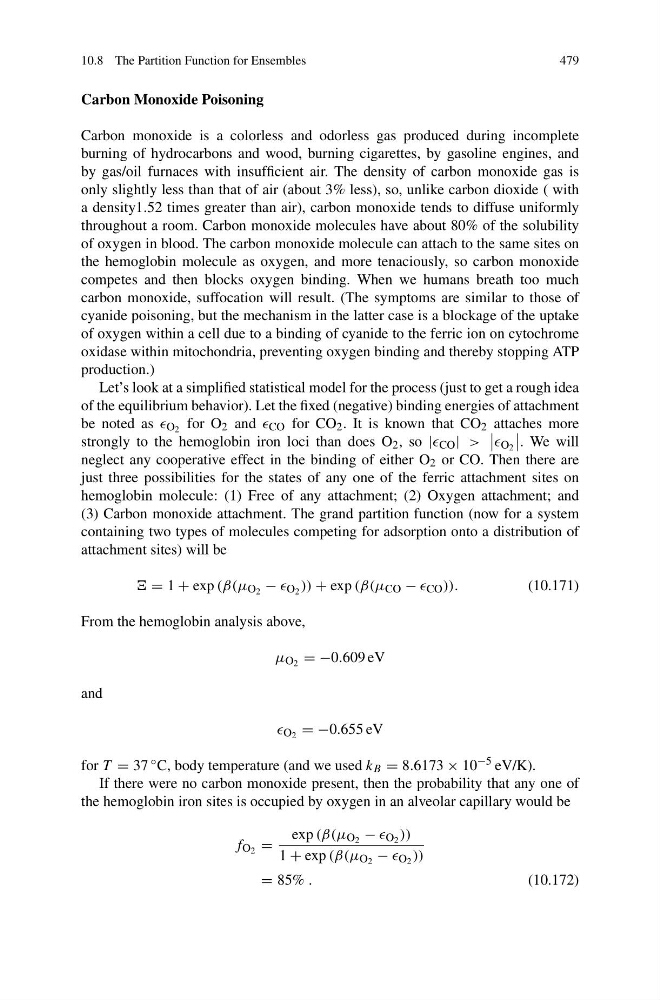
= 1 + exp (β(μ O 2 − O 2 )) + exp (β(μ CO − CO )).
(10.171)
From the hemoglobin analysis above,
μ O 2 = −0.609 eV
and
O 2 = −0.655 eV
for T = 37 ◦ C, body temperature (and we used k B = 8.6173 × 10 −5 eV/K).
If there were no carbon monoxide present, then the probability that any one of
the hemoglobin iron sites is occupied by oxygen in an alveolar capillary would be
f O 2 =
exp (β(μ O 2 − O 2 ))
1 + exp (β(μ O 2 − O 2 ))
= 85% .
(10.172)
479
Carbon Monoxide Poisoning
Carbon monoxide is a colorless and odorless gas produced during incomplete
burning of hydrocarbons and wood, burning cigarettes, by gasoline engines, and
by gas/oil furnaces with insufficient air. The density of carbon monoxide gas is
only slightly less than that of air (about 3% less), so, unlike carbon dioxide ( with
a density1.52 times greater than air), carbon monoxide tends to diffuse uniformly
throughout a room. Carbon monoxide molecules have about 80% of the solubility
of oxygen in blood. The carbon monoxide molecule can attach to the same sites on
the hemoglobin molecule as oxygen, and more tenaciously, so carbon monoxide
competes and then blocks oxygen binding. When we humans breath too much
carbon monoxide, suffocation will result. (The symptoms are similar to those of
cyanide poisoning, but the mechanism in the latter case is a blockage of the uptake
of oxygen within a cell due to a binding of cyanide to the ferric ion on cytochrome
oxidase within mitochondria, preventing oxygen binding and thereby stopping ATP
production.)
Let’s look at a simplified statistical model for the process (just to get a rough idea
of the equilibrium behavior). Let the fixed (negative) binding energies of attachment
be noted as O 2 for O 2 and CO for CO 2 . It is known that CO 2 attaches more
strongly to the hemoglobin iron loci than does O 2 , so | CO | >
O 2
. We will
neglect any cooperative effect in the binding of either O 2 or CO. Then there are
just three possibilities for the states of any one of the ferric attachment sites on
hemoglobin molecule: (1) Free of any attachment; (2) Oxygen attachment; and
(3) Carbon monoxide attachment. The grand partition function (now for a system
containing two types of molecules competing for adsorption onto a distribution of
attachment sites) will be
= 1 + exp (β(μ O 2 − O 2 )) + exp (β(μ CO − CO )).
(10.171)
From the hemoglobin analysis above,
μ O 2 = −0.609 eV
and
O 2 = −0.655 eV
for T = 37 ◦ C, body temperature (and we used k B = 8.6173 × 10 −5 eV/K).
If there were no carbon monoxide present, then the probability that any one of
the hemoglobin iron sites is occupied by oxygen in an alveolar capillary would be
f O 2 =
exp (β(μ O 2 − O 2 ))
1 + exp (β(μ O 2 − O 2 ))
= 85% .
(10.172)