

10.8 The Partition Function for Ensembles
477
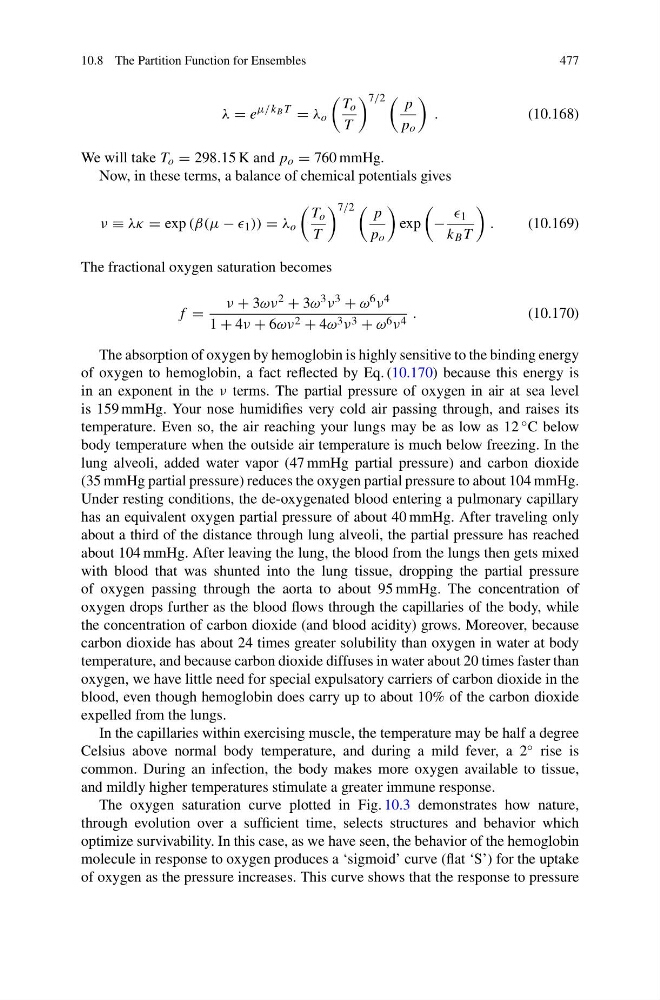
λ = e
μ/k B T
= λ o
T o
T
7/2
p
p o
.
(10.168)
We will take T o = 298.15 K and p o = 760 mmHg.
Now, in these terms, a balance of chemical potentials gives
ν ≡ λκ = exp (β(μ − 1 )) = λ o
T o
T
7/2
p
p o
exp
−
1
k B T
.
(10.169)
The fractional oxygen saturation becomes
f =
ν + 3ων 2 + 3ω 3 ν 3 + ω 6 ν 4
1 + 4ν + 6ων 2 + 4ω 3 ν 3 + ω 6 ν 4 .
(10.170)
The absorption of oxygen by hemoglobin is highly sensitive to the binding energy
of oxygen to hemoglobin, a fact reflected by Eq. (10.170) because this energy is
in an exponent in the ν terms. The partial pressure of oxygen in air at sea level
is 159 mmHg. Your nose humidifies very cold air passing through, and raises its
temperature. Even so, the air reaching your lungs may be as low as 12 ◦ C below
body temperature when the outside air temperature is much below freezing. In the
lung alveoli, added water vapor (47 mmHg partial pressure) and carbon dioxide
(35 mmHg partial pressure) reduces the oxygen partial pressure to about 104 mmHg.
Under resting conditions, the de-oxygenated blood entering a pulmonary capillary
has an equivalent oxygen partial pressure of about 40 mmHg. After traveling only
about a third of the distance through lung alveoli, the partial pressure has reached
about 104 mmHg. After leaving the lung, the blood from the lungs then gets mixed
with blood that was shunted into the lung tissue, dropping the partial pressure
of oxygen passing through the aorta to about 95 mmHg. The concentration of
oxygen drops further as the blood flows through the capillaries of the body, while
the concentration of carbon dioxide (and blood acidity) grows. Moreover, because
carbon dioxide has about 24 times greater solubility than oxygen in water at body
temperature, and because carbon dioxide diffuses in water about 20 times faster than
oxygen, we have little need for special expulsatory carriers of carbon dioxide in the
blood, even though hemoglobin does carry up to about 10% of the carbon dioxide
expelled from the lungs.
In the capillaries within exercising muscle, the temperature may be half a degree
Celsius above normal body temperature, and during a mild fever, a 2 ◦ rise is
common. During an infection, the body makes more oxygen available to tissue,
and mildly higher temperatures stimulate a greater immune response.
The oxygen saturation curve plotted in Fig. 10.3 demonstrates how nature,
through evolution over a sufficient time, selects structures and behavior which
optimize survivability. In this case, as we have seen, the behavior of the hemoglobin
molecule in response to oxygen produces a ‘sigmoid’ curve (flat ‘S’) for the uptake
of oxygen as the pressure increases. This curve shows that the response to pressure
477
λ = e
μ/k B T
= λ o
T o
T
7/2
p
p o
.
(10.168)
We will take T o = 298.15 K and p o = 760 mmHg.
Now, in these terms, a balance of chemical potentials gives
ν ≡ λκ = exp (β(μ − 1 )) = λ o
T o
T
7/2
p
p o
exp
−
1
k B T
.
(10.169)
The fractional oxygen saturation becomes
f =
ν + 3ων 2 + 3ω 3 ν 3 + ω 6 ν 4
1 + 4ν + 6ων 2 + 4ω 3 ν 3 + ω 6 ν 4 .
(10.170)
The absorption of oxygen by hemoglobin is highly sensitive to the binding energy
of oxygen to hemoglobin, a fact reflected by Eq. (10.170) because this energy is
in an exponent in the ν terms. The partial pressure of oxygen in air at sea level
is 159 mmHg. Your nose humidifies very cold air passing through, and raises its
temperature. Even so, the air reaching your lungs may be as low as 12 ◦ C below
body temperature when the outside air temperature is much below freezing. In the
lung alveoli, added water vapor (47 mmHg partial pressure) and carbon dioxide
(35 mmHg partial pressure) reduces the oxygen partial pressure to about 104 mmHg.
Under resting conditions, the de-oxygenated blood entering a pulmonary capillary
has an equivalent oxygen partial pressure of about 40 mmHg. After traveling only
about a third of the distance through lung alveoli, the partial pressure has reached
about 104 mmHg. After leaving the lung, the blood from the lungs then gets mixed
with blood that was shunted into the lung tissue, dropping the partial pressure
of oxygen passing through the aorta to about 95 mmHg. The concentration of
oxygen drops further as the blood flows through the capillaries of the body, while
the concentration of carbon dioxide (and blood acidity) grows. Moreover, because
carbon dioxide has about 24 times greater solubility than oxygen in water at body
temperature, and because carbon dioxide diffuses in water about 20 times faster than
oxygen, we have little need for special expulsatory carriers of carbon dioxide in the
blood, even though hemoglobin does carry up to about 10% of the carbon dioxide
expelled from the lungs.
In the capillaries within exercising muscle, the temperature may be half a degree
Celsius above normal body temperature, and during a mild fever, a 2 ◦ rise is
common. During an infection, the body makes more oxygen available to tissue,
and mildly higher temperatures stimulate a greater immune response.
The oxygen saturation curve plotted in Fig. 10.3 demonstrates how nature,
through evolution over a sufficient time, selects structures and behavior which
optimize survivability. In this case, as we have seen, the behavior of the hemoglobin
molecule in response to oxygen produces a ‘sigmoid’ curve (flat ‘S’) for the uptake
of oxygen as the pressure increases. This curve shows that the response to pressure