

476
10 The Statistical Basis of Bioenergetics
f =
1
4
N .
At this stage, there remains just one unknown, the chemical potential μ = k B T γ
for the oxygen. As the blood flows through the lungs, the oxygen in the plasma and
red-blood corpuscles come into close equilibrium with the oxygen in the air of each
lung. This makes the chemical potential of the oxygen in the blood stream close to
that of the air in the alveoli. For this model, we will use an ideal gas approximation
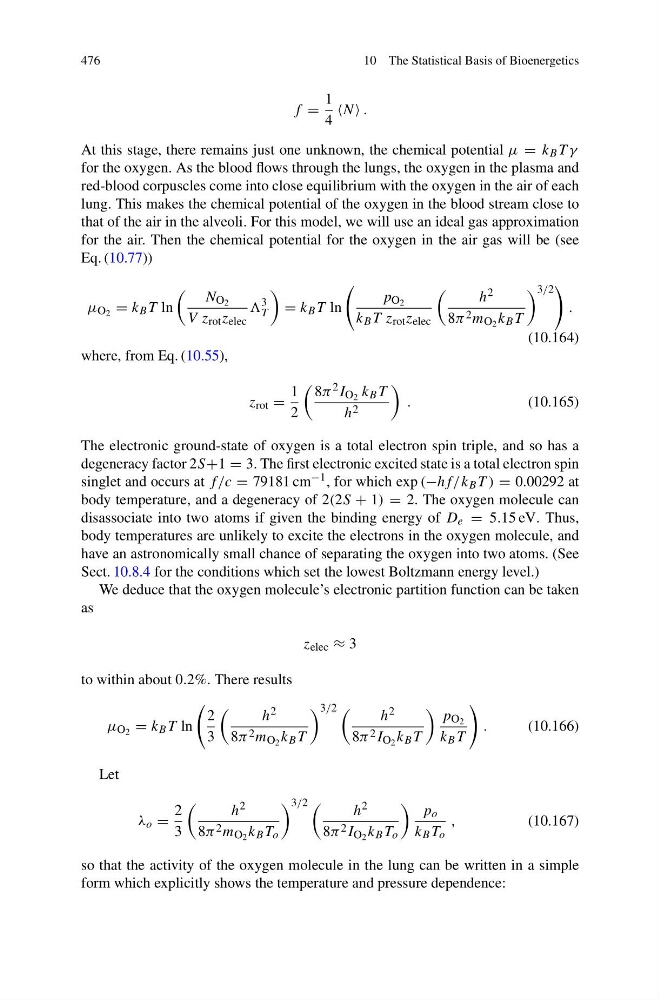
for the air. Then the chemical potential for the oxygen in the air gas will be (see
Eq. (10.77))
μ O 2 = k B T ln
N O 2
V z rot z elec
3
T
= k B T ln
p O 2
k B T z rot z elec
h 2
8π 2 m O 2 k B T
3/2
.
(10.164)
where, from Eq. (10.55),
z rot =
1
2
8π 2 I O 2 k B T
h 2
.
(10.165)
The electronic ground-state of oxygen is a total electron spin triple, and so has a
degeneracy factor 2S+1 = 3. The first electronic excited state is a total electron spin
singlet and occurs at f/c = 79181 cm −1 , for which exp (−hf/ k B T ) = 0.00292 at
body temperature, and a degeneracy of 2(2S + 1) = 2. The oxygen molecule can
disassociate into two atoms if given the binding energy of D e = 5.15 eV. Thus,
body temperatures are unlikely to excite the electrons in the oxygen molecule, and
have an astronomically small chance of separating the oxygen into two atoms. (See
Sect. 10.8.4 for the conditions which set the lowest Boltzmann energy level.)
We deduce that the oxygen molecule’s electronic partition function can be taken
as
z elec ≈ 3
to within about 0.2%. There results
μ O 2 = k B T ln
2
3
h 2
8π 2 m O 2 k B T
3/2
h 2
8π 2 I O 2 k B T
p O 2
k B T
.
(10.166)
Let
λ o =
2
3
h 2
8π 2 m O 2 k B T o
3/2
h 2
8π 2 I O 2 k B T o
p o
k B T o
,
(10.167)
so that the activity of the oxygen molecule in the lung can be written in a simple
form which explicitly shows the temperature and pressure dependence:
10 The Statistical Basis of Bioenergetics
f =
1
4
N .
At this stage, there remains just one unknown, the chemical potential μ = k B T γ
for the oxygen. As the blood flows through the lungs, the oxygen in the plasma and
red-blood corpuscles come into close equilibrium with the oxygen in the air of each
lung. This makes the chemical potential of the oxygen in the blood stream close to
that of the air in the alveoli. For this model, we will use an ideal gas approximation
for the air. Then the chemical potential for the oxygen in the air gas will be (see
Eq. (10.77))
μ O 2 = k B T ln
N O 2
V z rot z elec
3
T
= k B T ln
p O 2
k B T z rot z elec
h 2
8π 2 m O 2 k B T
3/2
.
(10.164)
where, from Eq. (10.55),
z rot =
1
2
8π 2 I O 2 k B T
h 2
.
(10.165)
The electronic ground-state of oxygen is a total electron spin triple, and so has a
degeneracy factor 2S+1 = 3. The first electronic excited state is a total electron spin
singlet and occurs at f/c = 79181 cm −1 , for which exp (−hf/ k B T ) = 0.00292 at
body temperature, and a degeneracy of 2(2S + 1) = 2. The oxygen molecule can
disassociate into two atoms if given the binding energy of D e = 5.15 eV. Thus,
body temperatures are unlikely to excite the electrons in the oxygen molecule, and
have an astronomically small chance of separating the oxygen into two atoms. (See
Sect. 10.8.4 for the conditions which set the lowest Boltzmann energy level.)
We deduce that the oxygen molecule’s electronic partition function can be taken
as
z elec ≈ 3
to within about 0.2%. There results
μ O 2 = k B T ln
2
3
h 2
8π 2 m O 2 k B T
3/2
h 2
8π 2 I O 2 k B T
p O 2
k B T
.
(10.166)
Let
λ o =
2
3
h 2
8π 2 m O 2 k B T o
3/2
h 2
8π 2 I O 2 k B T o
p o
k B T o
,
(10.167)
so that the activity of the oxygen molecule in the lung can be written in a simple
form which explicitly shows the temperature and pressure dependence: