

10.8 The Partition Function for Ensembles
473
N =
∂ ln
∂γ
= ln ,
(10.154)
E = −
∂ ln
∂β
=
3
2β
ln .
(10.155)
Now, since generally,
βpV = ln ,
we have
pV = Nk B T ,
(10.156)
E =
3
2
pV =
3
2
Nk B T ,
(10.157)
well known for a monatomic ideal gas. 42
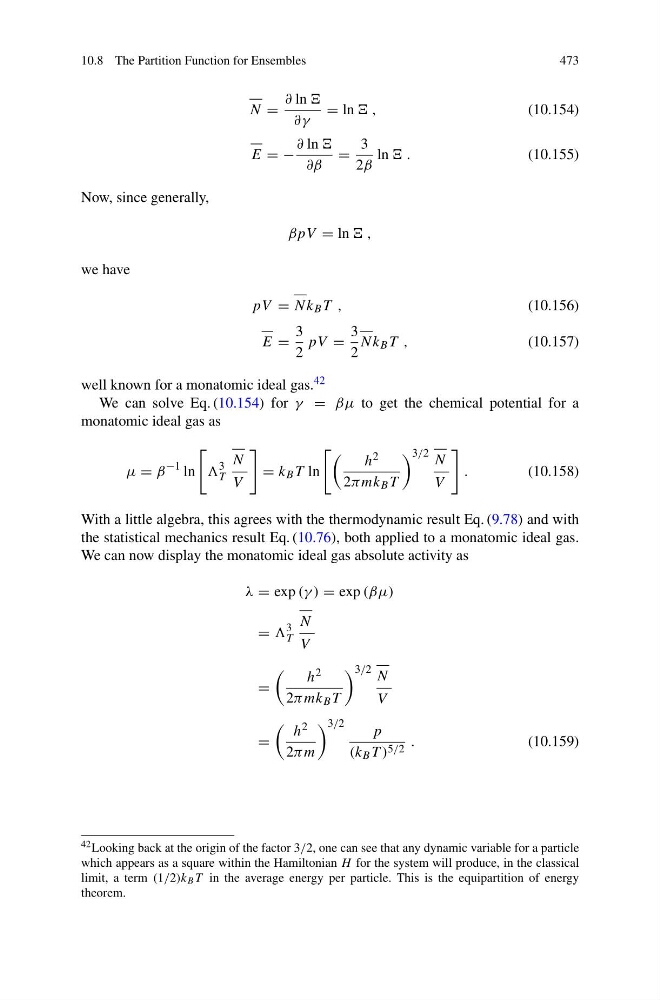
We can solve Eq. (10.154) for γ = βμ to get the chemical potential for a
monatomic ideal gas as
μ = β
−1 ln
3
T
N
V
= k B T ln
h 2
2πmk B T
3/2 N
V
.
(10.158)
With a little algebra, this agrees with the thermodynamic result Eq. (9.78) and with
the statistical mechanics result Eq. (10.76), both applied to a monatomic ideal gas.
We can now display the monatomic ideal gas absolute activity as
λ = exp (γ ) = exp (βμ)
=
3
T
N
V
=
h 2
2πmk B T
3/2 N
V
=
h 2
2πm
3/2
p
(k B T ) 5/2 .
(10.159)
42 Looking back at the origin of the factor 3/2, one can see that any dynamic variable for a particle
which appears as a square within the Hamiltonian H for the system will produce, in the classical
limit, a term (1/2)k B T in the average energy per particle. This is the equipartition of energy
theorem.
473
N =
∂ ln
∂γ
= ln ,
(10.154)
E = −
∂ ln
∂β
=
3
2β
ln .
(10.155)
Now, since generally,
βpV = ln ,
we have
pV = Nk B T ,
(10.156)
E =
3
2
pV =
3
2
Nk B T ,
(10.157)
well known for a monatomic ideal gas. 42
We can solve Eq. (10.154) for γ = βμ to get the chemical potential for a
monatomic ideal gas as
μ = β
−1 ln
3
T
N
V
= k B T ln
h 2
2πmk B T
3/2 N
V
.
(10.158)
With a little algebra, this agrees with the thermodynamic result Eq. (9.78) and with
the statistical mechanics result Eq. (10.76), both applied to a monatomic ideal gas.
We can now display the monatomic ideal gas absolute activity as
λ = exp (γ ) = exp (βμ)
=
3
T
N
V
=
h 2
2πmk B T
3/2 N
V
=
h 2
2πm
3/2
p
(k B T ) 5/2 .
(10.159)
42 Looking back at the origin of the factor 3/2, one can see that any dynamic variable for a particle
which appears as a square within the Hamiltonian H for the system will produce, in the classical
limit, a term (1/2)k B T in the average energy per particle. This is the equipartition of energy
theorem.