

472
10 The Statistical Basis of Bioenergetics
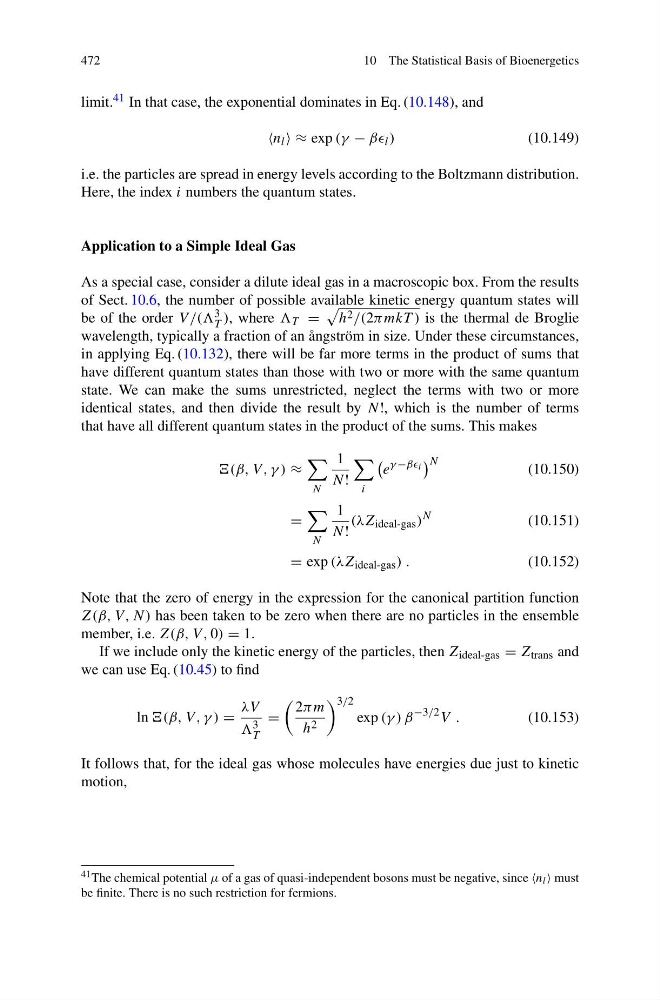
limit. 41 In that case, the exponential dominates in Eq. (10.148), and
n l ≈ exp (γ − ββ l )
(10.149)
i.e. the particles are spread in energy levels according to the Boltzmann distribution.
Here, the index i numbers the quantum states.
Application to a Simple Ideal Gas
As a special case, consider a dilute ideal gas in a macroscopic box. From the results
of Sect. 10.6, the number of possible available kinetic energy quantum states will
be of the order V /(( 3
T ), where T =
h 2 /(2πmkT ) is the thermal de Broglie
wavelength, typically a fraction of an ångström in size. Under these circumstances,
in applying Eq. (10.132), there will be far more terms in the product of sums that
have different quantum states than those with two or more with the same quantum
state. We can make the sums unrestricted, neglect the terms with two or more
identical states, and then divide the result by N !, which is the number of terms
that have all different quantum states in the product of the sums. This makes
V , γ ) ≈
N
1
N !
i
e
γ −ββ i
N
(10.150)
=
N
1
N !
(λZ ideal-gas )
N
(10.151)
= exp (λZ ideal-gas ) .
(10.152)
Note that the zero of energy in the expression for the canonical partition function
Z(β, V , N) has been taken to be zero when there are no particles in the ensemble
member, i.e. Z(β, V , 0) = 1.
If we include only the kinetic energy of the particles, then Z ideal-gas = Z trans and
we can use Eq. (10.45) to find
ln V , γ ) =
λV
3
T
=
2πm
h 2
3/2
exp (γ ) β
−3/2 V .
(10.153)
It follows that, for the ideal gas whose molecules have energies due just to kinetic
motion,
41 The chemical potential μ of a gas of quasi-independent bosons must be negative, since n l must
be finite. There is no such restriction for fermions.
10 The Statistical Basis of Bioenergetics
limit. 41 In that case, the exponential dominates in Eq. (10.148), and
n l ≈ exp (γ − ββ l )
(10.149)
i.e. the particles are spread in energy levels according to the Boltzmann distribution.
Here, the index i numbers the quantum states.
Application to a Simple Ideal Gas
As a special case, consider a dilute ideal gas in a macroscopic box. From the results
of Sect. 10.6, the number of possible available kinetic energy quantum states will
be of the order V /(( 3
T ), where T =
h 2 /(2πmkT ) is the thermal de Broglie
wavelength, typically a fraction of an ångström in size. Under these circumstances,
in applying Eq. (10.132), there will be far more terms in the product of sums that
have different quantum states than those with two or more with the same quantum
state. We can make the sums unrestricted, neglect the terms with two or more
identical states, and then divide the result by N !, which is the number of terms
that have all different quantum states in the product of the sums. This makes
V , γ ) ≈
N
1
N !
i
e
γ −ββ i
N
(10.150)
=
N
1
N !
(λZ ideal-gas )
N
(10.151)
= exp (λZ ideal-gas ) .
(10.152)
Note that the zero of energy in the expression for the canonical partition function
Z(β, V , N) has been taken to be zero when there are no particles in the ensemble
member, i.e. Z(β, V , 0) = 1.
If we include only the kinetic energy of the particles, then Z ideal-gas = Z trans and
we can use Eq. (10.45) to find
ln V , γ ) =
λV
3
T
=
2πm
h 2
3/2
exp (γ ) β
−3/2 V .
(10.153)
It follows that, for the ideal gas whose molecules have energies due just to kinetic
motion,
41 The chemical potential μ of a gas of quasi-independent bosons must be negative, since n l must
be finite. There is no such restriction for fermions.