

10.8 The Partition Function for Ensembles
471
=
j
1/(1 − exp (γ − ββ j )) bosons
1 + exp (γ − ββ j )
fermions
.
(10.141)
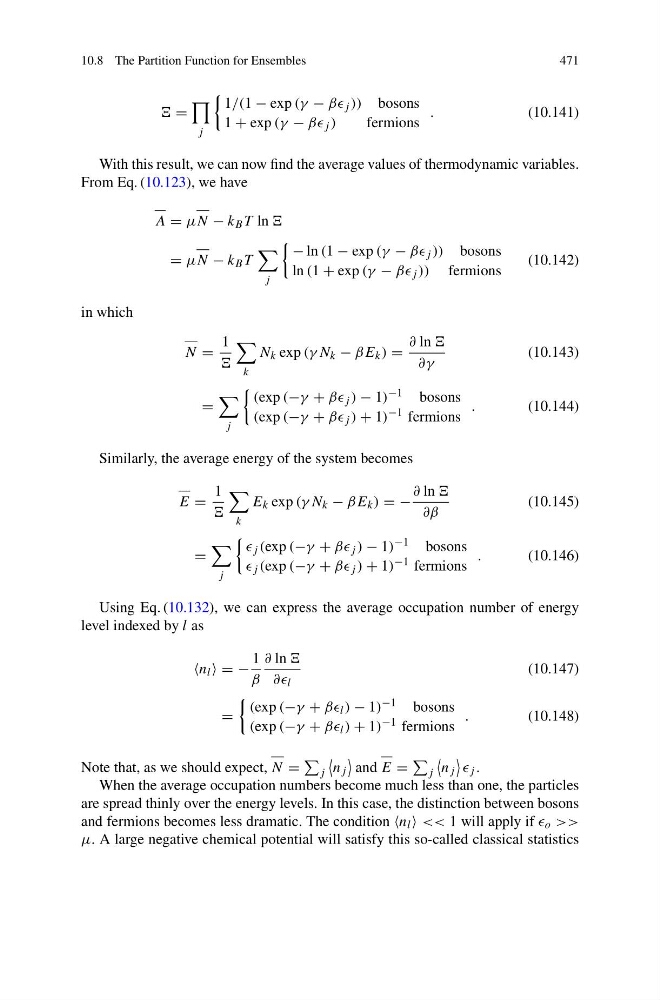
With this result, we can now find the average values of thermodynamic variables.
From Eq. (10.123), we have
A = μN − k B T ln
= μN − k B T
j
− ln (1 − exp (γ − ββ j )) bosons
ln (1 + exp (γ − ββ j )) fermions
(10.142)
in which
N =
1
k
N k exp (γ N k − βE k ) =
∂ ln
∂γ
(10.143)
=
j
(exp (−γ + ββ j ) − 1) −1 bosons
(exp (−γ + ββ j ) + 1) −1 fermions
.
(10.144)
Similarly, the average energy of the system becomes
E =
1
k
E k exp (γ N k − βE k ) = −
∂ ln
∂β
(10.145)
=
j
j (exp (−γ + ββ j ) − 1) −1 bosons
j (exp (−γ + ββ j ) + 1) −1 fermions
.
(10.146)
Using Eq. (10.132), we can express the average occupation number of energy
level indexed by l as
n l = −
1
β
∂ ln
∂∂ l
(10.147)
=
(exp (−γ + ββ l ) − 1) −1 bosons
(exp (−γ + ββ l ) + 1) −1 fermions
.
(10.148)
Note that, as we should expect, N =
j
n j
and E =
j
n j
j .
When the average occupation numbers become much less than one, the particles
are spread thinly over the energy levels. In this case, the distinction between bosons
and fermions becomes less dramatic. The condition n l << 1 will apply if o >>
μ. A large negative chemical potential will satisfy this so-called classical statistics
471
=
j
1/(1 − exp (γ − ββ j )) bosons
1 + exp (γ − ββ j )
fermions
.
(10.141)
With this result, we can now find the average values of thermodynamic variables.
From Eq. (10.123), we have
A = μN − k B T ln
= μN − k B T
j
− ln (1 − exp (γ − ββ j )) bosons
ln (1 + exp (γ − ββ j )) fermions
(10.142)
in which
N =
1
k
N k exp (γ N k − βE k ) =
∂ ln
∂γ
(10.143)
=
j
(exp (−γ + ββ j ) − 1) −1 bosons
(exp (−γ + ββ j ) + 1) −1 fermions
.
(10.144)
Similarly, the average energy of the system becomes
E =
1
k
E k exp (γ N k − βE k ) = −
∂ ln
∂β
(10.145)
=
j
j (exp (−γ + ββ j ) − 1) −1 bosons
j (exp (−γ + ββ j ) + 1) −1 fermions
.
(10.146)
Using Eq. (10.132), we can express the average occupation number of energy
level indexed by l as
n l = −
1
β
∂ ln
∂∂ l
(10.147)
=
(exp (−γ + ββ l ) − 1) −1 bosons
(exp (−γ + ββ l ) + 1) −1 fermions
.
(10.148)
Note that, as we should expect, N =
j
n j
and E =
j
n j
j .
When the average occupation numbers become much less than one, the particles
are spread thinly over the energy levels. In this case, the distinction between bosons
and fermions becomes less dramatic. The condition n l << 1 will apply if o >>
μ. A large negative chemical potential will satisfy this so-called classical statistics