

470
10 The Statistical Basis of Bioenergetics
Shift of the Zero of Energy per Particle
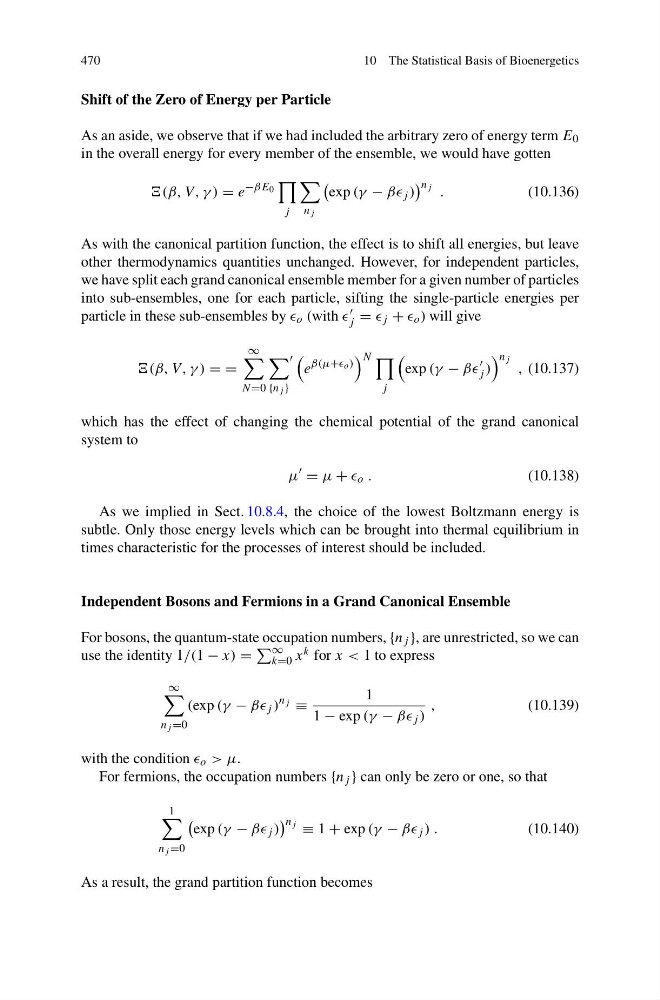
As an aside, we observe that if we had included the arbitrary zero of energy term E 0
in the overall energy for every member of the ensemble, we would have gotten
V , γ ) = e
−βE 0
j
n j
exp (γ − ββ j )
n j .
(10.136)
As with the canonical partition function, the effect is to shift all energies, but leave
other thermodynamics quantities unchanged. However, for independent particles,
we have split each grand canonical ensemble member for a given number of particles
into sub-ensembles, one for each particle, sifting the single-particle energies per
particle in these sub-ensembles by o (with
j = j + o ) will give
V , γ ) = =
∞
N =0
{n j }
e
β(μ+ o )
N
j
exp (γ − ββ
j )
n j
, (10.137)
which has the effect of changing the chemical potential of the grand canonical
system to
μ
= μ + o .
(10.138)
As we implied in Sect. 10.8.4, the choice of the lowest Boltzmann energy is
subtle. Only those energy levels which can be brought into thermal equilibrium in
times characteristic for the processes of interest should be included.
Independent Bosons and Fermions in a Grand Canonical Ensemble
For bosons, the quantum-state occupation numbers, {n j }, are unrestricted, so we can
use the identity 1/(1 − x) =
∞
k=0 x k for x < 1 to express
∞
n j =0
(exp (γ − ββ j )
n j ≡
1
1 − exp (γ − ββ j )
,
(10.139)
with the condition o > μ.
For fermions, the occupation numbers {n j } can only be zero or one, so that
1
n j =0
exp (γ − ββ j )
n j ≡ 1 + exp (γ − ββ j ) .
(10.140)
As a result, the grand partition function becomes
10 The Statistical Basis of Bioenergetics
Shift of the Zero of Energy per Particle
As an aside, we observe that if we had included the arbitrary zero of energy term E 0
in the overall energy for every member of the ensemble, we would have gotten
V , γ ) = e
−βE 0
j
n j
exp (γ − ββ j )
n j .
(10.136)
As with the canonical partition function, the effect is to shift all energies, but leave
other thermodynamics quantities unchanged. However, for independent particles,
we have split each grand canonical ensemble member for a given number of particles
into sub-ensembles, one for each particle, sifting the single-particle energies per
particle in these sub-ensembles by o (with
j = j + o ) will give
V , γ ) = =
∞
N =0
{n j }
e
β(μ+ o )
N
j
exp (γ − ββ
j )
n j
, (10.137)
which has the effect of changing the chemical potential of the grand canonical
system to
μ
= μ + o .
(10.138)
As we implied in Sect. 10.8.4, the choice of the lowest Boltzmann energy is
subtle. Only those energy levels which can be brought into thermal equilibrium in
times characteristic for the processes of interest should be included.
Independent Bosons and Fermions in a Grand Canonical Ensemble
For bosons, the quantum-state occupation numbers, {n j }, are unrestricted, so we can
use the identity 1/(1 − x) =
∞
k=0 x k for x < 1 to express
∞
n j =0
(exp (γ − ββ j )
n j ≡
1
1 − exp (γ − ββ j )
,
(10.139)
with the condition o > μ.
For fermions, the occupation numbers {n j } can only be zero or one, so that
1
n j =0
exp (γ − ββ j )
n j ≡ 1 + exp (γ − ββ j ) .
(10.140)
As a result, the grand partition function becomes