

10.8 The Partition Function for Ensembles
469
Application to Independent Particles
Now let’s see how the grand canonical ensemble might describe a system of particles
that, for the most part, do not interact. Examples will include atoms in an ideal
gas, atoms in a solid crystal held by individual binding forces, or ‘free’ conduction
electrons in a metal. Some interaction is necessary to allow the particles in a given
system to share their energy, but interactions between particles should be so weak
that their energies are dominated by energies internal to each particle. As usual, we
assume that after a relaxation time, the particles reach a quasi-steady equilibrium
state.
With these assumptions, E k will be a sum of possible energies for each particle,
E(N, V ) = E 0 +
i
n j j (N, V ) ,
where j labels the possible energy states for each particle, n j is the occupation
number for the particle within the k-th ensemble in the j -th quantum energy state,
and j is the energy of that j -th state. We have included an arbitrary zero of energy
term E 0 .
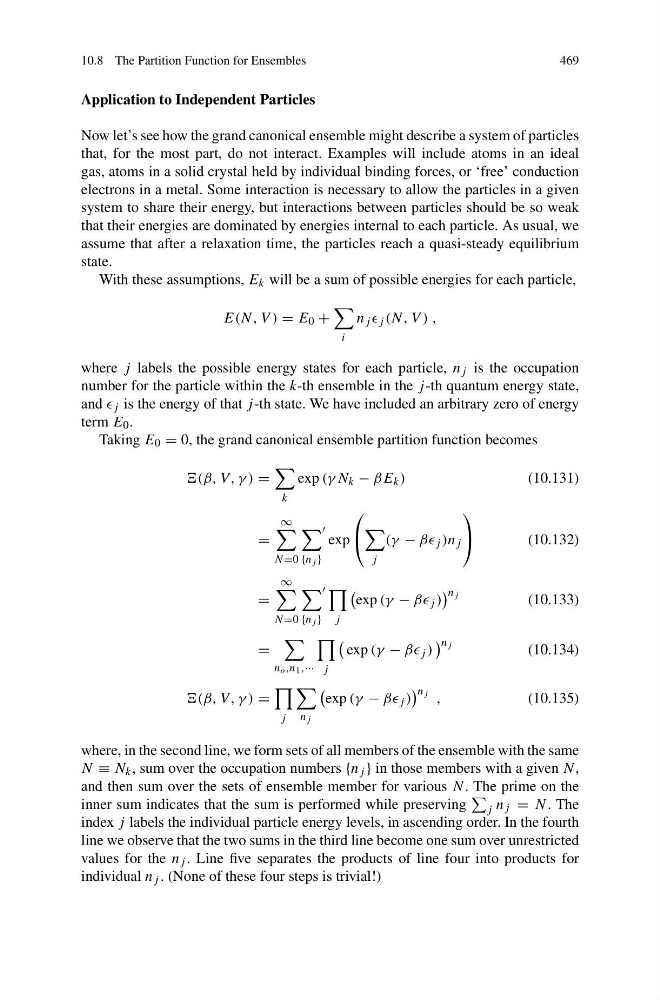
Taking E 0 = 0, the grand canonical ensemble partition function becomes
V , γ ) =
k
exp (γ N k − βE k )
(10.131)
=
∞
N =0
{n j }
exp
⎛
⎝
j
(γ − ββ j )n j
⎞
⎠
(10.132)
=
∞
N =0
{n j }
j
exp (γ − ββ j )
n j
(10.133)
=
n o ,n 1 ,···
j
exp (γ − ββ j )
n j
(10.134)
(β, V , γ ) =
j
n j
exp (γ − ββ j )
n j ,
(10.135)
where, in the second line, we form sets of all members of the ensemble with the same
N ≡ N k , sum over the occupation numbers {n j } in those members with a given N ,
and then sum over the sets of ensemble member for various N . The prime on the
inner sum indicates that the sum is performed while preserving
j n j = N . The
index j labels the individual particle energy levels, in ascending order. In the fourth
line we observe that the two sums in the third line become one sum over unrestricted
values for the n j . Line five separates the products of line four into products for
individual n j . (None of these four steps is trivial!)
469
Application to Independent Particles
Now let’s see how the grand canonical ensemble might describe a system of particles
that, for the most part, do not interact. Examples will include atoms in an ideal
gas, atoms in a solid crystal held by individual binding forces, or ‘free’ conduction
electrons in a metal. Some interaction is necessary to allow the particles in a given
system to share their energy, but interactions between particles should be so weak
that their energies are dominated by energies internal to each particle. As usual, we
assume that after a relaxation time, the particles reach a quasi-steady equilibrium
state.
With these assumptions, E k will be a sum of possible energies for each particle,
E(N, V ) = E 0 +
i
n j j (N, V ) ,
where j labels the possible energy states for each particle, n j is the occupation
number for the particle within the k-th ensemble in the j -th quantum energy state,
and j is the energy of that j -th state. We have included an arbitrary zero of energy
term E 0 .
Taking E 0 = 0, the grand canonical ensemble partition function becomes
V , γ ) =
k
exp (γ N k − βE k )
(10.131)
=
∞
N =0
{n j }
exp
⎛
⎝
j
(γ − ββ j )n j
⎞
⎠
(10.132)
=
∞
N =0
{n j }
j
exp (γ − ββ j )
n j
(10.133)
=
n o ,n 1 ,···
j
exp (γ − ββ j )
n j
(10.134)
(β, V , γ ) =
j
n j
exp (γ − ββ j )
n j ,
(10.135)
where, in the second line, we form sets of all members of the ensemble with the same
N ≡ N k , sum over the occupation numbers {n j } in those members with a given N ,
and then sum over the sets of ensemble member for various N . The prime on the
inner sum indicates that the sum is performed while preserving
j n j = N . The
index j labels the individual particle energy levels, in ascending order. In the fourth
line we observe that the two sums in the third line become one sum over unrestricted
values for the n j . Line five separates the products of line four into products for
individual n j . (None of these four steps is trivial!)