

468
10 The Statistical Basis of Bioenergetics
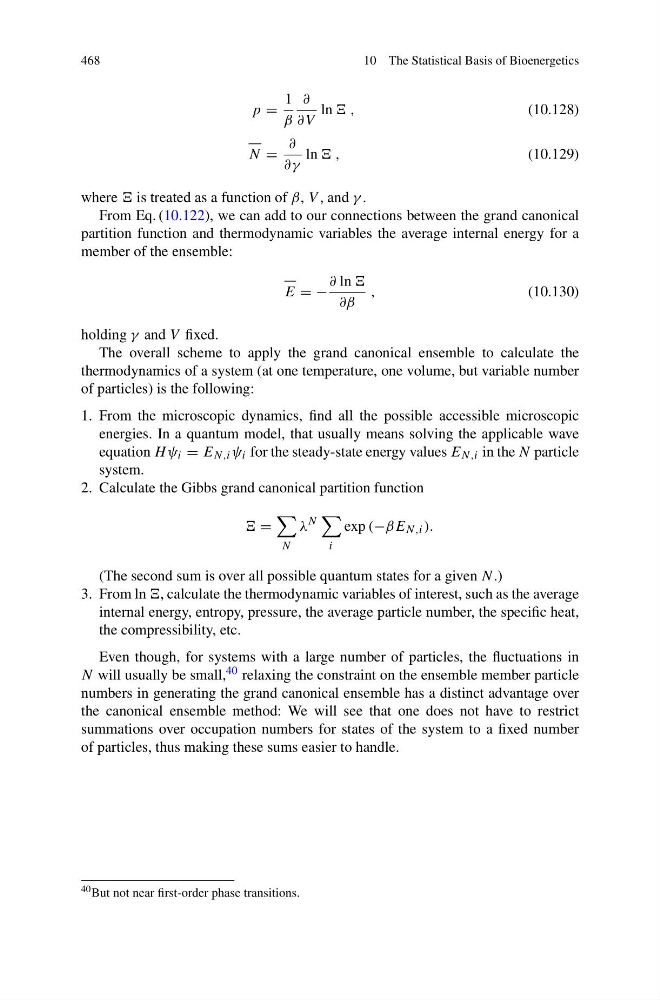
p =
1
β
∂
∂V
ln ,
(10.128)
N =
∂
∂γ
ln ,
(10.129)
where is treated as a function of β, V , and γ .
From Eq. (10.122), we can add to our connections between the grand canonical
partition function and thermodynamic variables the average internal energy for a
member of the ensemble:
E = −
∂ ln
∂β
,
(10.130)
holding γ and V fixed.
The overall scheme to apply the grand canonical ensemble to calculate the
thermodynamics of a system (at one temperature, one volume, but variable number
of particles) is the following:
1. From the microscopic dynamics, find all the possible accessible microscopic
energies. In a quantum model, that usually means solving the applicable wave
equation H ψ i = E N,i ψ i for the steady-state energy values E N,i in the N particle
system.
2. Calculate the Gibbs grand canonical partition function
=
N
λ
N
i
exp (−βE N,i ).
(The second sum is over all possible quantum states for a given N .)
3. From ln , calculate the thermodynamic variables of interest, such as the average
internal energy, entropy, pressure, the average particle number, the specific heat,
the compressibility, etc.
Even though, for systems with a large number of particles, the fluctuations in
N will usually be small, 40 relaxing the constraint on the ensemble member particle
numbers in generating the grand canonical ensemble has a distinct advantage over
the canonical ensemble method: We will see that one does not have to restrict
summations over occupation numbers for states of the system to a fixed number
of particles, thus making these sums easier to handle.
40 But not near first-order phase transitions.
10 The Statistical Basis of Bioenergetics
p =
1
β
∂
∂V
ln ,
(10.128)
N =
∂
∂γ
ln ,
(10.129)
where is treated as a function of β, V , and γ .
From Eq. (10.122), we can add to our connections between the grand canonical
partition function and thermodynamic variables the average internal energy for a
member of the ensemble:
E = −
∂ ln
∂β
,
(10.130)
holding γ and V fixed.
The overall scheme to apply the grand canonical ensemble to calculate the
thermodynamics of a system (at one temperature, one volume, but variable number
of particles) is the following:
1. From the microscopic dynamics, find all the possible accessible microscopic
energies. In a quantum model, that usually means solving the applicable wave
equation H ψ i = E N,i ψ i for the steady-state energy values E N,i in the N particle
system.
2. Calculate the Gibbs grand canonical partition function
=
N
λ
N
i
exp (−βE N,i ).
(The second sum is over all possible quantum states for a given N .)
3. From ln , calculate the thermodynamic variables of interest, such as the average
internal energy, entropy, pressure, the average particle number, the specific heat,
the compressibility, etc.
Even though, for systems with a large number of particles, the fluctuations in
N will usually be small, 40 relaxing the constraint on the ensemble member particle
numbers in generating the grand canonical ensemble has a distinct advantage over
the canonical ensemble method: We will see that one does not have to restrict
summations over occupation numbers for states of the system to a fixed number
of particles, thus making these sums easier to handle.
40 But not near first-order phase transitions.