

10.8 The Partition Function for Ensembles
467
γ =
μ
k B T
.
(10.121)
Note that μ = k B T ln λ. Compare this with the chemical potential for an
ideal gas: μ = k B T ln (cp), where c is a number independent of pressure. This
comparison motivated the chemist G.N. Lewis to define 39 ‘fugacity’ f (“fleeing
tendency”) by f ≡ p o λ, with p o a constant pressure (such as one atmosphere).
Thus, the fugacity is a ‘generalized pressure’, since f → p for a material which
has an ideal-gas limit. If we let f = ϕp, where p is the pressure in the system, then
ϕ will be the fugacity coefficient introduced in Sect. 9.19.
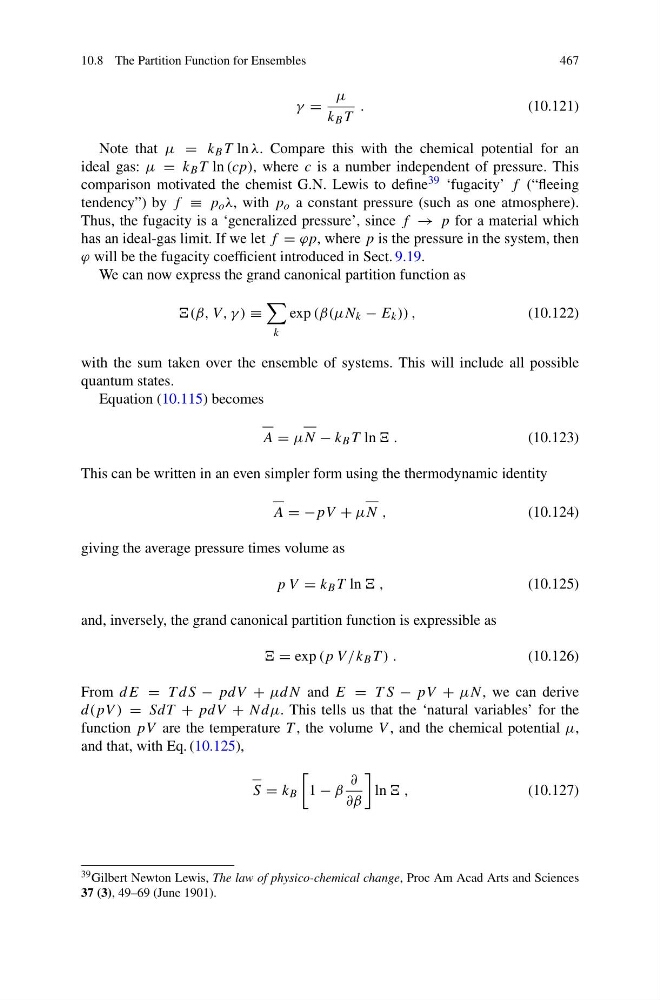
We can now express the grand canonical partition function as
V , γ ) ≡
k
exp (β(μN k − E k )) ,
(10.122)
with the sum taken over the ensemble of systems. This will include all possible
quantum states.
Equation (10.115) becomes
A = μN − k B T ln .
(10.123)
This can be written in an even simpler form using the thermodynamic identity
A = −pV + μN ,
(10.124)
giving the average pressure times volume as
p V = k B T ln ,
(10.125)
and, inversely, the grand canonical partition function is expressible as
= exp (p V /k B T ) .
(10.126)
From dE = T dS − pdV + μdN and E = T S − pV + μN , we can derive
d(pV ) = SdT + pdV + Ndμ. This tells us that the ‘natural variables’ for the
function pV are the temperature T , the volume V , and the chemical potential μ,
and that, with Eq. (10.125),
S = k B
1 − β
∂
∂β
ln ,
(10.127)
39 Gilbert Newton Lewis, The law of physico-chemical change, Proc Am Acad Arts and Sciences
37 (3), 49–69 (June 1901).
467
γ =
μ
k B T
.
(10.121)
Note that μ = k B T ln λ. Compare this with the chemical potential for an
ideal gas: μ = k B T ln (cp), where c is a number independent of pressure. This
comparison motivated the chemist G.N. Lewis to define 39 ‘fugacity’ f (“fleeing
tendency”) by f ≡ p o λ, with p o a constant pressure (such as one atmosphere).
Thus, the fugacity is a ‘generalized pressure’, since f → p for a material which
has an ideal-gas limit. If we let f = ϕp, where p is the pressure in the system, then
ϕ will be the fugacity coefficient introduced in Sect. 9.19.
We can now express the grand canonical partition function as
V , γ ) ≡
k
exp (β(μN k − E k )) ,
(10.122)
with the sum taken over the ensemble of systems. This will include all possible
quantum states.
Equation (10.115) becomes
A = μN − k B T ln .
(10.123)
This can be written in an even simpler form using the thermodynamic identity
A = −pV + μN ,
(10.124)
giving the average pressure times volume as
p V = k B T ln ,
(10.125)
and, inversely, the grand canonical partition function is expressible as
= exp (p V /k B T ) .
(10.126)
From dE = T dS − pdV + μdN and E = T S − pV + μN , we can derive
d(pV ) = SdT + pdV + Ndμ. This tells us that the ‘natural variables’ for the
function pV are the temperature T , the volume V , and the chemical potential μ,
and that, with Eq. (10.125),
S = k B
1 − β
∂
∂β
ln ,
(10.127)
39 Gilbert Newton Lewis, The law of physico-chemical change, Proc Am Acad Arts and Sciences
37 (3), 49–69 (June 1901).