

474
10 The Statistical Basis of Bioenergetics
For a dilute gas, we expect V /N >> > 3
T , i.e. the volume taken up per particle
to be much greater than the volume of the thermal de Broglie wavelength for the
particles in the gas. This makes the chemical potential less than zero for an ideal
gas. This property is a reflection of the fact that adding a particle to an ideal gas at
constant volume and entropy can only be done by reducing the energy of the system.
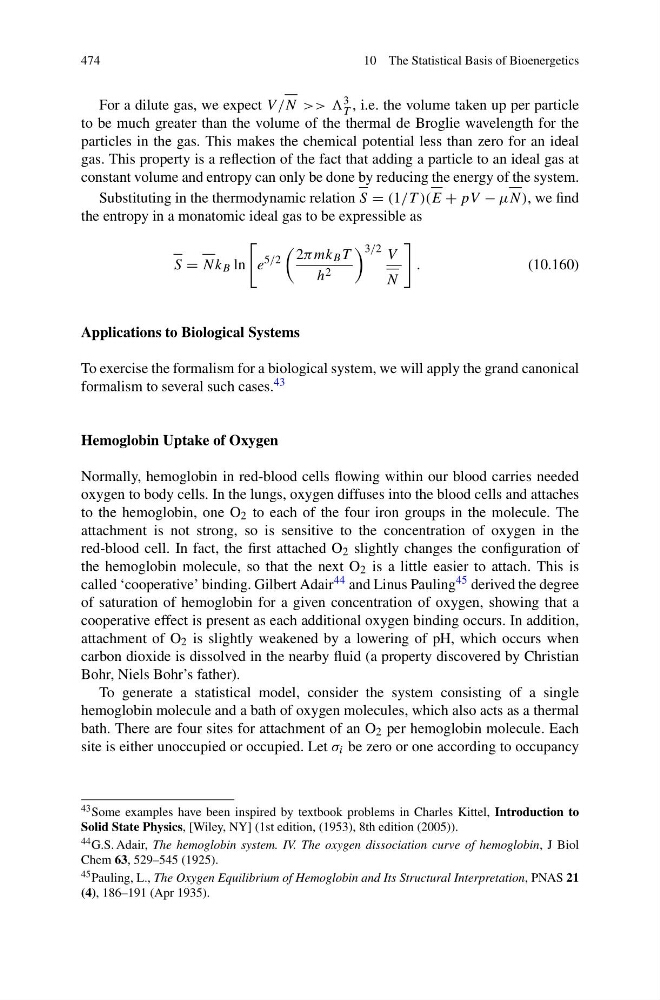
Substituting in the thermodynamic relation S = (1/T )(E + pV − μN), we find
the entropy in a monatomic ideal gas to be expressible as
S = Nk B ln
e
5/2
2πmk B T
h 2
3/2 V
N
.
(10.160)
Applications to Biological Systems
To exercise the formalism for a biological system, we will apply the grand canonical
formalism to several such cases. 43
Hemoglobin Uptake of Oxygen
Normally, hemoglobin in red-blood cells flowing within our blood carries needed
oxygen to body cells. In the lungs, oxygen diffuses into the blood cells and attaches
to the hemoglobin, one O 2 to each of the four iron groups in the molecule. The
attachment is not strong, so is sensitive to the concentration of oxygen in the
red-blood cell. In fact, the first attached O 2 slightly changes the configuration of
the hemoglobin molecule, so that the next O 2 is a little easier to attach. This is
called ‘cooperative’ binding. Gilbert Adair 44 and Linus Pauling 45 derived the degree
of saturation of hemoglobin for a given concentration of oxygen, showing that a
cooperative effect is present as each additional oxygen binding occurs. In addition,
attachment of O 2 is slightly weakened by a lowering of pH, which occurs when
carbon dioxide is dissolved in the nearby fluid (a property discovered by Christian
Bohr, Niels Bohr’s father).
To generate a statistical model, consider the system consisting of a single
hemoglobin molecule and a bath of oxygen molecules, which also acts as a thermal
bath. There are four sites for attachment of an O 2 per hemoglobin molecule. Each
site is either unoccupied or occupied. Let σ i be zero or one according to occupancy
43 Some examples have been inspired by textbook problems in Charles Kittel, Introduction to
Solid State Physics, [Wiley, NY] (1st edition, (1953), 8th edition (2005)).
44 G.S. Adair, The hemoglobin system. IV. The oxygen dissociation curve of hemoglobin, J Biol
Chem 63, 529–545 (1925).
45 Pauling, L., The Oxygen Equilibrium of Hemoglobin and Its Structural Interpretation, PNAS 21
(4), 186–191 (Apr 1935).
10 The Statistical Basis of Bioenergetics
For a dilute gas, we expect V /N >> > 3
T , i.e. the volume taken up per particle
to be much greater than the volume of the thermal de Broglie wavelength for the
particles in the gas. This makes the chemical potential less than zero for an ideal
gas. This property is a reflection of the fact that adding a particle to an ideal gas at
constant volume and entropy can only be done by reducing the energy of the system.
Substituting in the thermodynamic relation S = (1/T )(E + pV − μN), we find
the entropy in a monatomic ideal gas to be expressible as
S = Nk B ln
e
5/2
2πmk B T
h 2
3/2 V
N
.
(10.160)
Applications to Biological Systems
To exercise the formalism for a biological system, we will apply the grand canonical
formalism to several such cases. 43
Hemoglobin Uptake of Oxygen
Normally, hemoglobin in red-blood cells flowing within our blood carries needed
oxygen to body cells. In the lungs, oxygen diffuses into the blood cells and attaches
to the hemoglobin, one O 2 to each of the four iron groups in the molecule. The
attachment is not strong, so is sensitive to the concentration of oxygen in the
red-blood cell. In fact, the first attached O 2 slightly changes the configuration of
the hemoglobin molecule, so that the next O 2 is a little easier to attach. This is
called ‘cooperative’ binding. Gilbert Adair 44 and Linus Pauling 45 derived the degree
of saturation of hemoglobin for a given concentration of oxygen, showing that a
cooperative effect is present as each additional oxygen binding occurs. In addition,
attachment of O 2 is slightly weakened by a lowering of pH, which occurs when
carbon dioxide is dissolved in the nearby fluid (a property discovered by Christian
Bohr, Niels Bohr’s father).
To generate a statistical model, consider the system consisting of a single
hemoglobin molecule and a bath of oxygen molecules, which also acts as a thermal
bath. There are four sites for attachment of an O 2 per hemoglobin molecule. Each
site is either unoccupied or occupied. Let σ i be zero or one according to occupancy
43 Some examples have been inspired by textbook problems in Charles Kittel, Introduction to
Solid State Physics, [Wiley, NY] (1st edition, (1953), 8th edition (2005)).
44 G.S. Adair, The hemoglobin system. IV. The oxygen dissociation curve of hemoglobin, J Biol
Chem 63, 529–545 (1925).
45 Pauling, L., The Oxygen Equilibrium of Hemoglobin and Its Structural Interpretation, PNAS 21
(4), 186–191 (Apr 1935).