

462
10 The Statistical Basis of Bioenergetics
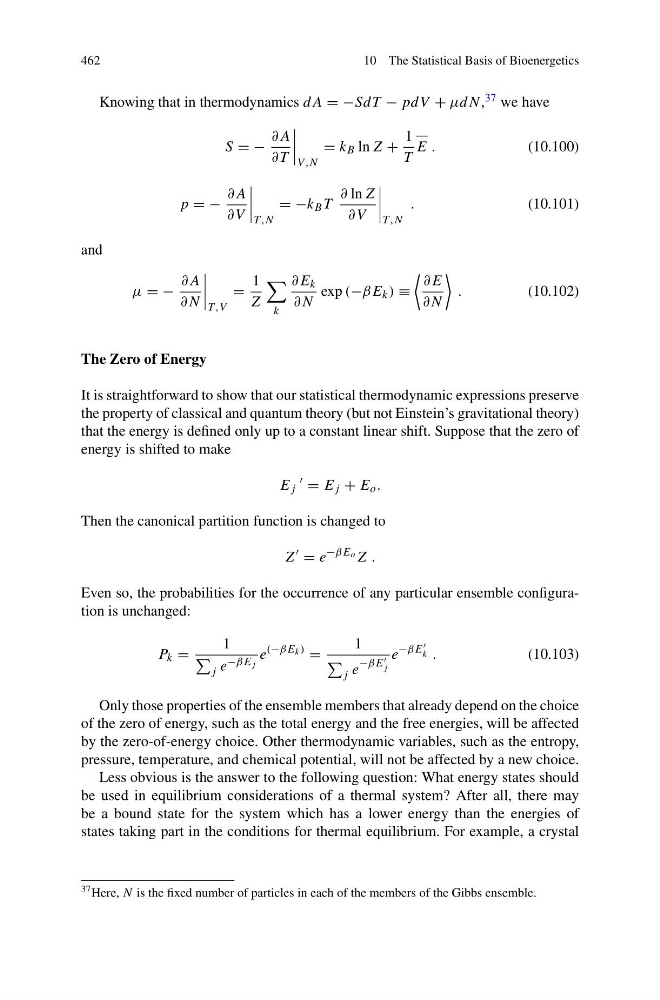
Knowing that in thermodynamics dA = −SdT − pdV + μdN, 37 we have
S = −
∂A
∂T
V ,N
= k B ln Z +
1
T
E .
(10.100)
p = −
∂A
∂V
T ,N
= −k B T
∂ ln Z
∂V
T ,N
.
(10.101)
and
μ = −
∂A
∂N
T ,V
=
1
Z
k
∂E k
∂N
exp (−βE k ) ≡
∂E
∂N
.
(10.102)
The Zero of Energy
It is straightforward to show that our statistical thermodynamic expressions preserve
the property of classical and quantum theory (but not Einstein’s gravitational theory)
that the energy is defined only up to a constant linear shift. Suppose that the zero of
energy is shifted to make
E j
= E j + E o .
Then the canonical partition function is changed to
Z
= e
−βE o Z .
Even so, the probabilities for the occurrence of any particular ensemble configuration is unchanged:
P k =
1
j e −βE j
e
(−βE k )
=
1
j e
−βE
j
e
−βE
k .
(10.103)
Only those properties of the ensemble members that already depend on the choice
of the zero of energy, such as the total energy and the free energies, will be affected
by the zero-of-energy choice. Other thermodynamic variables, such as the entropy,
pressure, temperature, and chemical potential, will not be affected by a new choice.
Less obvious is the answer to the following question: What energy states should
be used in equilibrium considerations of a thermal system? After all, there may
be a bound state for the system which has a lower energy than the energies of
states taking part in the conditions for thermal equilibrium. For example, a crystal
37 Here, N is the fixed number of particles in each of the members of the Gibbs ensemble.
10 The Statistical Basis of Bioenergetics
Knowing that in thermodynamics dA = −SdT − pdV + μdN, 37 we have
S = −
∂A
∂T
V ,N
= k B ln Z +
1
T
E .
(10.100)
p = −
∂A
∂V
T ,N
= −k B T
∂ ln Z
∂V
T ,N
.
(10.101)
and
μ = −
∂A
∂N
T ,V
=
1
Z
k
∂E k
∂N
exp (−βE k ) ≡
∂E
∂N
.
(10.102)
The Zero of Energy
It is straightforward to show that our statistical thermodynamic expressions preserve
the property of classical and quantum theory (but not Einstein’s gravitational theory)
that the energy is defined only up to a constant linear shift. Suppose that the zero of
energy is shifted to make
E j
= E j + E o .
Then the canonical partition function is changed to
Z
= e
−βE o Z .
Even so, the probabilities for the occurrence of any particular ensemble configuration is unchanged:
P k =
1
j e −βE j
e
(−βE k )
=
1
j e
−βE
j
e
−βE
k .
(10.103)
Only those properties of the ensemble members that already depend on the choice
of the zero of energy, such as the total energy and the free energies, will be affected
by the zero-of-energy choice. Other thermodynamic variables, such as the entropy,
pressure, temperature, and chemical potential, will not be affected by a new choice.
Less obvious is the answer to the following question: What energy states should
be used in equilibrium considerations of a thermal system? After all, there may
be a bound state for the system which has a lower energy than the energies of
states taking part in the conditions for thermal equilibrium. For example, a crystal
37 Here, N is the fixed number of particles in each of the members of the Gibbs ensemble.