

10.8 The Partition Function for Ensembles
463
might be compressible into a denser and more tightly bound set of molecules than
a given state. A diamond as a form of carbon is an example. The diamond phase
of carbon may not be needed in determining the thermodynamics of carbon if the
region being studied has pressures far below those needed to make diamonds. The
ultimate compression of any matter would make a black hole, far more tightly bound
(by gravity) than ordinary matter. But the thermodynamic description of ordinary
matter in ordinary ranges of temperature and pressure does not include black hole
states.
The answer to the posed question is: The quantum states that should be included
must have the following properties
1. The quantum state must be accessible from other quantum states by heat transfer;
2. The system being considered must have at least one quasi-static state with a
lifetime much longer than the expected observation time. Such a state will be
called a quasi-equilibrium state.
3. The time for the system to ‘fall’ into or be excited out of the accessible quantum
states must be smaller than the time needed for the system to reach a quasiequilibrium.
In statistical mechanical considerations, among those states that satisfy these
conditions, the one with the lowest energy will have the highest probability of being
occupied when the system approaches equilibrium.
Fluctuations in the Internal Energy
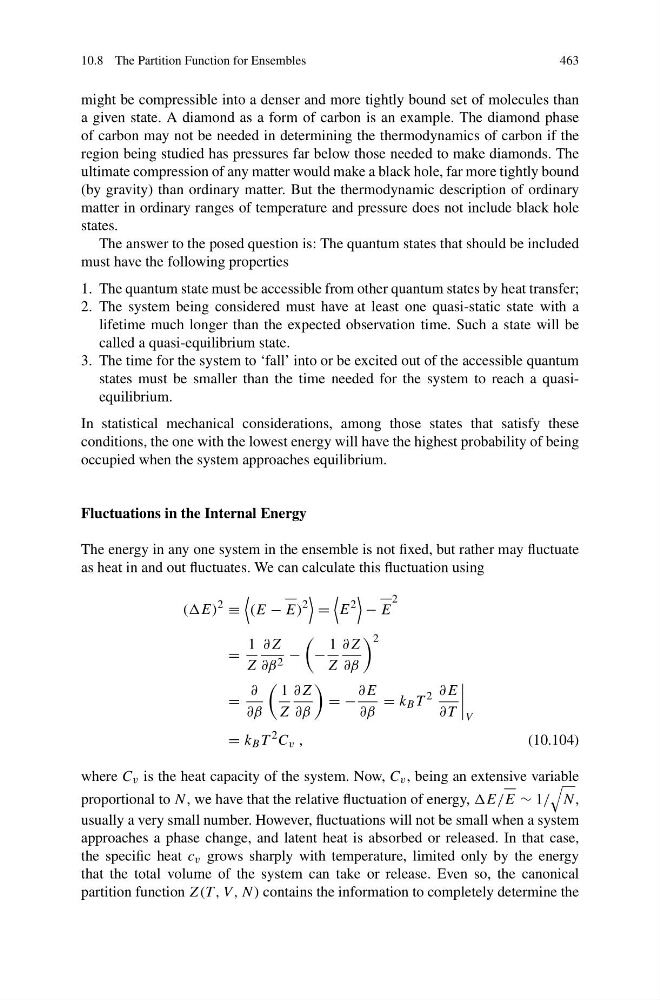
The energy in any one system in the ensemble is not fixed, but rather may fluctuate
as heat in and out fluctuates. We can calculate this fluctuation using
((E)
2
≡
(E − E)
2
=
E
2
− E
2
=
1
Z
∂Z
∂β 2 −
−
1
Z
∂Z
∂β
2
=
∂
∂β
1
Z
∂Z
∂β
= −
∂E
∂β
= k B T
2 ∂E
∂T
V
= k B T
2 C v ,
(10.104)
where C v is the heat capacity of the system. Now, C v , being an extensive variable
proportional to N , we have that the relative fluctuation of energy, E/E ∼ 1/
N ,
usually a very small number. However, fluctuations will not be small when a system
approaches a phase change, and latent heat is absorbed or released. In that case,
the specific heat c v grows sharply with temperature, limited only by the energy
that the total volume of the system can take or release. Even so, the canonical
partition function Z(T , V , N) contains the information to completely determine the
463
might be compressible into a denser and more tightly bound set of molecules than
a given state. A diamond as a form of carbon is an example. The diamond phase
of carbon may not be needed in determining the thermodynamics of carbon if the
region being studied has pressures far below those needed to make diamonds. The
ultimate compression of any matter would make a black hole, far more tightly bound
(by gravity) than ordinary matter. But the thermodynamic description of ordinary
matter in ordinary ranges of temperature and pressure does not include black hole
states.
The answer to the posed question is: The quantum states that should be included
must have the following properties
1. The quantum state must be accessible from other quantum states by heat transfer;
2. The system being considered must have at least one quasi-static state with a
lifetime much longer than the expected observation time. Such a state will be
called a quasi-equilibrium state.
3. The time for the system to ‘fall’ into or be excited out of the accessible quantum
states must be smaller than the time needed for the system to reach a quasiequilibrium.
In statistical mechanical considerations, among those states that satisfy these
conditions, the one with the lowest energy will have the highest probability of being
occupied when the system approaches equilibrium.
Fluctuations in the Internal Energy
The energy in any one system in the ensemble is not fixed, but rather may fluctuate
as heat in and out fluctuates. We can calculate this fluctuation using
((E)
2
≡
(E − E)
2
=
E
2
− E
2
=
1
Z
∂Z
∂β 2 −
−
1
Z
∂Z
∂β
2
=
∂
∂β
1
Z
∂Z
∂β
= −
∂E
∂β
= k B T
2 ∂E
∂T
V
= k B T
2 C v ,
(10.104)
where C v is the heat capacity of the system. Now, C v , being an extensive variable
proportional to N , we have that the relative fluctuation of energy, E/E ∼ 1/
N ,
usually a very small number. However, fluctuations will not be small when a system
approaches a phase change, and latent heat is absorbed or released. In that case,
the specific heat c v grows sharply with temperature, limited only by the energy
that the total volume of the system can take or release. Even so, the canonical
partition function Z(T , V , N) contains the information to completely determine the