

10.8 The Partition Function for Ensembles
461
Z(β, V , N) ≡
k
exp (−βE k )
(10.93)
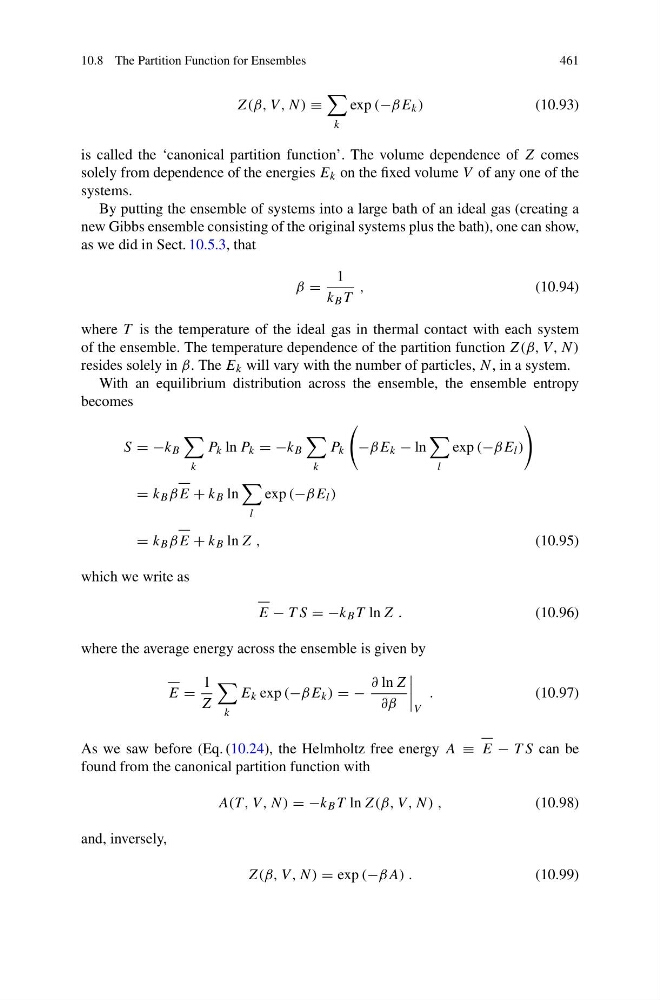
is called the ‘canonical partition function’. The volume dependence of Z comes
solely from dependence of the energies E k on the fixed volume V of any one of the
systems.
By putting the ensemble of systems into a large bath of an ideal gas (creating a
new Gibbs ensemble consisting of the original systems plus the bath), one can show,
as we did in Sect. 10.5.3, that
β =
1
k B T
,
(10.94)
where T is the temperature of the ideal gas in thermal contact with each system
of the ensemble. The temperature dependence of the partition function Z(β, V , N)
resides solely in β. The E k will vary with the number of particles, N , in a system.
With an equilibrium distribution across the ensemble, the ensemble entropy
becomes
S = −k B
k
P k ln P k = −k B
k
P k
−βE k − ln
l
exp (−βE l )
= k B βE + k B ln
l
exp (−βE l )
= k B βE + k B ln Z ,
(10.95)
which we write as
E − T S = −k B T ln Z .
(10.96)
where the average energy across the ensemble is given by
E =
1
Z
k
E k exp (−βE k ) = −
∂ ln Z
∂β
V
.
(10.97)
As we saw before (Eq. (10.24), the Helmholtz free energy A ≡ E − T S can be
found from the canonical partition function with
A(T , V , N) = −k B T ln Z(β, V , N) ,
(10.98)
and, inversely,
Z(β, V , N) = exp (−βA) .
(10.99)
461
Z(β, V , N) ≡
k
exp (−βE k )
(10.93)
is called the ‘canonical partition function’. The volume dependence of Z comes
solely from dependence of the energies E k on the fixed volume V of any one of the
systems.
By putting the ensemble of systems into a large bath of an ideal gas (creating a
new Gibbs ensemble consisting of the original systems plus the bath), one can show,
as we did in Sect. 10.5.3, that
β =
1
k B T
,
(10.94)
where T is the temperature of the ideal gas in thermal contact with each system
of the ensemble. The temperature dependence of the partition function Z(β, V , N)
resides solely in β. The E k will vary with the number of particles, N , in a system.
With an equilibrium distribution across the ensemble, the ensemble entropy
becomes
S = −k B
k
P k ln P k = −k B
k
P k
−βE k − ln
l
exp (−βE l )
= k B βE + k B ln
l
exp (−βE l )
= k B βE + k B ln Z ,
(10.95)
which we write as
E − T S = −k B T ln Z .
(10.96)
where the average energy across the ensemble is given by
E =
1
Z
k
E k exp (−βE k ) = −
∂ ln Z
∂β
V
.
(10.97)
As we saw before (Eq. (10.24), the Helmholtz free energy A ≡ E − T S can be
found from the canonical partition function with
A(T , V , N) = −k B T ln Z(β, V , N) ,
(10.98)
and, inversely,
Z(β, V , N) = exp (−βA) .
(10.99)