

10.6 Partition Function for a Gas
449
associated with intermolecular interactions. 28 An example in which intermolecular
interactions cannot be ignored is ionic solutions, an important topic in biological
cells. We will present a simplified model for this case in Sect. 10.9.5.
10.6.14 Combining the Parts
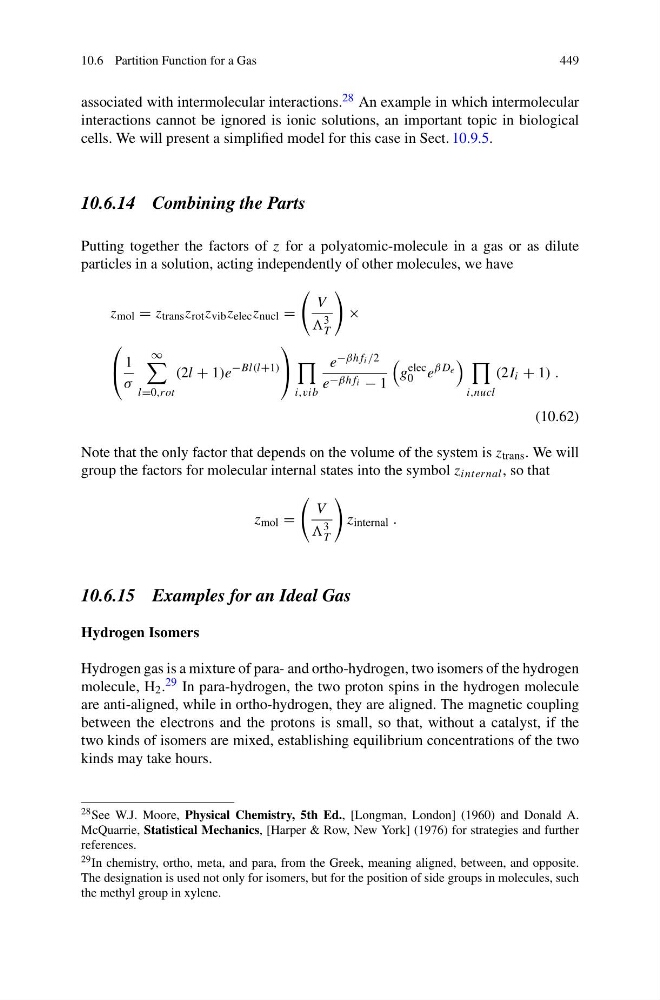
Putting together the factors of z for a polyatomic-molecule in a gas or as dilute
particles in a solution, acting independently of other molecules, we have
z mol = z trans z rot z vib z elec z nucl =
V
3
T
×
⎛
⎝ 1
σ
∞
l=0,rot
(2l + 1)e
−Bl(l+1)
⎞
⎠
i,vib
e −βhf i /2
e −βhf i − 1
g
elec
0 e
βD e
i,nucl
(2I i + 1) .
(10.62)
Note that the only factor that depends on the volume of the system is z trans . We will
group the factors for molecular internal states into the symbol z internal , so that
z mol =
V
3
T
z internal .
10.6.15 Examples for an Ideal Gas
Hydrogen Isomers
Hydrogen gas is a mixture of para- and ortho-hydrogen, two isomers of the hydrogen
molecule, H 2 . 29 In para-hydrogen, the two proton spins in the hydrogen molecule
are anti-aligned, while in ortho-hydrogen, they are aligned. The magnetic coupling
between the electrons and the protons is small, so that, without a catalyst, if the
two kinds of isomers are mixed, establishing equilibrium concentrations of the two
kinds may take hours.
28 See W.J. Moore, Physical Chemistry, 5th Ed., [Longman, London] (1960) and Donald A.
McQuarrie, Statistical Mechanics, [Harper & Row, New York] (1976) for strategies and further
references.
29 In chemistry, ortho, meta, and para, from the Greek, meaning aligned, between, and opposite.
The designation is used not only for isomers, but for the position of side groups in molecules, such
the methyl group in xylene.
449
associated with intermolecular interactions. 28 An example in which intermolecular
interactions cannot be ignored is ionic solutions, an important topic in biological
cells. We will present a simplified model for this case in Sect. 10.9.5.
10.6.14 Combining the Parts
Putting together the factors of z for a polyatomic-molecule in a gas or as dilute
particles in a solution, acting independently of other molecules, we have
z mol = z trans z rot z vib z elec z nucl =
V
3
T
×
⎛
⎝ 1
σ
∞
l=0,rot
(2l + 1)e
−Bl(l+1)
⎞
⎠
i,vib
e −βhf i /2
e −βhf i − 1
g
elec
0 e
βD e
i,nucl
(2I i + 1) .
(10.62)
Note that the only factor that depends on the volume of the system is z trans . We will
group the factors for molecular internal states into the symbol z internal , so that
z mol =
V
3
T
z internal .
10.6.15 Examples for an Ideal Gas
Hydrogen Isomers
Hydrogen gas is a mixture of para- and ortho-hydrogen, two isomers of the hydrogen
molecule, H 2 . 29 In para-hydrogen, the two proton spins in the hydrogen molecule
are anti-aligned, while in ortho-hydrogen, they are aligned. The magnetic coupling
between the electrons and the protons is small, so that, without a catalyst, if the
two kinds of isomers are mixed, establishing equilibrium concentrations of the two
kinds may take hours.
28 See W.J. Moore, Physical Chemistry, 5th Ed., [Longman, London] (1960) and Donald A.
McQuarrie, Statistical Mechanics, [Harper & Row, New York] (1976) for strategies and further
references.
29 In chemistry, ortho, meta, and para, from the Greek, meaning aligned, between, and opposite.
The designation is used not only for isomers, but for the position of side groups in molecules, such
the methyl group in xylene.